
How to do SEO for Google AI Overview and Increase AI Visibility in 2026
By
Rushabh Menon
Founder - Sagashi Digital

Summarize this article using AI
If you’re into content marketing - you know the drill. Everyday starts like - “how to do SEO for Google AI Overviews?”
Directly answering the user's question, using highly specific question-based headings, and formatting your information into scannable lists and tables make your content easy to read for Google’s AI. And that helps increase your AI visibility.
Appearing in Google AI Overview matters more than ever because they reduce search clicks by 42%.
Without further ado, let’s explore how to do SEO for Google AI Overview, so you can boost your site’s AI visibility.

What AI Overviews mean for SEO and how does it impact SEO?
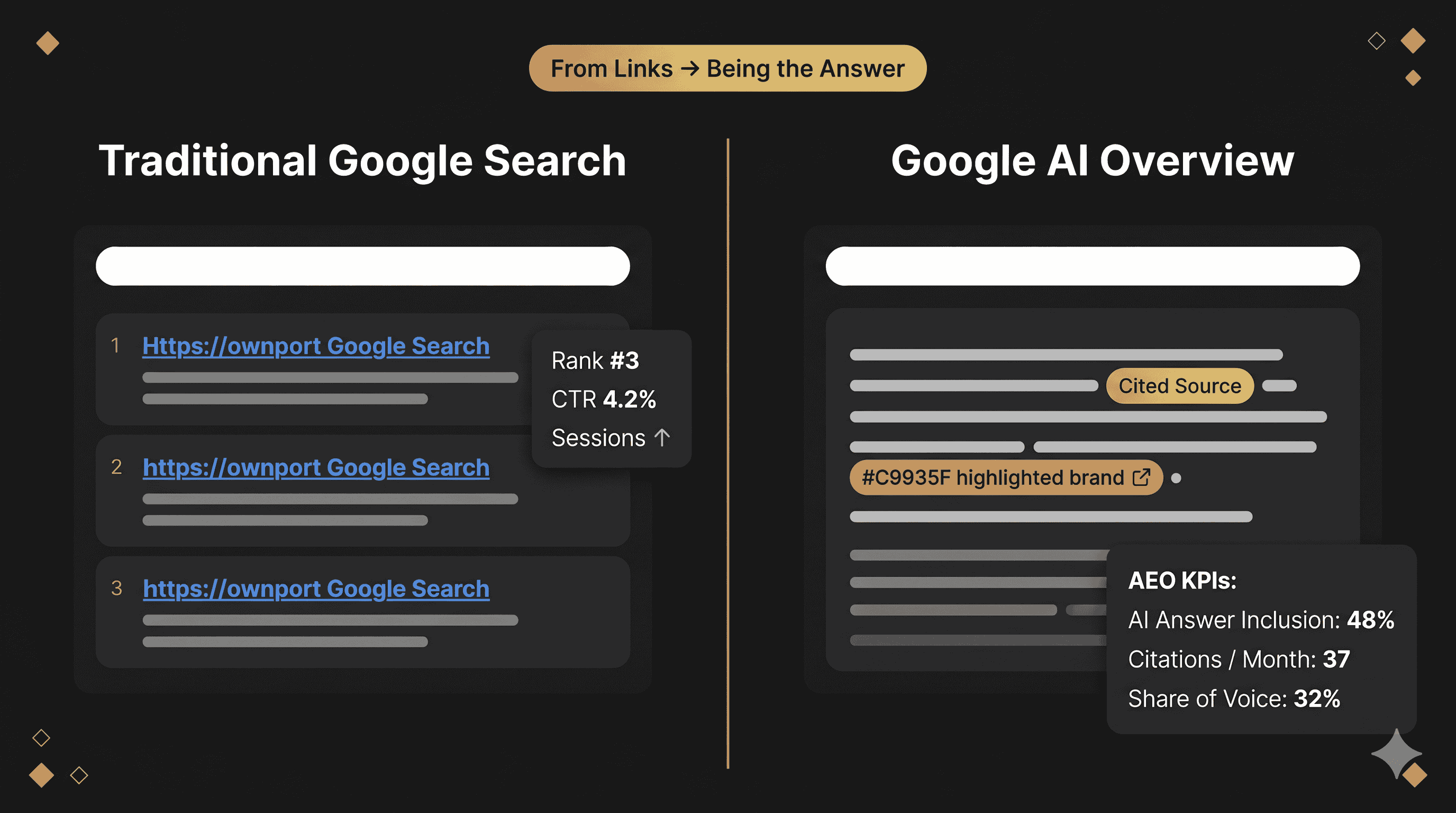
Google AI Overview (sometimes still called SGE or Search Generative Experience) is Google's AI-powered feature that generates a conversational summary at the top of search results.
It pulls information from multiple sources to answer queries directly, reducing the need for users to click through to websites.
It’s affecting SEO more than you think. Google SGE SEO is shifting priorities from pure rankings to being a trusted, extractable source.
When you ask a question, the AI overview loads a shaded box above the traditional blue links. It provides paragraphs, bullet points, and clickable source cards (citations), so users can see exactly where the AI got its information.
Featured snippets, or short excerpts from one page, were the early version of this. AI Overviews go further by combining insights from several top sources into a cohesive, multi-paragraph response. This leads to more zero-click searches, where users get what they need without leaving Google.
According to McKinsey’s October 2025 report, brands may experience a 20% to 50% decline in traffic from traditional search channels.
Table: Traditional SERPs vs Google AI Overviews
How does Google choose content for AI Overviews?
Google evaluates content based on AI Overview ranking factors, quality of AI citations, and overall Google AI ranking signals. The goal is to deliver accurate, helpful responses.
Topical authority, concise answers, experience, expertise, authoritativeness, and trustworthiness (EEAT), links from trusted sources, citations, and structured formatting are factors that dictate which sites win those coveted citation cards.
Importance of topical authority
Sites that demonstrate deep knowledge across a topic (through content clusters) get cited more often. Google AI ranking rewards comprehensive coverage rather than isolated pages.
Why concise answers improve extraction
AI loves content that gets to the point quickly. Direct answers in the first 40 to 60 words are far more likely to be pulled into summaries.
How EEAT affects AI visibility
Experience, Expertise, Authoritativeness, and Trustworthiness (E-E-A-T) are crucial. Show real author credentials, original insights, and reliable sources. AI systems heavily favor trustworthy content.
Role of trusted sources and citations
Being linked by or similar to well-known authoritative sites boosts your chances. Original research and data-backed claims make excellent AI citations.
Why structured formatting matters
Clear headings, lists, tables, and schema help AI parse and understand your content faster, improving selection odds.
How should you structure content for Google AI Overviews?
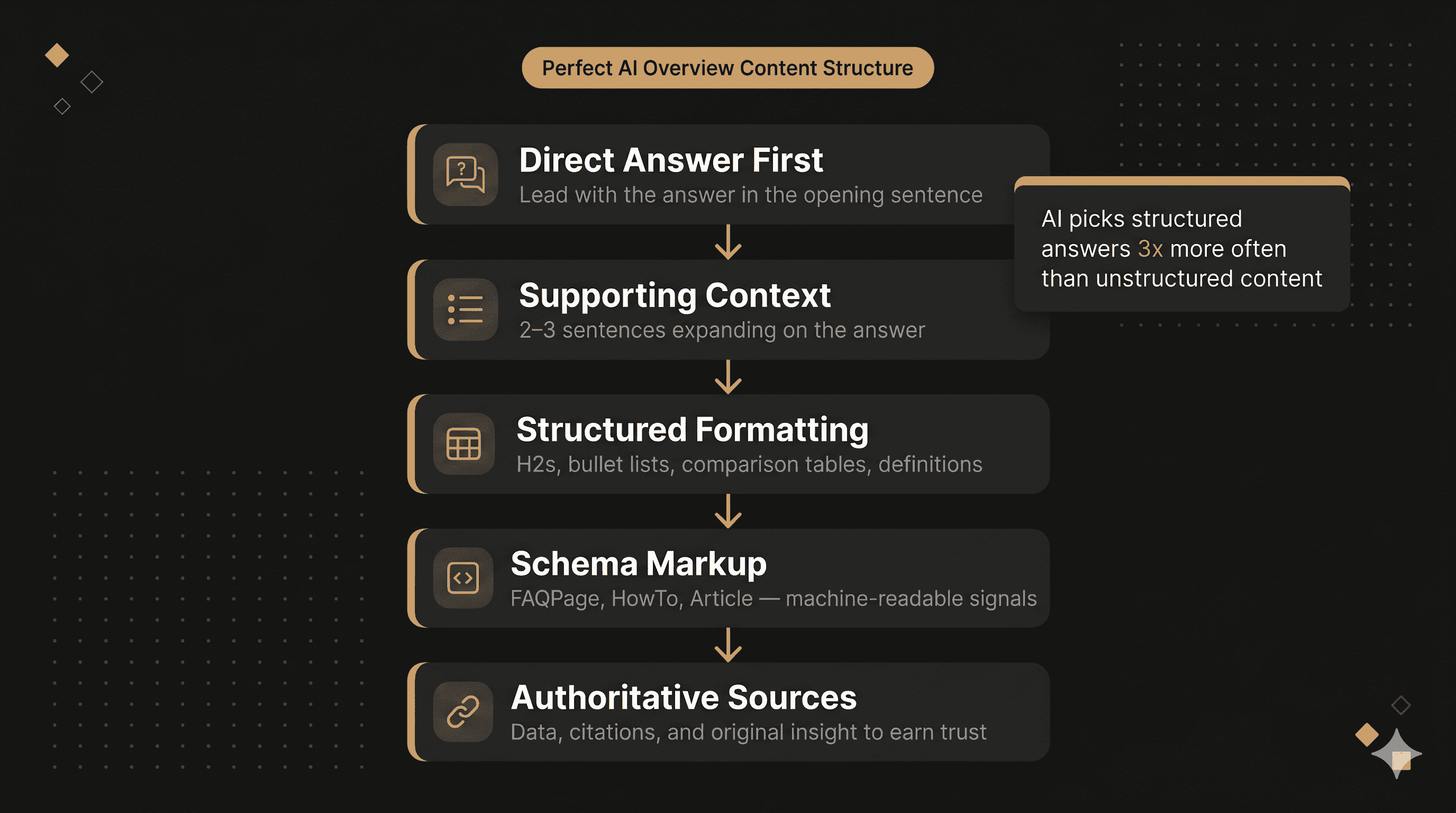
AI overview optimization is all about making your content easy for AI to understand and quote.
Follow this framework to structure your content: put the most important information within the first 40 to 60 words, break up the rest with clear question headings, add tables, and use visual formatting like lists to make scanning effortless.
Answer the query within the first 40–60 words
Lead with a clear, direct response. This inverted pyramid style helps AI extract your key points immediately.
Use question-based H2 headings
Phrase headings as real user questions. This mirrors how people search and helps AI match content to queries.
Keep paragraphs concise and scannable
Keep your paragraphs to three or four sentences maximum. This helps AI parse the context and pull out the facts without grabbing irrelevant information.
Add bullet points and numbered lists
Whenever you are listing out steps, benefits, or items, always use bullet points or numbered lists. AI models are specifically trained to look for lists because they format perfectly inside the AI Overview box.
Use tables for comparisons and summaries
If your page compares two or more items, or presents a summary of key metrics, build an elegant, clear Markdown table. It gives the AI an incredibly organized data matrix that it can easily reference to construct comparative answers for users.
Table: Ideal AI Overview Content Structure
This structure boosts content structure for AI success significantly.
What type of content performs best in AI Overviews?
Content that is factual, straightforward, and clearly structured performs best in AI overviews. In simple terms, the best AI overview content features definitions, step-by-step instructions, comparisons, and FAQs.
Definition-style content
When users search for complex terms or new industry concepts, the AI engine searches for the most accurate, objective explanation available.
Writing clear, authoritative definitions free of unnecessary marketing jargon makes your page the go-to reference point for the algorithm's opening sentences.
Step-by-step guides
"How-to" searches trigger AI summaries almost every single time. Whether it is a recipe or a software tutorial, AI search optimization relies heavily on clear sequences. Break your process down into logical, numbered steps, and the AI will often pull your exact list to display directly to the user.
Comparison pages
Users constantly search for "X vs Y". Comparison pages that use tables, clear pros and cons lists, and objective facts are highly favored by AI.
FAQs and conversational content
A dedicated Frequently Asked Questions section at the bottom of your article is a goldmine for featured snippet seo. As FAQs are naturally formatted as Question (Heading) and Answer (Short paragraph), they perfectly match the way AI processes information.
Data-backed expert insights
AI systems are programmed to look for consensus and facts. If your content includes original data, expert quotes, and proper citations, it stands out. Sharing unique insights that are backed by credible numbers gives the AI a strong reason to cite your page instead of a competitor who only offers generic opinions.
How can schema markup improve Google AI Overview visibility?
Schema markup is behind-the-scenes code that tells Google exactly what your content means. That removes any guesswork and drastically improves the chances that your page is understood and cited by AI.
Implementing the FAQ schema, how-to schema, article schema, and organization and author schema helps improve Google AI overview visibility.
- FAQ schema: Applying this code to your question-and-answer sections allows the AI tool to instantly recognize queries and their corresponding answers
- How-to schema: It’s ideal for tactical, instructional articles. It breaks down prerequisites, tools, and sequential actions into machine-readable fields.
- Article schema: Applying this markup to your blogs and resources outlines your primary headlines, publication dates, and content summaries
- Organization and author schema: This code connects your content directly to verified entities, highlighting the real name, credentials, and social profiles of the expert writer behind the page.
Why structured data improves AI understanding
Large language models process information by tracking connections between distinct entities (people, places, concepts, things).
Schema markup for AI overview details exactly how the data points on your web page connect to one another, removing the guesswork for the crawler.
How do featured snippets help with Google AI Overview SEO?
Targeted featured snippet optimization provides the ideal foundation for AI extraction because both systems prioritize clear, modular content that instantly resolves search intent.
Refining your snippet SEO through structured lists and standalone definitions creates versatile content tailored for both traditional search engines and modern AI-driven platforms.
- Why snippet-ready formatting matters: The rules for winning a featured snippet, such as tight paragraphs, clear headings, and lists, are the exact same rules for featured snippet optimization in the AI era. If your page is already winning snippets, it is highly likely to be picked up by the AI.
- Creating concise answer blocks: Both systems look for a standalone, 40-to-60-word answer block that perfectly resolves the searcher's intent without needing extra context.
- Using lists and definitions strategically: Placing a bulleted list immediately after an H2 question signals to both snippet bots and AI models that a comprehensive, easy-to-read answer is ready for AI extraction.
- Optimizing headings for extractability: Using direct, question-based headings ensures that when the AI is trying to answer that specific question, it lands directly on your exact heading.
- Improving content clarity for AI systems: If a human can scan your page and find the answer in three seconds, the AI can do it in milliseconds. Snippet optimization forces you to be clear, which is exactly what AI prefers.
What are the best SEO strategies for increasing AI citations?
The best SEO strategies for increasing AI citations include building topical authority clusters, publishing original research and insights, improving internal linking structure, using semantic keywords, and refreshing outdated content regularly.
Building topical authority clusters
If you want AI citations, you need to be the go-to source for a subject. Instead of writing one giant article, create a cluster of 10 or 15 articles that cover every sub-topic in detail.
Publishing original research and insights
The most secure way to force an LLM to cite your website is to own the data it needs to answer a query. Conduct original surveys, publish annual industry benchmarks, or release proprietary case studies.
Improving internal linking structure
AI models look for new facts. If you just reword what everyone else is saying, you blend in.
But when you publish original surveys, unique case studies, or fresh data, you give the AI something valuable to extract. This is a core pillar of LLM optimization (Large Language Model optimization).
Using semantic keywords naturally
Incorporate natural variations, industry terms, and related synonyms that give your text rich semantic depth. That allows the algorithm to match your pages with complex, multi-part conversational questions easily.
Refreshing outdated content regularly
AI wants the most current answer. Make it a habit to go back to your best pages every six months to update stats, check links, and add new insights.
What mistakes should you avoid when optimizing for Google AI Overviews?
When auditing your digital strategy, avoid common AI overview mistakes. These include writing long, fluffy introductory text, ignoring structure and readability, and focusing only on rankings instead of extractability.
- Writing overly long introductions: Starting your articles with broad, generic introductory sentences simply dilutes your page's immediate value. Get straight to the point to prevent crawlers from abandoning your content.
- Keyword stuffing instead of answering intent: This is one of the most common AI search SEO mistakes. Shoving exact-match keywords into every sentence makes your writing robotic and hard to read. Focus on genuinely answering the user's question naturally.
- Publishing generic AI-generated content: If your site simply publishes basic, unedited text generated by standard LLMs, you are offering zero information gain. Google's systems are designed to weed out this exact type of commodity content.
- Ignoring structure and readability: Leaving your content in huge text blocks without descriptive subheadings, bullet points, or clean formatting makes it technically invisible to extraction engines.
- Focusing only on rankings instead of extractability: Traditional ranking metrics don't matter if your content can't be easily broken down into quick, citable data blocks. Build your pages to be easily sourceable.
How can brands adapt their SEO strategy for AI-driven search?
Focus on creating helpful, people-first content while optimizing for citations. Combine this with technical improvements like schema and fast loading times. For local businesses, GEO SEO remains powerful when paired with structured location data.
At Sagashi Digital, we specialize in forward-thinking SEO that thrives in the AI era.
Our approach blends deep topical authority, structured optimization, and continuous content refreshing to help brands earn consistent AI citations while driving quality traffic.
In our AI SEO strategy, we prioritize E-E-A-T, structure content for easy extraction, build authority clusters, implement schema, and measure both traditional rankings and AI visibility.
Frequently Asked Questions
It's Google's generative AI feature that provides summarized, conversational answers drawn from web sources at the top of search results.
Focus on clear structure, direct answers, E-E-A-T, schema markup, and creating citable, authoritative content.
Yes. It improves how AI understands and extracts your content, increasing citation chances.
It can, but purely generic AI content often performs poorly. Human expertise and originality are still essential for strong visibility.
Concise, structured pieces like step-by-step guides, comparisons, definitions, FAQs, and data-rich expert content work best for AI overviews.
Ready to Get Found by More Customers?
We help you generate qualified inbound leads through search - without paying for ads. Our content strategy is built to create a consistent pipeline, shorten sales cycles, and turn organic traffic into revenue.