
How to Structure a Page for AEO (Answer Engine Optimization) in 2026?
By
Rushabh Menon
Founder - Sagashi Digital

Summarize this article using AI
Wondering how to structure a page for AEO? The secret is to put clear, direct answers first, use a logical question-based hierarchy, incorporate scannable elements like bullets and tables, and add schema markup. That way, AI can confidently extract your content.
This approach helps your pages shine in AI Overviews, voice search, featured snippets, and generative answers, giving you visibility even when users don’t click through.
This matters because AI-powered answer engines like Google’s AI Overviews, Perplexity, ChatGPT Search, and voice assistants dominate the landscape. An article published in Search Engine Land reveals that around 77% of people use AI to shop.
With no surprise, there has been a rise in answer engine optimization (AEO). If you want your brand to remain visible, you need to master AEO or get help from the best AI SEO agencies. Structuring your pages for AI ingestion is the final, definitive move to secure your visibility.
What is AEO, and why does page structure matter?
In simple terms, answer engine optimization is the practice of structuring your content so AI-powered answer engines can easily understand, extract, and deliver it as a clear, trustworthy response.
Unlike traditional search, answer engines don’t just link to your page. They pull the actual answer and show it directly to users. That’s why page structure matters more than ever.
A well-structured page helps AI parse your content quickly, boosts your chances of appearing in featured snippets, voice results, and generative answers. Ultimately, that drives more visibility even if users don’t click through.
Page structuring for AEO matters more because in top sectors like beauty and wellness, roughly one out of every two customers uses AI to decide what to buy. That’s according to the findings of McKinsey.
SEO vs AEO - A Quick Comparison
What is the ideal AEO page structure? (Proven framework)

Structuring a page for AEO requires a bit of a reverse-engineering approach. Instead of burying the lead, successful AEO front-loads the value. Failing to provide an immediate answer means losing your spot to a more efficient source.
Developing a content structure for AI involves four key pillars:
Direct answer in the first 40 - 60 words
Follow the inverted pyramid style of journalism. Start your page or your section with a concise, factual summary. This answer-first approach boosts your chances of being featured or cited.
Clear H2 - H3 hierarchy based on questions
Organize around natural user questions. Use H2s for main topics and H3s for sub-questions. This mirrors how people (and AI) search conversationally.
Use of bullet points and concise explanations
Break up text with bullets for quick scanning. Keep explanations tight and factual.
Schema markup for answer extraction
Add structured data, so engines know exactly what each section means. This is your backstage pass to better visibility.
Ideal AEO Page Layout
How to write content that ranks in answer engines?
AEO writing is all about being helpful first. Shift from keyword-focused to answer-focused content.
Use question-based headings
Turn your H2s and H3s into questions users actually ask. This aligns perfectly with conversational search.
Keep answers concise and factual
Aim for clarity. Back claims with data, but keep it straightforward.
Optimize for featured snippets
Write 40 to 60-word answers that stand alone. Use lists and definitions.
Add definitions, steps, and lists
Define terms, number your processes, and use bullets. These formats are AI favorites.
What formatting elements improve AEO performance?
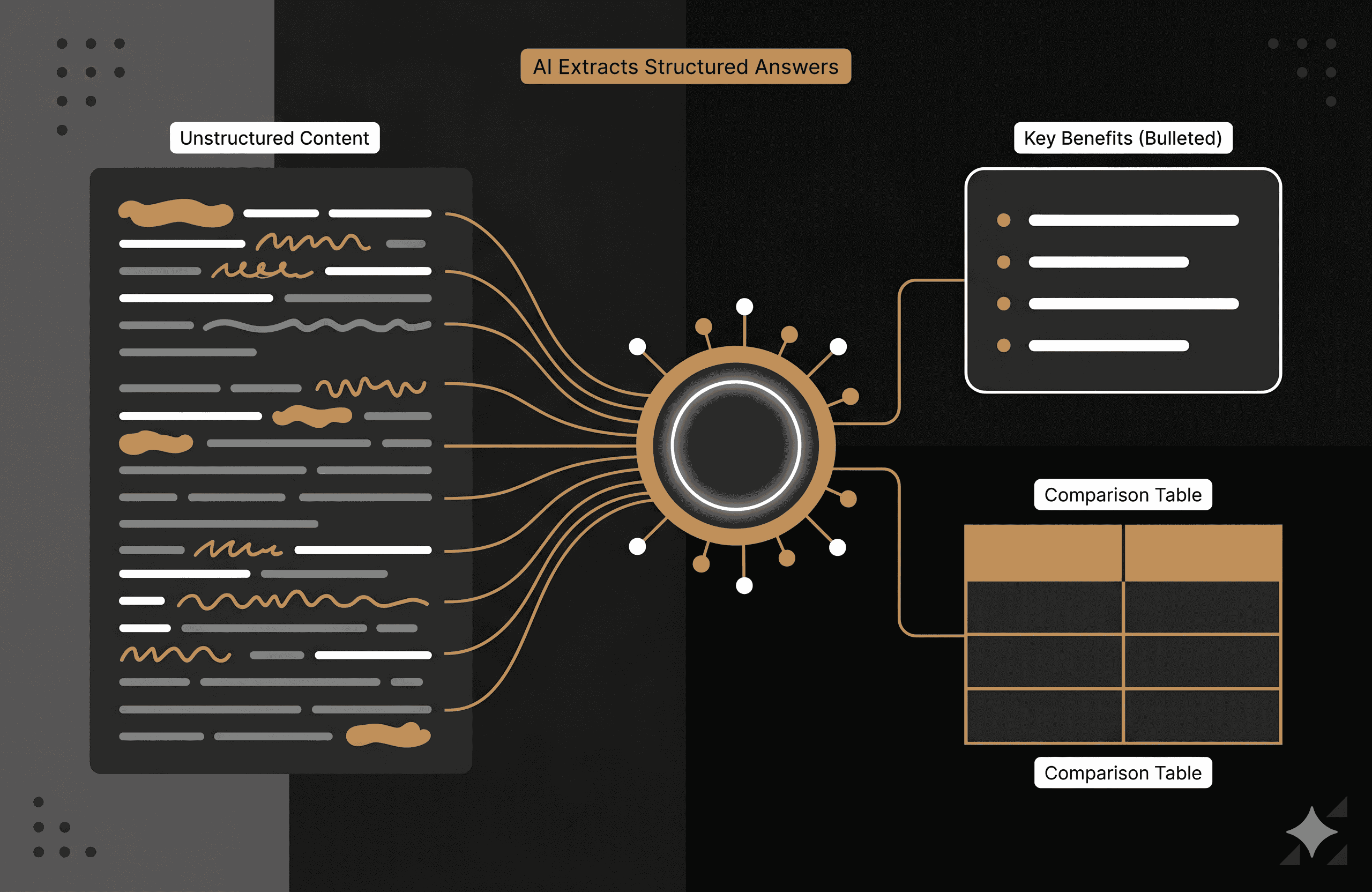
Structured content and snippet optimization are your best friends in 2026.
Tables for comparisons and clarity
Tables help AI understand relationships between items quickly.
Bullet points for quick answers
Bullets help users, and AI scans key information fast. These are perfect for summarizing benefits, features, or quick tips.
Numbered steps for processes
Use these for "How-to" content. AI assistants like Siri or Gemini use these to read instructions aloud to users.
Short paragraphs (2–3 lines max)
This improves readability for humans on mobile devices and allows AI to categorize thought blocks more effectively.
Best Performing Content Formats
How does schema markup help in AEO?

A schema for AEO (also called structured data) provides the answer engine with a detailed map of your content.
- FAQ schema: Mark up your questions and answers so AI can pull them directly.
- How-to schema: Ideal for step-by-step guides; helps with procedural answers.
- Article schema: Helps establish your content as authoritative.
Search engines rely on structured data because it removes guesswork. Instead of trying to interpret paragraphs, engines get clear, machine-readable facts. Further, pages with proper schema appear more often in generative summaries and rich results.
What mistakes should you avoid in AEO page structure?
Avoid these common AEO mistakes if you want to stay relevant in an AI-first world:
Overly long introductions
The narrative hook is a bit of a liability if it takes up the first 300 words. Get to the answer immediately, then expand later for the humans who want to keep reading.
Keyword stuffing instead of intent matching
AI is too smart for keyword stuffing. It understands context. Focus on answering the user's intent, not repeating a phrase ten times.
Poor heading hierarchy
If your H2s and H3s are all over the place, the AI won't be able to map the relationship between your ideas. Stick to a logical flow.
Lack of clear answers
If your content is vague or non-committal, the AI won't cite you as a source of truth.
How Sagashi Digital helps brands optimize for AEO?
The leap from traditional search to answer-engine dominance is steep, but you don't have to climb it alone. Sagashi Digital provides the strategic blueprint needed to turn that daunting transition into your greatest competitive advantage.
As a leading answer optimization platform, we provide the AEO tools necessary to ensure your brand doesn’t just rank but gets cited by AI engines.
Here’s how we help optimize for AEO:
- We analyze how LLMs perceive your brand and restructure your content to fit those models.
- We ensure your organic answers match your paid messaging, so they create a cohesive brand presence across AI interfaces.
- We find the gaps where your competitors aren't providing clear answers and help you fill them.
Frequently Asked Questions
AEO, or answer engine optimization, is a strategy within SEO that focuses on making content easily accessible and answerable for AI-powered engines and voice assistants.
While SEO focuses on ranking in a list of search results, AEO focuses on becoming the single, definitive answer provided by an AI. SEO values traffic. Conversely, AEO values being the source of truth.
Content that is highly structured, factual, and direct works best. This includes FAQs, how-to guides, definitions, and comparison tables.
To optimize for snippets, provide a clear, 40 to 60-word answer directly under a question-based heading (H2) and use structured formatting like bullet points or tables.
Yes. Schema markup helps AI engines understand the context and structure of your data. That makes it significantly easier for them to extract your content and present it as a direct answer.
Ready to Get Found by More Customers?
We help you generate qualified inbound leads through search - without paying for ads. Our content strategy is built to create a consistent pipeline, shorten sales cycles, and turn organic traffic into revenue.