
Is AI Content Good for SEO? What Google Says in 2026
By
Rushabh Menon
Founder - Sagashi Digital

Summarize this article using AI
“Is AI content good for SEO?” is now one of the most asked questions by marketers.
Many experts now agree that it can be, but only when the quality is high. That is to say, AI content is good for SEO only when it’s properly edited, enriched, and made to sound human.
Lots of brands seem to understand that. Perhaps that is why around 74% of new web pages include AI-generated content, according to Ahrefs.
Below, we’ll discuss in detail whether AI content is good for SEO and share Google’s take on it.

Is AI-generated content good for SEO?
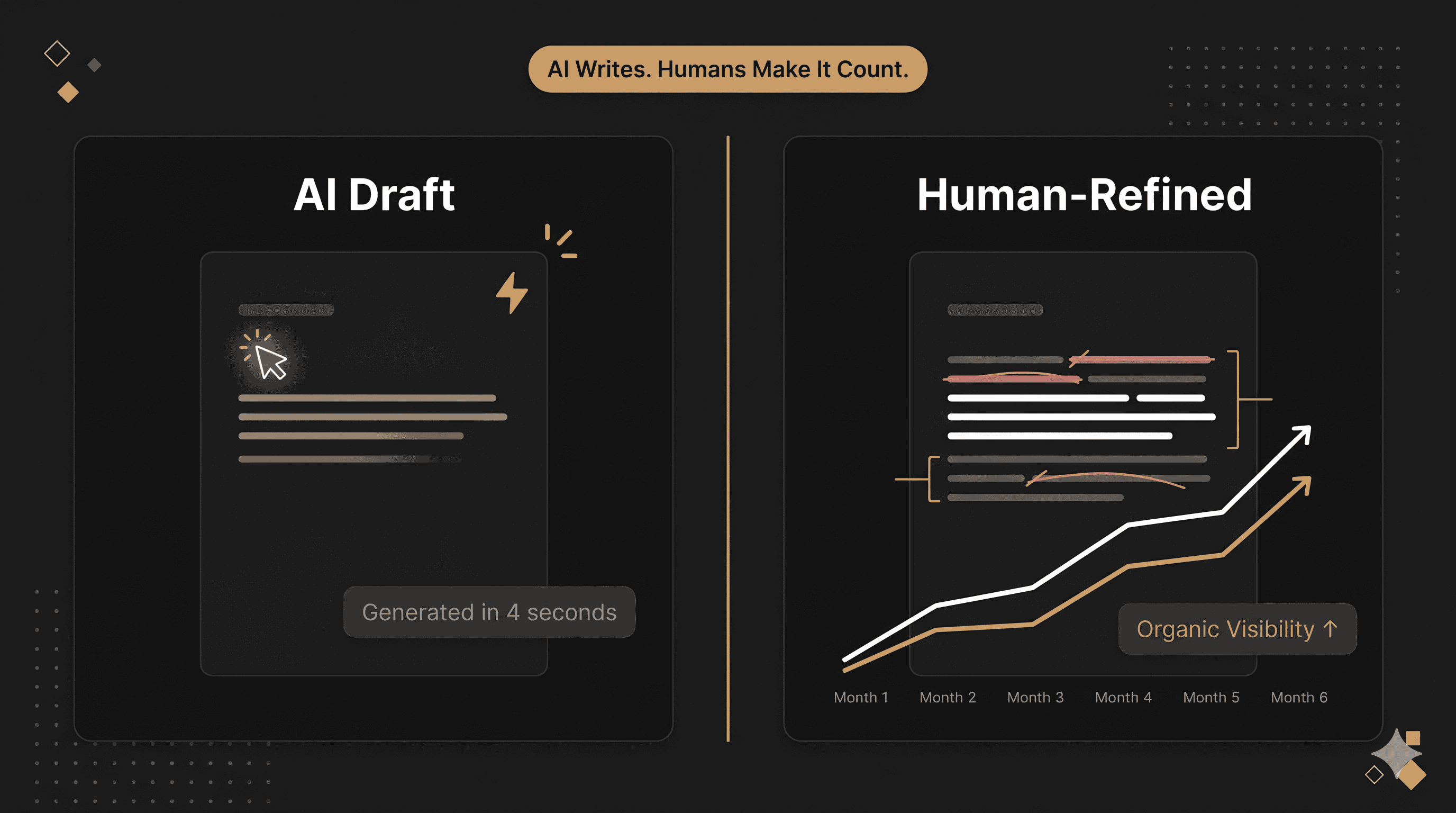
Yes, AI-generated content can be excellent for SEO when done right. It requires a human touch to avoid being flagged as thin or unhelpful.
AI content seo isn't as simple as copying text from a prompt and pasting it directly into your content management system (CMS). Cracking the code on why some AI platforms thrive, and others tank, requires a look at where this tech fits into the current online ecosystem.
Definition of AI-generated content
AI-generated content is text, images, or other media created primarily by artificial intelligence tools like ChatGPT, Grok, Claude, or Jasper. These tools use large language models trained on massive datasets to produce human-like writing based on your prompts.
A study published in eMarketer found that Google doesn’t penalize AI content. In fact, 86.5% of top-ranking pages contain AI-generated content.
How AI content is used in modern SEO
AI content SEO strategies involve using AI for everything from keyword research and topic clustering to drafting articles and generating meta descriptions. It's especially popular for scaling informational content, such as "how-to" guides, comparison articles, and FAQ pages.
Why marketers are scaling content with AI
Marketers scale content with AI because it saves time and reduces costs. Instead of spending weeks on research and writing, you can produce high volumes of drafts quickly. This allows smaller teams to compete with bigger players.
What does Google say about AI content and SEO?
Google's stance is clear: AI content is fine as long as it's helpful and high-quality. There’s no blanket ban on AI-generated material.
The Google AI content policy makes it clear that it focuses on quality, not the creation method. Its algorithm rewards helpful, original, reliable information over spammy ones. Google’s AI content guidelines also state that the pages must exhibit high levels of E-E-A-T.
Google focuses on quality, not how content is created
Google’s systems evaluate content based on usefulness, not the creation method. Appropriate use of AI isn't against their rules. What is against the rules is using AI to create spammy, manipulative content primarily to game rankings.
Why helpful content matters more than AI usage
The Google helpful content update (now a core part of their algorithm) rewards "people-first" content.
Does it solve a real problem? Answer questions thoroughly? If yes, it has a great shot at ranking, whether AI-assisted or not. Low-effort, generic stuff gets pushed down, whether written by humans or machines.
How EEAT impacts AI-generated content
EEAT stands for experience, expertise, authoritativeness, and trustworthiness. AI struggles with real experience, so Google looks for human signals.
Adding author bios, real examples, and citations strengthens AI content SEO by demonstrating trustworthiness that pure AI often lacks.
What Google considers spammy AI content
Google considers content that is mass-produced, unedited, factually wrong, or stuffed with keywords just to game the system as spammy. This falls under scaled content abuse in their spam policies. It demotes purely automated pages that feel empty or repetitive.
Can AI content trigger manual penalties?
Rarely, if it's part of a clear spam scheme. Most issues are algorithmic demotions via Helpful Content systems rather than manual actions. Well-edited, valuable AI content rarely faces penalties.
Why does some AI content rank while other content fails?
AI content ranking factors that decide whether content will rank include search intent alignment, original insights and expertise, content depth and topical authority, human editing and fact-checking, and user engagement.
AI Content Ranking Comparison
Search intent alignment
The ultimate rule of AI content quality is satisfying user intent. AI models often generate beautiful, generic essays. But that content ranks when a human guides the AI to output the exact format, length, and style that matches what searchers are looking for.
Original insights and expertise
AI is a predictive mirror of the past; it cannot invent new concepts or share proprietary data. A major reason purely automated content fails is that it lacks information gain.
To rank, your content must include exclusive quotes, proprietary survey data, or a unique industry perspective that the AI could never generate on its own.
Content depth and topical authority
Search engines do not look at articles in isolation. They look at your entire domain's authority on a topic. AI is great at helping you build this authority quickly.
When you use AI to find related topics and write a bunch of helpful, connected articles about one main subject, search engines will trust your website as an expert.
Human editing and fact-checking
AI models are notorious for hallucinating. They confidentially state false facts, outdated data, or entirely fabricated citations.
A failing piece of content leaves these errors intact. A winning piece goes through a rigorous human editing loop where every single statistic is cross-referenced, and every claim is verified.
User engagement and readability
A giant block of dense text feels overwhelming and pushes readers away fast. The best content looks clean and inviting with short paragraphs, bold key points, bullet lists, and eye-catching boxes.
When people stick around, click your links, and explore your tables, Google notices and sees your page as truly valuable.
What are the biggest SEO risks of AI-generated content?
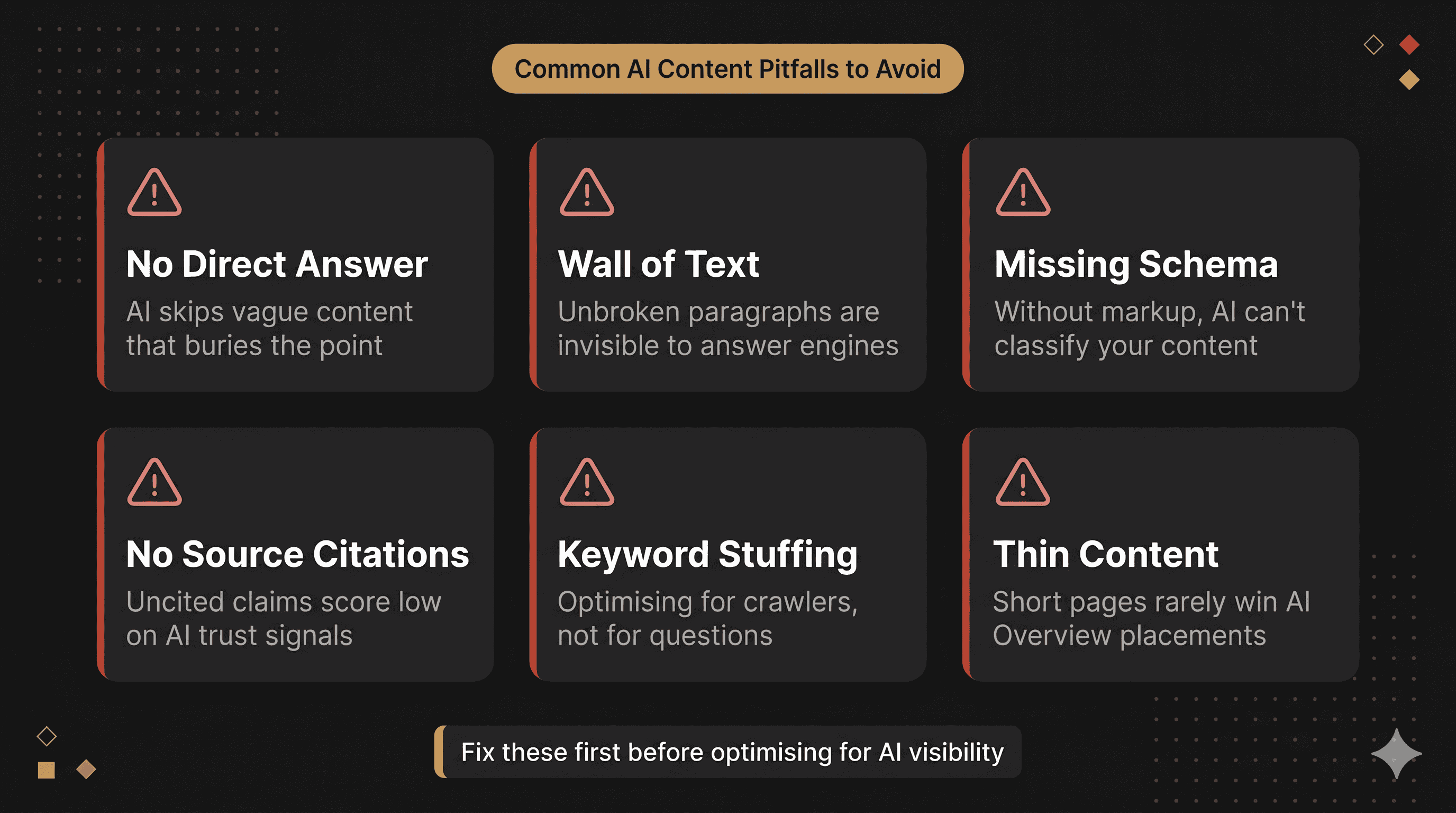
The two biggest AI content risks are brand erosion and algorithmic devaluation.
Publishing unedited AI articles, generating factually inaccurate content, creating duplicate or repetitive pages, overusing keywords, and scaling quantity over quality lead to drops in brand trust.
Low-quality AI content also triggers immediate penalties for web spam and a complete loss of indexing status.
Publishing unedited AI articles
Raw AI text frequently leaves behind noticeable structural footprints, such as repetitive transition words and cyclical phrasing. This creates a highly monotonous reading experience that signals to both users and algorithms that the page is low-quality AI content.
Generating factually inaccurate content
As AI models operate on pattern matching rather than absolute truth, they can occasionally pull incorrect dates, mismatched data points, or debunked advice. Publishing these errors ruins your brand's professional reputation and tells search engines your site is an unreliable resource.
Creating duplicate or repetitive pages
Tell an AI tool to write ten articles on slightly tweaked versions of one keyword. And chances are it will recycle the same phrases, structures, and stories in all of them.
This creates severe keyword cannibalization and signals to Google that you are spinning out AI spam content to clog up the SERPs.
Overusing keywords unnaturally
Older AI writing tools often try too hard to optimize for a specific density score, stuffing target terms into headings and paragraphs where they don't belong.
This creates an awkward, robotic flow that breaks user trust and violates modern web quality guidelines.
Scaling quantity over quality
It’s super tempting to jump from publishing 4 blog posts a month to 400. But if your team can’t properly review, polish, and improve all that content, you’re just creating a huge pile of digital junk that can slowly hurt your site’s overall authority.
How can you use AI content safely for SEO?
Shift your AI content strategy from "AI-authored" to "AI-assisted." Use AI for research and outlines, sprinkle expert insights and real examples, edit it for tone and accuracy, and optimize for engagement and readability.
- Use AI for research and outlines first: Generate topic ideas, competitor analysis, and structures quickly.
- Add expert insights and real examples: Layer in your knowledge, data, or interviews.
- Edit content for tone and accuracy: Refine voice, fix errors, and inject personality.
- Optimize for readability and engagement: Improve formatting, add visuals, and ensure mobile-friendliness.
- Combine AI efficiency with human expertise: This hybrid approach delivers the best of both worlds for sustainable results.
How should brands approach AI content in the future of SEO?
The future of AI SEO looks promising if you adapt with smart choices. AI-powered content marketing and AI-assisted SEO will soon become the norm. But the real winners will be brands that use AI as a strong, helpful partner rather than a full replacement. That’s what Sagashi helps you achieve.
Machines excel at speed, but humans bring authenticity and innovation that build lasting trust. From keyword research to content calendars, AI streamlines tasks, letting teams focus on strategy and creativity.
What’s more? Efficiency helps you compete, but authority (through EEAT) keeps you winning long-term. And in a sea of AI content, it’s only expertly refined pieces that stand out.
Frequently Asked Questions
No, not automatically. Google penalizes low-quality or spammy content, whether created by AI or humans. High-value AI-assisted content performs well.
Start with strong prompts, edit heavily for E-E-A-T, align with search intent, fact-check everything, and focus on reader value.
Not inherently. ChatGPT (or any tool) content is only as good as the editing and expertise behind it. Many top pages use it as a starting point.
Absolutely, but combine it with human oversight. Many successful businesses use it to boost productivity while maintaining high standards through editing and expertise.
The main risks include low quality, factual errors, lack of originality, and scaled spam that triggers algorithmic demotions or manual actions. Always prioritize value over volume.
Ready to Get Found by More Customers?
We help you generate qualified inbound leads through search - without paying for ads. Our content strategy is built to create a consistent pipeline, shorten sales cycles, and turn organic traffic into revenue.