
Is Optimizing Content for AI Search Different From SEO?
By
Rushabh Menon
Founder - Sagashi Digital

Summarize this article using AI
Is optimizing content for AI search different from SEO? This is a question that has been on every marketer’s and business owner’s mind lately.
The short answer is that AI search optimization builds on SEO but adds new requirements.
Traditional SEO is still valuable, but AI-powered search engines (like ChatGPT, Gemini, Perplexity, and Google’s AI Overviews) play by slightly different rules.
They don’t just rank pages. They read, understand, summarize, and cite content in natural language responses. That means the game has evolved. You must learn to play both sides. That’s because a 2025 McKinsey report reveals that about 50% of Google searches already include AI summaries. This number is expected to rise significantly in the coming years.
In this article, we’ll explore the differences, what still works, and how you can optimize for both worlds successfully.

SEO vs AI Search Optimization: Table View
Traditional SEO focuses on getting clicks from search engine results pages (SERPs), while AI search optimization focuses on being understood, trusted, and cited by AI systems, even when users don’t click through.
Table: SEO vs AI Search Optimization
What is traditional SEO designed to achieve?
Traditional SEO is designed to help your website rank as high as possible on search engine results pages to drive maximum organic traffic and user clicks.
It connects a user's typed phrase with the absolute best web page available. The ultimate goal has always been simple: pull people off the search engine results page (SERP) and land them directly on your website.
How SEO evolved around Google rankings
When Google first arrived, it changed everything. Instead of paying for every visitor, websites could earn organic search rankings by creating relevant content.
Over time, Google developed hundreds of ranking signals to deliver the best results. The entire SEO industry grew around understanding and optimizing for those signals.
Importance of keywords and search intent
Early SEO was all about stuffing keywords. Then it matured. Smart marketers started focusing on search intent, meaning understanding why someone was typing a query.
Were they looking to learn, buy, compare, or navigate? Matching content to intent became the golden rule of good traditional seo.
Why backlinks became major ranking signals
Google realized that if authoritative websites link to your content, it’s probably good. Backlinks became a powerful vote of confidence. A strong backlink profile could boost your organic search rankings.
Role of technical SEO and crawlability
Even the best content needs to be found. Technical SEO ensures your site loads fast, is mobile-friendly, has clean code, and uses proper schema markup, so search engines can easily crawl and understand your pages.
How SEO focuses heavily on driving clicks and traffic
The main success metric in traditional SEO has always been traffic. More clicks equals more potential customers, readers, or leads. Everything was optimized for that glorious moment when someone clicks from Google to your website.
What is AI search optimization? What’s its goal?
AI search optimization is the practice of structuring your content so that large language models can easily find, synthesize, and cite it within AI-generated responses.
The primary goal here is to make your content so clear, factual, and perfectly structured. So, AI models pick it as a main source, mention your brand, and use your ideas directly in their answers.
How AI-powered search engines generate answers
AI search engines don’t just match keywords. They understand context, synthesize information from multiple sources, and generate natural-sounding answers. Tools like ChatGPT, Gemini, and Perplexity pull relevant snippets and present them conversationally.
Difference between ranking and being cited
This is the biggest shift. You can rank #1 and still not appear in AI answers. AI systems look for content that’s clear, authoritative, and easy to extract. Being cited in an AI response can drive even more visibility than a traditional ranking sometimes.
Why ChatGPT, Gemini, and Perplexity change content discovery
These tools are changing how people search. Users ask full questions in plain English and get rich, conversational answers with sources. This creates new opportunities and challenges for content creators.
How Google AI Overviews are reshaping organic visibility
Google’s AI Overviews (formerly SGE) now appear at the top of many searches, summarizing information from multiple sources. This has dramatically increased zero-click searches, where users get their answer without visiting any website.
In 2024, there were around 58.5% of zero-click searches, according to Search Engine Roundtable.
Why AI search rewards structured and extractable information
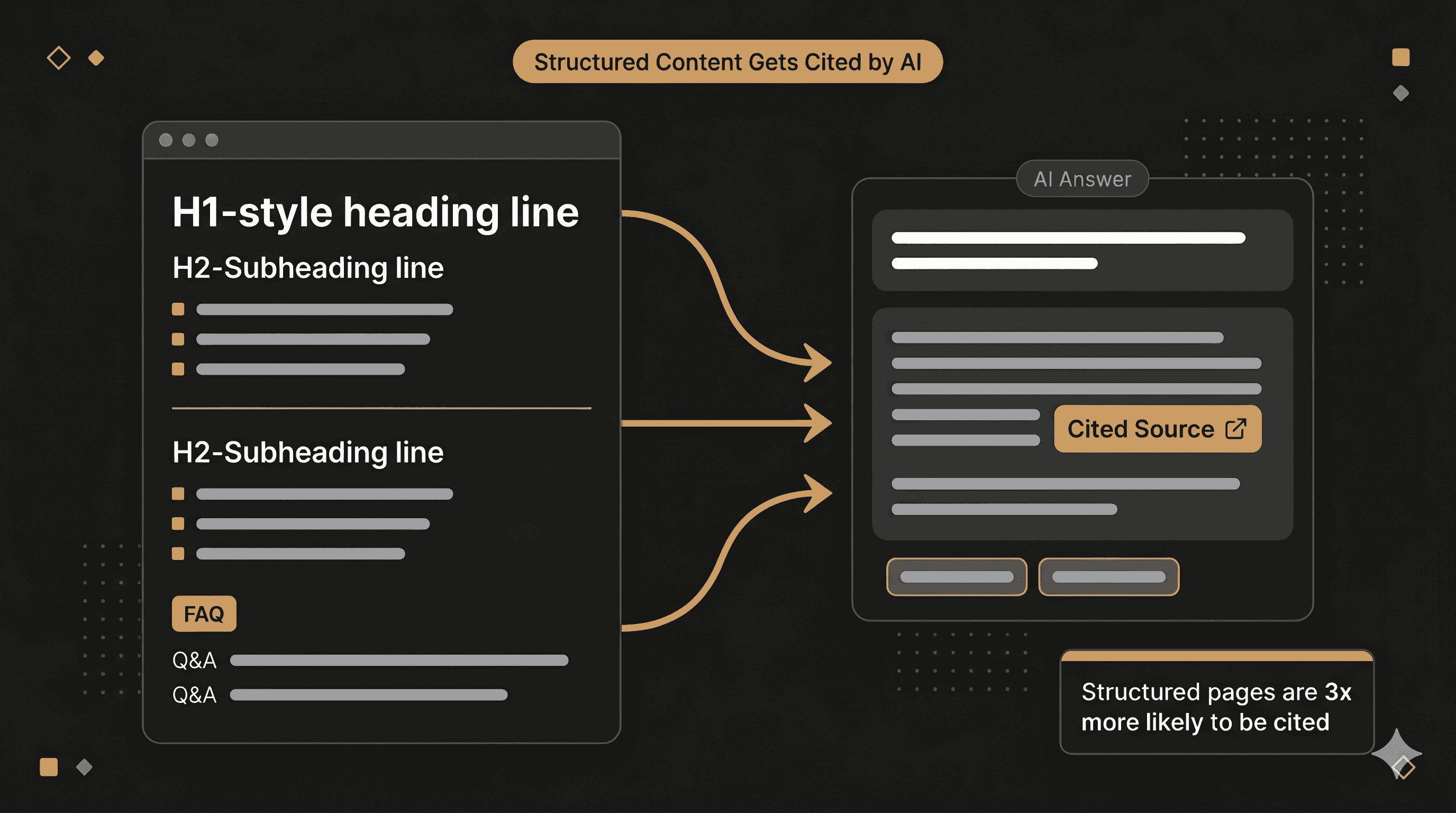
AI models love content that is easy to parse. Clear headings, bullet points, tables, concise answer blocks, and logical structure help AI systems extract and use your information confidently.
How do AI search engines evaluate content quality differently?
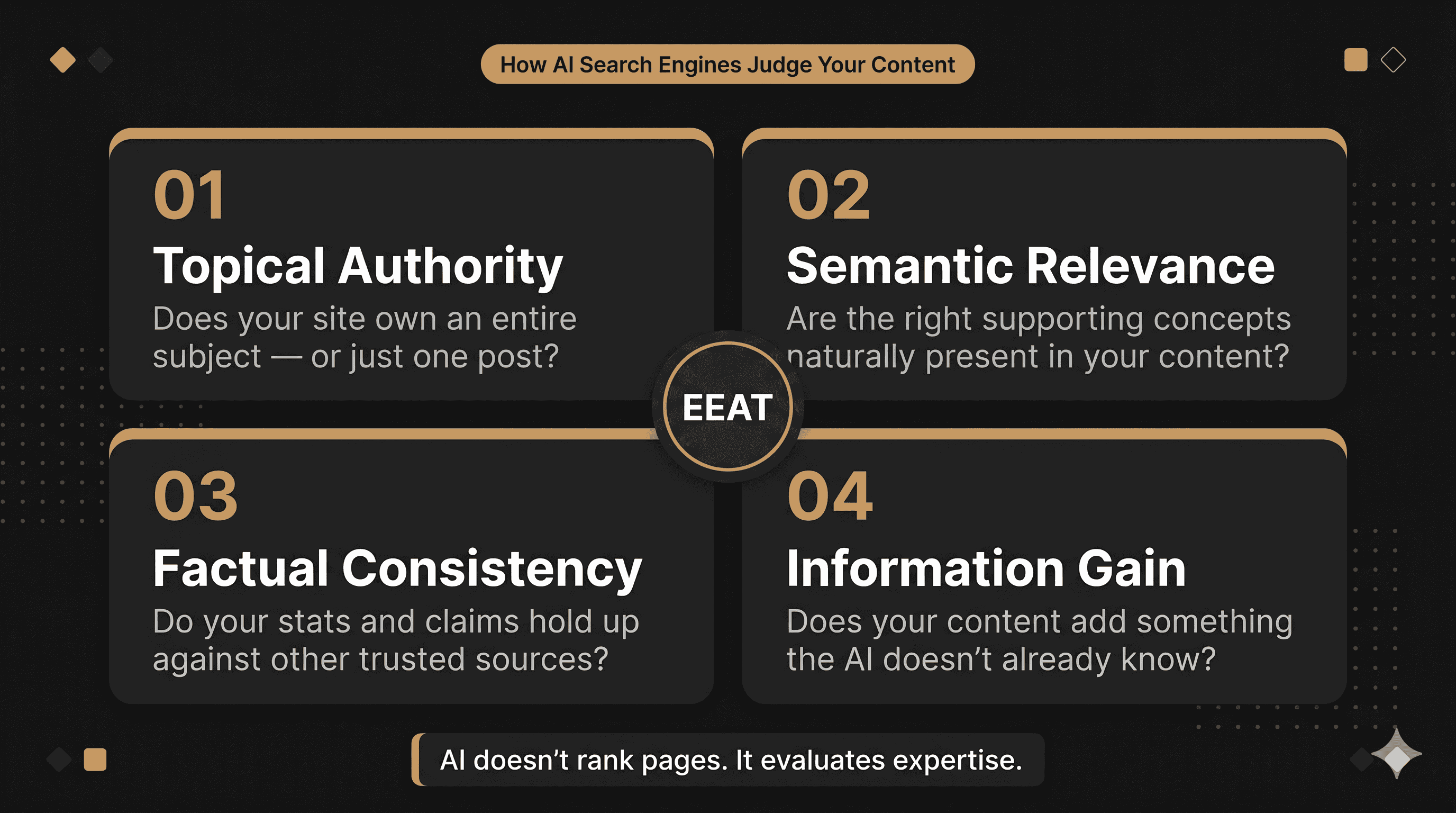
AI search engines evaluate content quality based on topical authority, semantic relevance, factual consistency, and EEAT.
In this section, we’ll break down each of these AI ranking factors to help you understand:
Importance of topical authority over isolated keywords
AI engines don't care if you've typed a specific phrase five times in an article. Instead, they look at your entire website's footprint to see if you possess topical authority.
They evaluate whether you have covered an entire subject inside out, addressing subtopics, edge cases, and adjacent questions. They prefer citing a niche site dedicated entirely to organic gardening over a generic news site that happened to write a single, keyword-stuffed post about tomatoes.
How semantic relevance matters more in AI search
Semantic relevance sees the family of ideas around your topic. AI gets synonyms, purpose, and the surrounding vibe.
Writing about baking bread? It wants to see related semantic terms like "yeast," "fermentation," and "gluten.” It values the complete, natural conversation, not a robotic repetition of the same target words.
Why factual consistency is critical
Traditional search engines might still rank a nicely polished page, even if it has small mistakes or old numbers.
AI search engines are different. They check facts against many sources across the internet. If your page has wrong stats or goes against common knowledge in your field, the AI quickly spots the problem. To get cited by AI, your information needs to be accurate and fresh.
Role of EEAT in AI-generated answers
Google’s core Quality Rater guidelines emphasize E-E-A-T: experience, expertise, authoritativeness, and trustworthiness.
AI search engines use these exact same pillars to protect themselves from hallucinating or spreading misinformation. They seek out explicit signals of real-world experience, clear author bios, and verified credentials before they display your content as a factual answer to a user.
Why information gain matters more now
The web is overflowing with AI-made content, so you need to provide real novelty to get noticed.
Information gain is how much new value your writing adds beyond what’s already common knowledge.
An article that just repeats the usual top results gives AI nothing useful. But include an original case study, a unique expert quote, or fresh statistics, and your content suddenly becomes highly attractive and valuable to large language models.
Why is SEO alone no longer enough for visibility?
The internet is heading strongly into the era of zero-click search.
AI engines solve user questions immediately on the search page itself, so clicking through to other websites feels unnecessary. This new reality is changing the future of SEO forever and forcing brands to find smarter ways to achieve AI search visibility.
An article published in Search Engine Journal reveals that AI Overviews caused zero-click searches to climb from 54% to 72%.
People are trusting AI summaries more and more for quick answers, which means traditional #1 rankings are losing their old traffic magic. You can rank first on Google yet never get shown in AI Overviews or Perplexity.
Shallow, keyword-focused content that says what everyone else says is struggling now. AI doesn’t need to cite basic dictionary-style pages when it can make its own. Success today means getting your brand named inside the actual AI responses users read.
What SEO fundamentals still matter for AI search optimization?
Core principles like technical SEO and indexability, backlinks, internal linking and content clusters, search intent alignment matter when it comes to SEO for AI search.
Technical SEO and indexability still matter
If an AI engine's crawler cannot access your webpage due to poor rendering, slow loading speeds, or incorrect canonical tags, your content will never be synthesized.
Clean code, fast mobile performance, and flawless indexability remain the absolute gatekeepers of digital visibility.
Why backlinks still influence authority
While AI engines look closely at content structure, they still use backlinks as a proxy for real-world trust. A website that earns high-quality links from respected news organizations, academic journals, and industry leaders signals to an AI that the domain is a reliable source of truth.
Importance of internal linking and content clusters
While AI engines look closely at content structure, they still use backlinks as a proxy for real-world trust.
A website that earns high-quality links from respected news organizations, academic journals, and industry leaders signals to an AI that the domain is a reliable source of truth.
Search intent alignment remains essential
A chaotic website layout confuses both human readers and AI models. Organizing your content into tight, logical topical hubs connected by clear internal links gives AI spiders a roadmap. This makes it incredibly easy for an LLM to navigate your site, understand the semantic context of your business, and see the full depth of your expertise.
Why strong brands gain more AI visibility
AI models are trained extensively on brand mentions, entity data, and public discussions across the web. Known brands with a strong, consistent digital footprint are naturally favored by AI search engines. That’s because their names are already deeply embedded within the model's knowledge graph.
How can brands optimize content for both SEO and AI search?
The smartest way to build this modern AI SEO strategy is to move away from isolated keyword pages and focus on building high-value, highly structured digital assets.
To execute this flawlessly, you need the right strategic partner in your corner. And that is exactly where Sagashi Digital comes in. Here is exactly how Sagashi Digital helps you optimize for AI search while keeping your traditional SEO ranking high:
- Build topic clusters instead of isolated pages: We move away from isolated keyword-stuffed posts and create rich hubs that explain a topic completely. This establishes undeniable topical authority that tells AI engines you are a definitive expert in your niche.
- Use concise answer blocks throughout content: We structure your articles with answer-ready, standalone paragraphs (typically 40 to 60 words) that sit right under question-styled headings. That makes it easy for AI models to extract and cite.
- Structure pages for easy extraction: Through clean formatting, structured data, bulleted summaries, and optimized code, we remove all reading friction for AI search spiders.
- Add original research and expert opinions: Sagashi Digital infuses your content with unique statistics, first-party data, and rich expert commentary to drive up your information gain score.
- Improve entity authority across the web: We help expand your brand's digital footprint outside your own website, building the third-party trust signals and digital mentions that LLMs look for when evaluating credibility.
Frequently Asked Questions
Yes. While it builds on SEO foundations, AI search optimization focuses more on citations, extractability, and conversational value rather than just rankings and clicks.
Absolutely. Many core principles, like quality content, technical excellence, and authority, still help. But you need additional AI-friendly optimizations for the best results.
Answer engine optimization (also called generative engine optimization) is the practice of optimizing content, so AI systems are more likely to understand, trust, and cite it in generated answers.
ChatGPT and similar models analyze vast training data plus real-time sources. They prioritize content that’s relevant, authoritative, well-structured, and consistent with other trusted sources.
Sites with strong topical authority, consistent branding, clear structure, original insights, and high EEAT signals tend to get cited more frequently.
Ready to Get Found by More Customers?
We help you generate qualified inbound leads through search - without paying for ads. Our content strategy is built to create a consistent pipeline, shorten sales cycles, and turn organic traffic into revenue.