
Google AI Overview May 2026 SEO Study: What Changed After the Update?
By
Rushabh Menon
Founder - Sagashi Digital
Summarize this article using AI
Stop panicking over your traffic drops. This Google AI Overview May 2026 SEO Study delivers eye-opening insights into one of the most important search updates of the year.
Released in mid-May 2026, this Google AI Overview update significantly shifted how content gets cited inside AI-generated answers. In our analysis of over 12 million SERPs, we tracked citation patterns, zero-click rates, and traffic shifts using AI monitoring tools and clickstream data before and after the mid-May rollout.
Key findings show a clear pivot: structured, authoritative, entity-rich content now earns more citations, while thin or generic pages lose visibility. According to Ahrefs’ 2025–2026 research, AI Overviews can reduce clicks to top-ranking pages by up to 58%.
This has created a major industry impact, especially for publishers, affiliates, and informational sites, while opening new opportunities for brands that adapt quickly. In this guide, we’ll explore exactly what changed and how to win in the new AI-first search world.
What changed in Google AI Overviews after the May 2026 update?
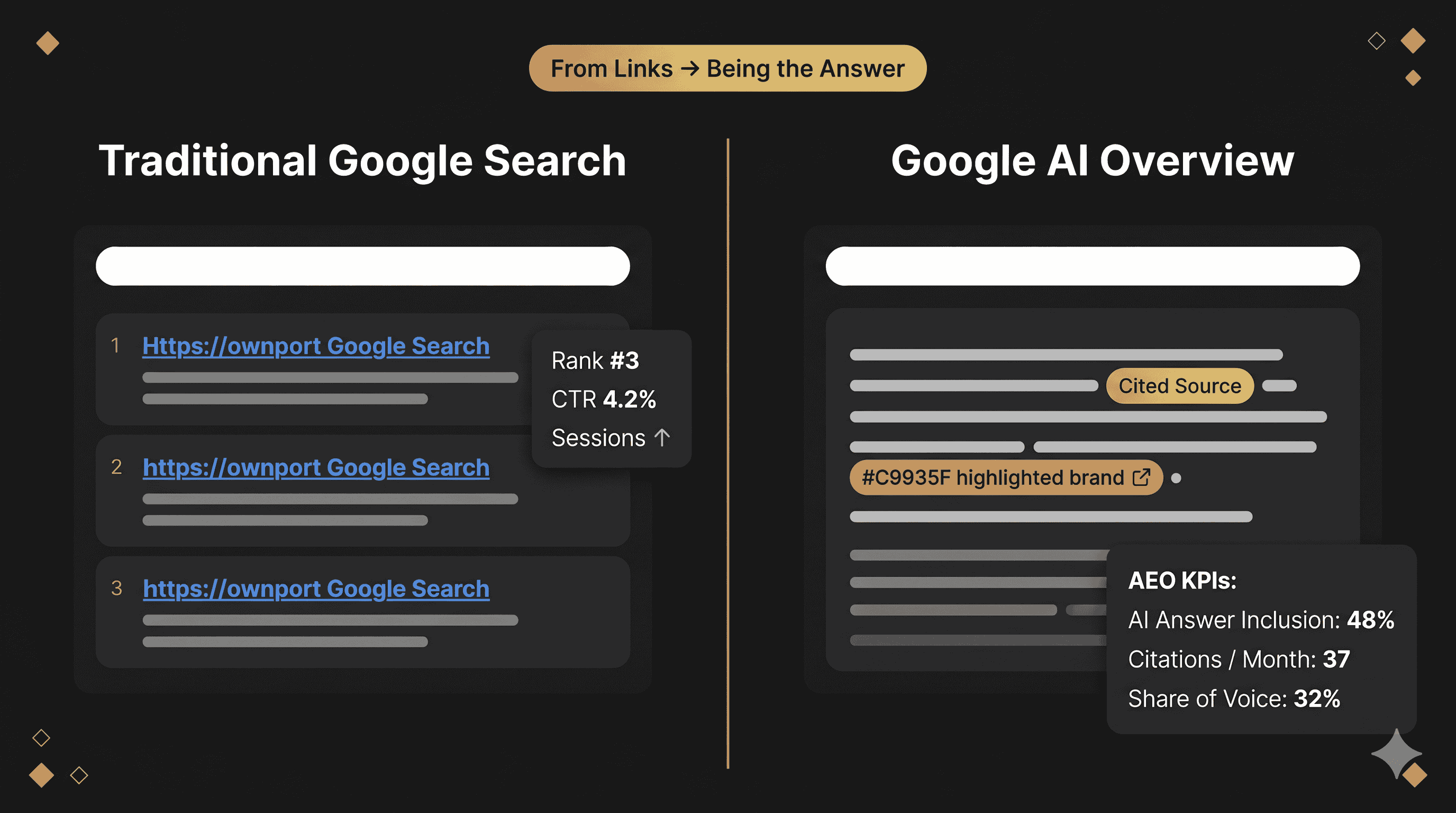
The Google AI overview update in May 2026 prioritizes a substantial increase in answer depth, a heightened reliance on top-tier authoritative domains, and a systematic filtering out of thin or repetitive content.
Google is also relying heavily on entity-based content extraction. So, users have far less incentive to click out to an external site.
- Increase in AI-generated answer depth: Google's Gemini-powered core (further enhanced by the recent Gemini 3 integration) is now executing complex, multi-source synthesis instead of a single snippet. The answers are deeper and more comprehensive, meaning a single AI summary can resolve highly complex user journeys right on the SERP.
- More authoritative domains cited: The wild west days of random blogs landing prime real estate in AI answers are gone. Google is heavily favoring established domains with documented real-world credibility. The algorithm is leaning on trusted publications, institutional sites, and niche leaders to anchor its generated answers.
- Reduced visibility for thin informational pages: If a page’s entire value proposition is answering a simple question, its search footprint likely just evaporated. Google now creates these basic summaries entirely on its own, cutting out the middleman and completely hiding thin, basic informational content.
- Rise of entity-based content extraction: Google is relying heavily on its underlying knowledge graph. It extracts specific real-world entities (brands, organizations, physical products, specific people) and maps their relationships rather than counting how many times a particular phrase appears in the body text.
The result? More aggressive zero-click behavior. A growing portion of users are finding precisely what they need directly on the SERP itself, eliminating the need to visit an external website.
According to an article published in Blog Herald, 58% of Google searches already end with zero clicks.
Table: Before vs After May 2026 AI Overview Update
How did the May 2026 update affect organic SEO traffic?
After the May 2026 core update, zero-click searches increased noticeably, contributing to AI search traffic redistribution. Many sites saw organic clicks dip for informational queries, and branded searches gained importance. Traditional affiliate and publisher sites particularly lost the citation slot.
Industries that lost the most clicks
The SaaS, technology, and digital publishing sectors bore the brunt of the immediate traffic drop. Software comparison queries that used to drive thousands of high-value clicks to review aggregators and vendor blogs are now completely answered inside the AI interface.
Informational keywords are most affected
"What is," "How to," and definition-based informational phrases experienced traffic collapse. The AI handles these direct, factual answers flawlessly, leaving traditional informational pages without their historical top-of-funnel audience.
Why have branded searches gained importance?
Interestingly, while informational terms are down, branded searches have become an absolute lifeline. When a user explicitly searches for your brand name or your unique proprietary framework, Google's AI is forced to pull from your domain.
Impact on affiliate and publisher sites
Traditional affiliate review blogs that rely on thin, rewritten product roundups were hit incredibly hard by this update.
Google's updated architecture often extracts product specifications, pros, cons, and real-time pricing data directly into its own interactive shopping widgets. If your site doesn't offer unique, proprietary field testing, original imagery, or deep, specialized insight, capturing a profitable citation slot has become nearly impossible.
How has CTR changed across top-ranking positions?
Holding the traditional "#1 spot" on Google simply doesn't mean what it used to. When a prominent AI Overview populates above the standard listings, click-through rates for the top organic link drop significantly.
Clicks are being heavily redistributed. You either earn a direct citation within the AI block itself, or you fight for the scraps left at the bottom of the fold.
What type of content gained visibility in AI Overviews after the update?
When it comes to AI overview ranking, content with a question-first structure, definition-style explanation, and research-backed content gained visibility. Those with tables, summaries, and entity-rich authoritative pages also experienced high growth.
Question-first content structures
Pages that explicitly state a clear user question in an H2 or H3 heading and immediately follow it with a direct, clear answer saw an immediate jump in AI visibility. The extraction algorithm favors clean, unbloated code blocks that it can quickly map to natural language queries.
Definition-style explanations
Content blocks that avoid fluff and adopt an encyclopedia-style format, stating the subject, its category, and its primary function in under 30 words, are winning citations constantly.
Research-backed content
Original data is king. Google’s Nick Fox, Senior Vice President of Knowledge & Information, emphasized during a May 2026 industry address that generative search mechanics place an intense algorithmic premium on "deep content."
The algorithm actively prioritizes original research, white papers, and proprietary statistics. If your site is the foundational source of a specific data point, Google will repeatedly reference your domain as the root source of truth.
Pages with tables and summaries
Data tables comparing product features, pricing models, or technical specifications are incredibly high-signal assets for machine learning models. Pages that summarize complex comparative data into clean, semantic Markdown or HTML tables are highly prized by the AI crawler.
Entity-rich authoritative pages
Pages that write comprehensively about a topic by touching on all related sub-entities, semantic terms, and industry concepts score high on topical depth scores. These multi-dimensional pages are pulled by Google to resolve complex, multi-part search intents.
Table: Highest Performing AI Overview Content Types
How does Google choose sources for AI Overview citations?
Topical authority, EEAT (experience, expertise, authoritativeness, and trustworthiness), entity recognition, concise answer blocks, and freshness of content are what help earn a place in Google AI overview citations.
This makes it clear that Google isn't just pulling links from the standard top ten results. But it is actively filtering content through a sophisticated quality sieve to build its AI citations.
Importance of topical authority [SME authors]
Google is heavily matching content with the recognized expertise of the author. Subject Matter Experts (SMEs) who have clear digital footprints, linked social profiles, and a history of writing on a single topic provide strong algorithmic trust signals.
Google wants to know exactly who stands behind the data it feeds to millions of searchers.
Why EEAT signals matter more now
E-E-A-T are the primary pillars of the post-update web. The algorithm checks your site’s digital footprint for hard trust signals, such as clear editorial policies, active outbound links to verified scientific consensus, and clear disclosures.
Role of entity recognition
Google maps your sentences against its internal Knowledge Graph. The algorithm calculates the statistical closeness of the semantic entities present on your page to determine if your text is an accurate reflection of established facts. If your content strays too far into unverified or logically inconsistent claims, it is instantly filtered out of the AI box.
Importance of concise answer blocks
The LLM operates under strict token limitations. It wants to build an accurate summary using the fewest computational cycles possible.
Pages that present information in bite-sized, 40-to-60-word micro-paragraphs are significantly easier for the crawler to extract and reuse than long, sprawling blocks of text.
How freshness impacts citations
For fields like technology, finance, or news, the algorithm enforces a strict freshness filter. The AI system constantly replaces outdated sources with pages displaying updated data tables, fresh case studies, and real-time insights to maintain maximum conversational accuracy.
What structural patterns appeared most in the cited pages?
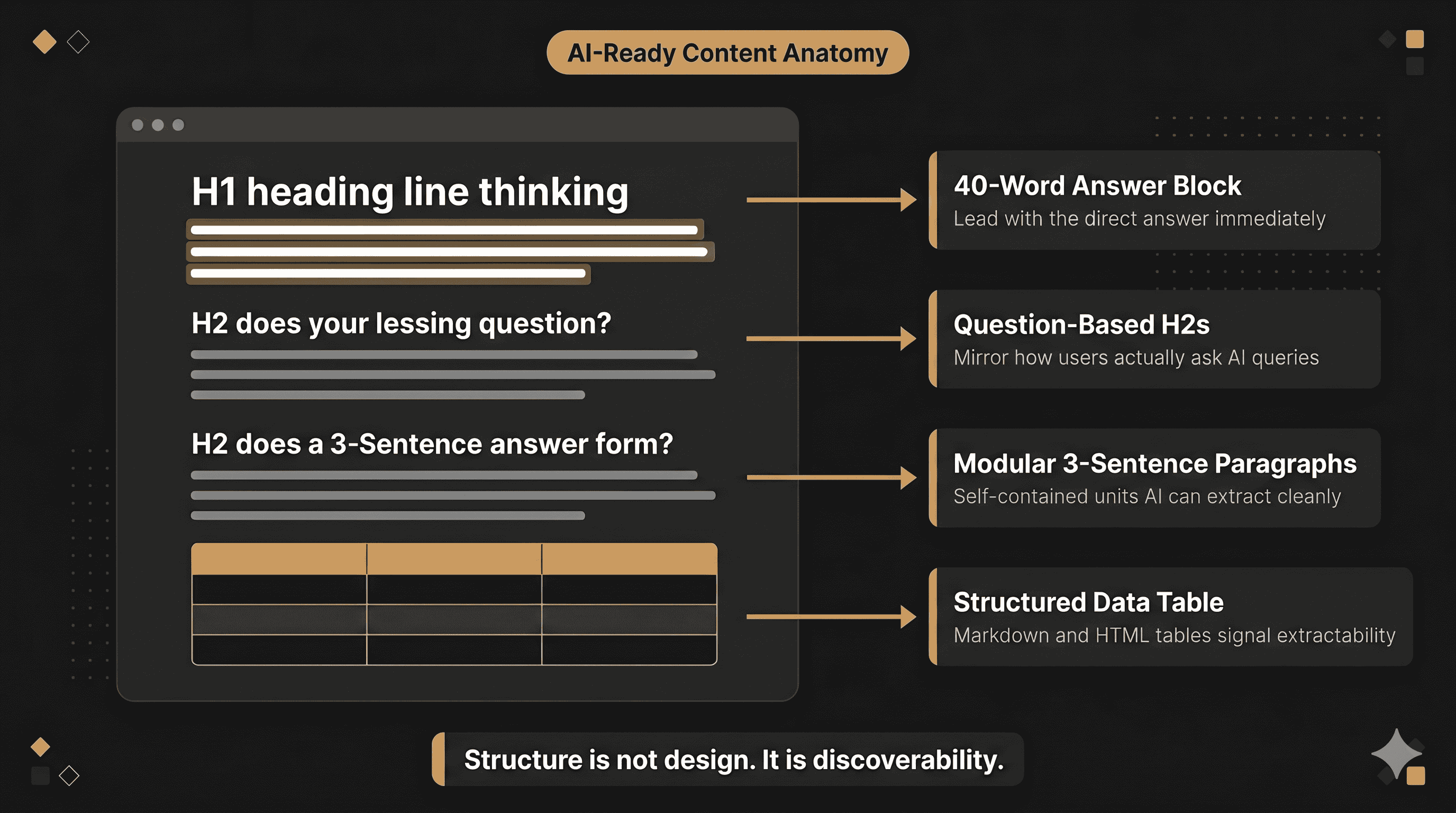
When we isolated the exact URLs that won the most citations, we discovered that they all shared highly consistent, recognizable code footprints.
These include direct answers within the first paragraph, question-based H2 structure, short paragraphs, extractable formatting, tables, and bullet points. Pages that the AI cites also feature FAQ-heavy layouts and consistent internal linking.
Optimizing your AI SEO formatting is all about tailoring your visual and structural architecture to match this specific AI overview structure.
- Direct answers within the first paragraph: Winning pages state the core answer to the main target query immediately within the first 2-3 sentences of the page. That makes it easy for an automated crawler to verify and scrape.
- Question-based H2 structure: Instead of using clever or creative section titles, top performers use direct, user-intent questions as their <h2> and <h3> subheadings.
- Short paragraphs and extractable formatting: Text blocks are kept tight, rarely exceeding three sentences per paragraph. This creates digestible, modular text snacks that an AI model can lift cleanly without needing to edit out extra noise.
- Tables and bullet points: Bulleted lists and well-formatted Markdown tables appear consistently in cited sources. They present complex, relational data in a perfectly organized format.
- FAQ-heavy layouts: Integrating an advanced, highly relevant FAQ section at the bottom of articles provides Google with clear, pre-packaged question-and-answer pairs that are tailor-made for conversational search modules.
- Consistent internal linking: Top-tier sites use tight internal link structures. They cluster related articles together around core hub pages to signal deep, structural topical coverage to the crawler.
What SEO mistakes became riskier after the May 2026 update?
Google AI update mistakes that now carry a huge risk of visibility loss include publishing low-tier, unedited AI content, scaling low-value pages, and ignoring structured formatting.
Weak topical depth and keyword-first instead of answer-first are also critical AI overview SEO mistakes you can make.
- Publishing generic AI content: Publishing plain, generic AI-generated content without human editing and input is a sure way to fail. If your content looks exactly like the training data of the LLM itself, Google has zero incentive to cite your site.
- Scaling low-value pages: Flooding your domain with thousands of programmatic, thin pages targeting minor keyword variations will trigger quality penalties. Google values deep, consolidated resources over fragmented, low-effort landing pages.
- Ignoring structured formatting: Writing long walls of text without clear headings, bullet points, schema markup, or data summaries makes your content functionally invisible to the AI extraction units.
- Weak topical depth: Creating shallow, isolated articles that don't belong to a wider, authoritative content cluster leaves your domain looking superficial. The algorithm will bypass your page for a competitor with deep, comprehensive topical roots.
- Keyword-first instead of answer-first SEO: Stuffing your text with random keywords instead of properly answering the user’s question will ruin your chances of getting an AI citation.
How should brands adapt after the May 2026 AI Overview update?
Smart AI search optimization is the way to survive and thrive in this ecosystem. Center your AI visibility strategy on these, and you can maximize your visibility in citations.
- Build authority clusters: Move beyond isolated blog posts. Create deep, interconnected topical hubs to prove to Google that you have comprehensive, end-to-end expertise.
- Publish original research: The single best way to protect your content from being completely replaced by an AI summary is to own the underlying data. Invest resources into publishing original surveys, proprietary case studies, and unique practitioner experiments.
- Structure content for AI extraction: Re-engineer your content delivery template. Lead your pages with short, punchy answer summaries, integrate clear tables for comparison queries, and deploy clean schema markup across your entire site layout.
- Combine SEO + GEO + AEO: Your strategy needs to be a unified, three-pronged framework. Use Search Engine Optimization for traditional crawling health, Generative Engine Optimization to win citation placements in LLM carousels, and Answer Engine Optimization to dominate voice and conversational search systems.
- Track AI visibility: Traditional rank tracking software doesn't give you the full picture anymore. You must monitor your brand's share of voice inside AI Overviews, tracking how often your domain is cited across your target keyword landscape.
Find implementing these changes overwhelming? Sagashi Digital is there to help you out.
We build complete AI-era strategies that blend classic SEO with AEO and GEO. We also handle everything from in-depth audits and content mapping to creating citation-ready content that drives qualified leads.
Our clients regularly report 2-3x more top rankings, tripled organic traffic, and stronger resilience during updates without paid ads.
Frequently Asked Questions
The update now focuses on combining information from multiple sources, recognizing key topics and entities, and rewarding websites with deep expertise. Google reduced the visibility of thin informational pages and altered its layout, placing links and interactive hover previews directly inside the AI text.
Yes, primarily for generic informational keywords and top-of-funnel search terms. As Google now synthesizes answers directly on the SERP, zero-click behavior has risen, dropping organic click-through rates for traditional listings beneath the AI block.
Google heavily features question-first content structures, short definition blocks, data-rich research tables, expert quotes, and entity-mapped pages that answer a user's intent without unnecessary filler.
Focus on establishing deep sitewide topical authority instead of writing isolated articles. Ensure you feature direct answer blocks in your very first paragraphs, structure your subheadings as questions, maintain excellent EEAT signals, and secure verified expert authors to write your content.
Zero-click searches are rising because Google’s generative AI summaries are now comprehensive enough to fully satisfy a user's research journey right on the search page. That eliminates the need for a user to click out to an independent website.
Ready to Get Found by More Customers?
We help you generate qualified inbound leads through search - without paying for ads. Our content strategy is built to create a consistent pipeline, shorten sales cycles, and turn organic traffic into revenue.