
AEO vs SEO: What’s the Difference and Why It Matters?
By
Rushabh Menon
Founder - Sagashi Digital
Summarize this article using AI
Wondering what the biggest change in marketing this year is? It’s AEO vs SEO.
SEO is all about ranking your pages in traditional search results so people click through and visit your site. AEO is about structuring your content, so AI-powered answer engines (like Google’s AI Overviews, Perplexity, ChatGPT Search, and voice assistants) can easily understand it and directly feature your answers to users.
AEO, alongside SEO, matters because research shows that 42% of people now use AI for shopping. This means consumers aren’t just searching but asking AI tools, voice assistants, and smart devices for direct answers.
That said, here, Sagashi Digital will walk you through what AEO is, what SEO is, the key difference between the two, and how to combine both for real results. Dive in, then!
What is AEO and what is SEO?
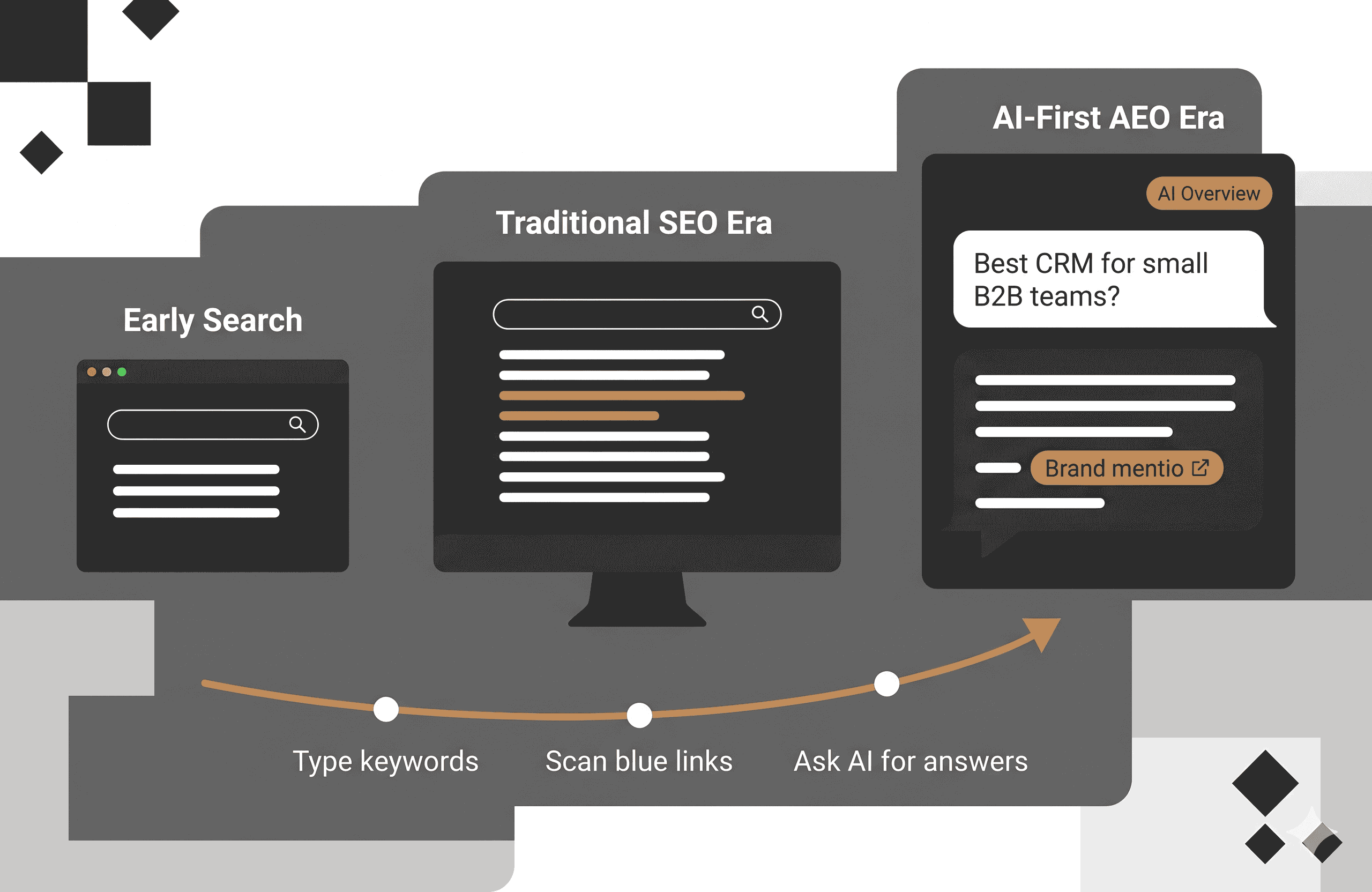
Before we dive into the details, let’s understand what is AEO and what is SEO.
SEO focuses on improving rankings on search engine results pages (SERPs). You tweak your website so Google and Bing show your page near the top when someone types in a query. The goal? Drive clicks, visitors, and ultimately sales or leads to your site.
On the flip side, AEO focuses on providing direct, concise answers for AI-driven search, voice assistants, and featured snippets. Instead of sending people to your full page, AEO makes sure your content pops up as the quick, ready-to-go answer right in the results, or even spoken aloud by Alexa.
The core shift is from getting clicks to giving answers. So, the goal is no longer just to get people to your site. But it’s to be the definitive source that provides value the moment a question is asked.
What is the difference between AEO and SEO?
Here, we’ll dig into the difference between AEO and SEO. They both aim to get your content in front of people, but the how and why are worlds apart.
Table: AEO vs SEO Comparison
As you can see, traditional SEO drives people to your site, while AEO shines when users get what they need without ever leaving the search results. No wonder Gartner predicted a 25% drop in traditional search volume by 2026.
How does SEO work?
So, how SEO works in practice? It’s a mix of art and science that has been evolving since the early 2000s. Here’s how the pros break it down step by step.
Keyword research and search demand
You dig into what people are actually typing (tools like SEMrush or Ahrefs help). Focus on high-volume, relevant terms that match your audience’s needs.
On-page optimization (titles, content, internal links)
You optimize titles, meta descriptions, headings, and body content with those keywords naturally. Internal links guide visitors (and Google bots) around your site, keeping people engaged longer.
Authority building through backlinks
Search engines view backlinks as votes of confidence. If reputable sites link to you, you must be an authority.
Technical performance (speed, indexing, UX)
Your site has to be fast, mobile-friendly, and easy to crawl. Slow load times or broken links? Google notices and ranks you lower.
How does AEO work?
AEO is less about the page and more about the point. Here, we’ll figure out how AEO works.
Identifying user questions and intent
AEO starts by digging into real questions. Tools like AnswerThePublic or Google’s “People Also Ask” show you exactly what folks want to know.
Providing direct answers in the first few lines
Your content needs to answer right up front, no fluff. The first paragraph or two should deliver the goods, so AI engines and voice assistants can pull it cleanly.
Structuring content with clear headings
Use descriptive headings (H2s and H3s) that match common questions. This makes it easy for machines to understand and feature your information.
Using schema markup and snippet-friendly formats
Add schema markup and formats like lists, tables, or FAQs. These help search engines and AI grab your content for featured snippets or spoken replies.
When should you focus on AEO vs SEO?
Deciding your AEO vs SEO strategy depends on your goals. Neither is better. They just solve different problems.
McKinsey data shows unprepared brands could lose 20% to 50% traffic, so hybrid is the way forward.
Use SEO when:
- You want to drive high-volume traffic to your blog.
- You are selling a complex product that requires a long consideration phase.
- You want to build a long-term brand narrative through storytelling.
Use AEO when:
- You are targeting voice search users (on-the-go queries).
- You want to own the "Featured Snippet" or "AI Overview" box.
- Your content answers specific, factual, or how-to questions.
In 2026, most winning strategies combine both.
Table: When to Use Each
How to optimize for both AEO and SEO together
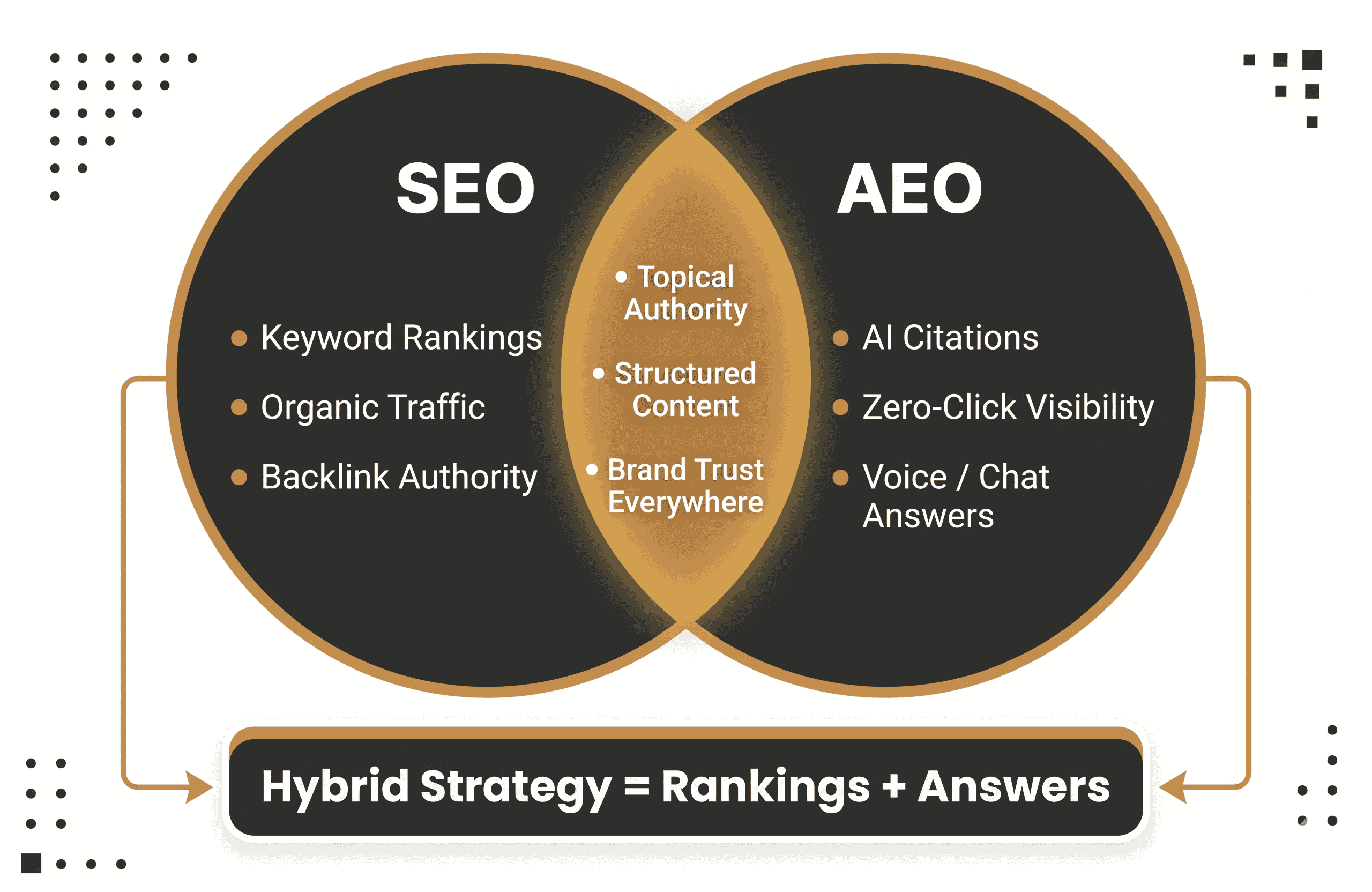
Creating a unified AEO SEO strategy is the hallmark of a sophisticated digital marketer. You want the traffic from SEO and the authority of AEO. Here is how you do it:
Use question-based headings (H2s as queries)
Turn your headings into the exact questions people ask. It helps SEO rankings and makes AEO engines pull your content perfectly.
Add a direct answer at the top of sections
Lead every major section with a concise answer. Readers and AI get value immediately, then dive deeper if they want.
Keep paragraphs short and scannable
Giant walls of text are where rankings go to die. Keep your paragraphs to 3 to 4 sentences. This makes it easier for AI to extract specific entities and for humans to read on mobile devices.
Include lists, tables, and FAQs strategically
These formats are snippet magnets. They boost both click-through rates and zero-click wins.
Common mistakes to avoid
When pivoting toward AI-driven search, watch out for these SEO mistakes and AEO mistakes:
Focusing only on keywords, not intent
Chasing keywords without understanding why someone is searching is a classic SEO mistake. The same goes for AEO. Keyword stuffing sabotages the natural, conversational flow required to win the 'answer' spot.
Writing long intros without answering quickly
The recipe blog problem, where you have to read about the author's childhood before getting to the recipe, is a grave mistake. Don't bury the lead.
Poor content structure
If your H2s and H3s are messy or non-descriptive, search engines won't know how to categorize your answers. Structure is the bridge between your content and the AI's understanding.
Ignoring AI-driven search behavior
Assuming that people still search the same way they did in 2020 is a recipe for irrelevance. You must account for conversational queries and the zero-click reality of the modern web.
How Sagashi Digital helps with AEO and SEO [Compromising none!]
Mastering the balance between traditional search and AI-driven answers is tough, but you don’t have to tackle this evolution alone. There are AI SEO agencies to help you!
At Sagashi Digital, we specialize in SEO optimization that doesn't just look at today's rankings, but tomorrow's answers. We use advanced AEO tools to analyze semantic search patterns and identify the "Answer Gaps" your competitors are missing. Here’s how:
- High-Intent Query Identification: We find the questions your customers are actually asking, not just the keywords they are typing.
- Structured Content Architecture: We help you rewrite and restructure your site so that it's a fountain of answers for AI models while maintaining the depth needed for SEO rankings.
- The Hybrid Approach: We align your organic content with paid strategies to ensure that, whether a user clicks a link or gets an AI summary, your brand is the one they see.
We believe you shouldn't have to choose between traffic and visibility. We give you both.
Frequently Asked Questions
The main difference is focus. SEO drives clicks and traffic through rankings, while AEO delivers direct answers for zero-click searches and AI tools.
No, AEO is an evolution of SEO. Classic search still powers most discovery, especially for in-depth research.
Absolutely. A strong AEO SEO strategy uses SEO to build long-form authority and AEO to capture quick-answer snippets and voice search queries. They are two sides of the same coin.
Focus on clear structure, use schema markup, answer questions directly at the start of your content, and ensure your site's technical speed is top-notch.
AEO is important because more searches happen via voice, AI chatbots, and featured snippets. Ignoring AEO means missing out on visibility where your audience actually is.
Ready to Get Found by More Customers?
We help you generate qualified inbound leads through search - without paying for ads. Our content strategy is built to create a consistent pipeline, shorten sales cycles, and turn organic traffic into revenue.