
How to Do AEO: Step-by-Step Guide to Rank in AI Search
By
Rushabh Menon
Founder - Sagashi Digital
Summarize this article using AI
Is there any marketer or business owner not wondering how to do AEO right now? Not really.
Traditional SEO still matters, but AEO has taken center stage. And why not? Bain & Company's research reveals that AI summaries are a go-to for 80% of searchers during at least 40% of their sessions.
That makes it clear: if your content isn't built to be cited, it's effectively invisible to a fast-growing chunk of your audience. That's exactly the gap Answer Engine Optimization fills.
Instead of only chasing blue links and rankings, AEO gets your content extracted, quoted, and referenced by tools like ChatGPT, Gemini, and Perplexity.
Don't know how to do AEO to get your content in front of AI-first searchers? This guide's for you. Below, Sagashi Digital will walk you through everything, from understanding what AEO is to building a strategy that gets your content cited by AI engines. Dive in, then!
What Is AEO and How Is It Different From SEO?
Simply put, answer engine optimization (AEO) is the process of making your content as easy as possible for AI models to find, understand, and cite.
Traditional SEO focuses on getting a blue link on a search engine results page (SERP). But AEO focuses on being the source of the answer provided by an AI.
AEO vs SEO: What's the difference?
Here’s a quick side-by-side comparison of AEO and SEO:
How AI Search Engines Work (ChatGPT, Gemini, Perplexity)?
These tools use large language models (LLMs) trained on vast amounts of data. When you ask a question:
- Perplexity searches the live web in real time and cites sources inline.
- Gemini and Google AI Overviews pull from Google's index and show source links.
- ChatGPT (with browsing enabled) synthesizes from trained knowledge plus fresh retrieval.
They generate natural-language answers by pulling relevant snippets, then summarizing.
What Does "Getting Cited" Mean?
Getting cited means your page appears as a source link or is directly quoted in the AI response. That's huge for AI visibility because it puts your brand in front of millions without needing a click.
Why Is AEO Important for Ranking in AI Search Results?
AI search growth is exploding. In 2025, more than 1 in 2 Americans plan to use generative AI for their online shopping.
It shouldn't come as a surprise, then, that zero-click searches are rising. A ResearchGate paper found U.S. queries answered by AI jumped from 42% in 2024 to 67% in 2025. That leads to a significant drop in organic clicks.
Bottom line: if you're not optimizing for AI visibility, you risk significant traffic drops.
How Do You Do AEO Step by Step?
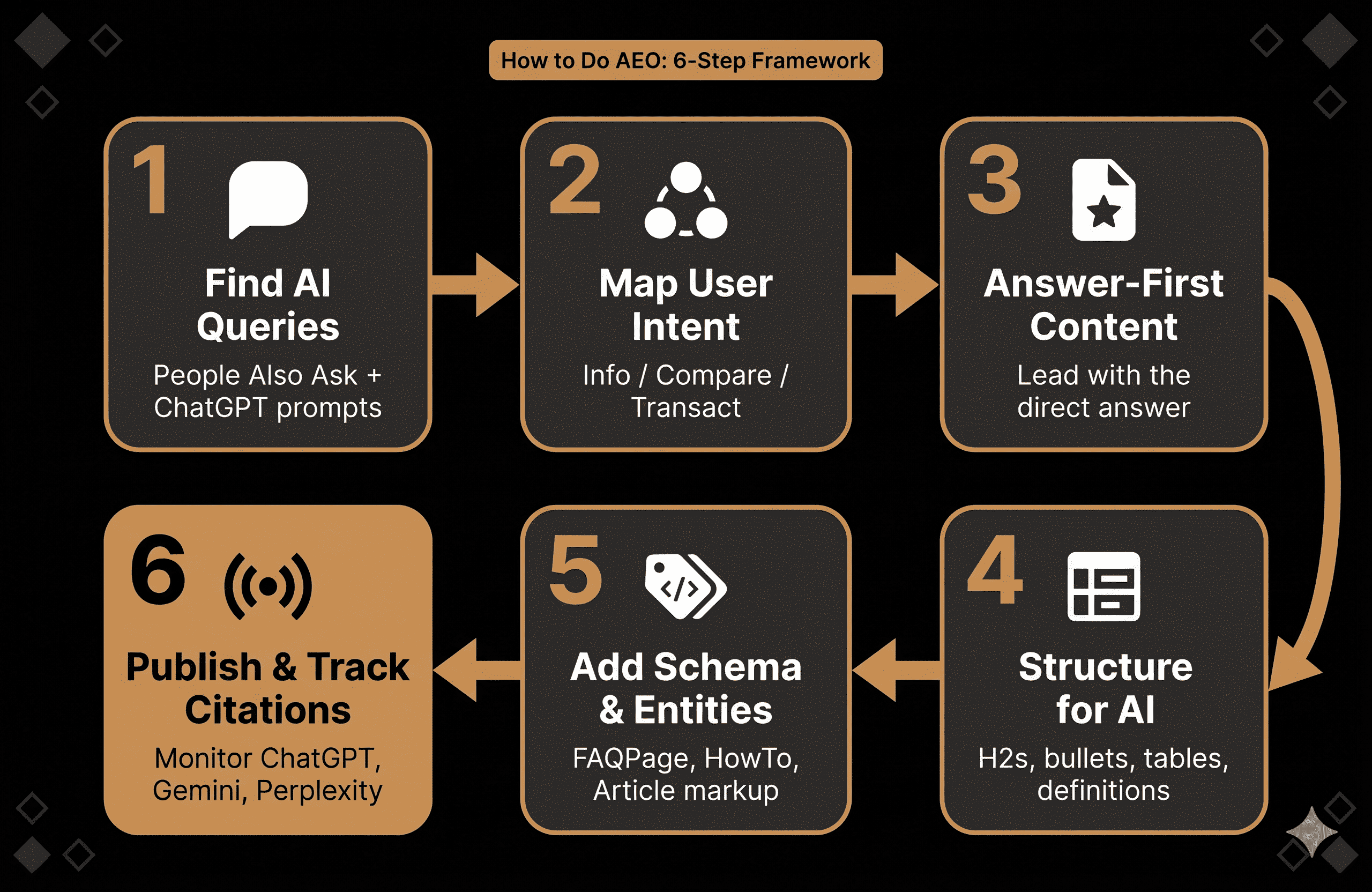
Wondering how to do AEO? Here's a complete AEO framework you can follow:
Step 1: Identify AI Search Queries (Prompt-Based Research)
Think like a conversational user. Instead of "best running shoes," people now ask, "What are the best cushioned running shoes for flat feet under $150?" Use tools like Google's People Also Ask, ChatGPT's "suggest related prompts," or Perplexity - the same AEO research tools most marketers already rely on - to mine real AI-style questions.
Step 2: Map Queries to User Intent
Cluster queries by intent: informational ("how does X work?"), comparative ("X vs Y"), or transactional ("best X for beginners"). This ensures your content matches exactly what the AI needs to answer.
Step 3: Create Answer-First Content
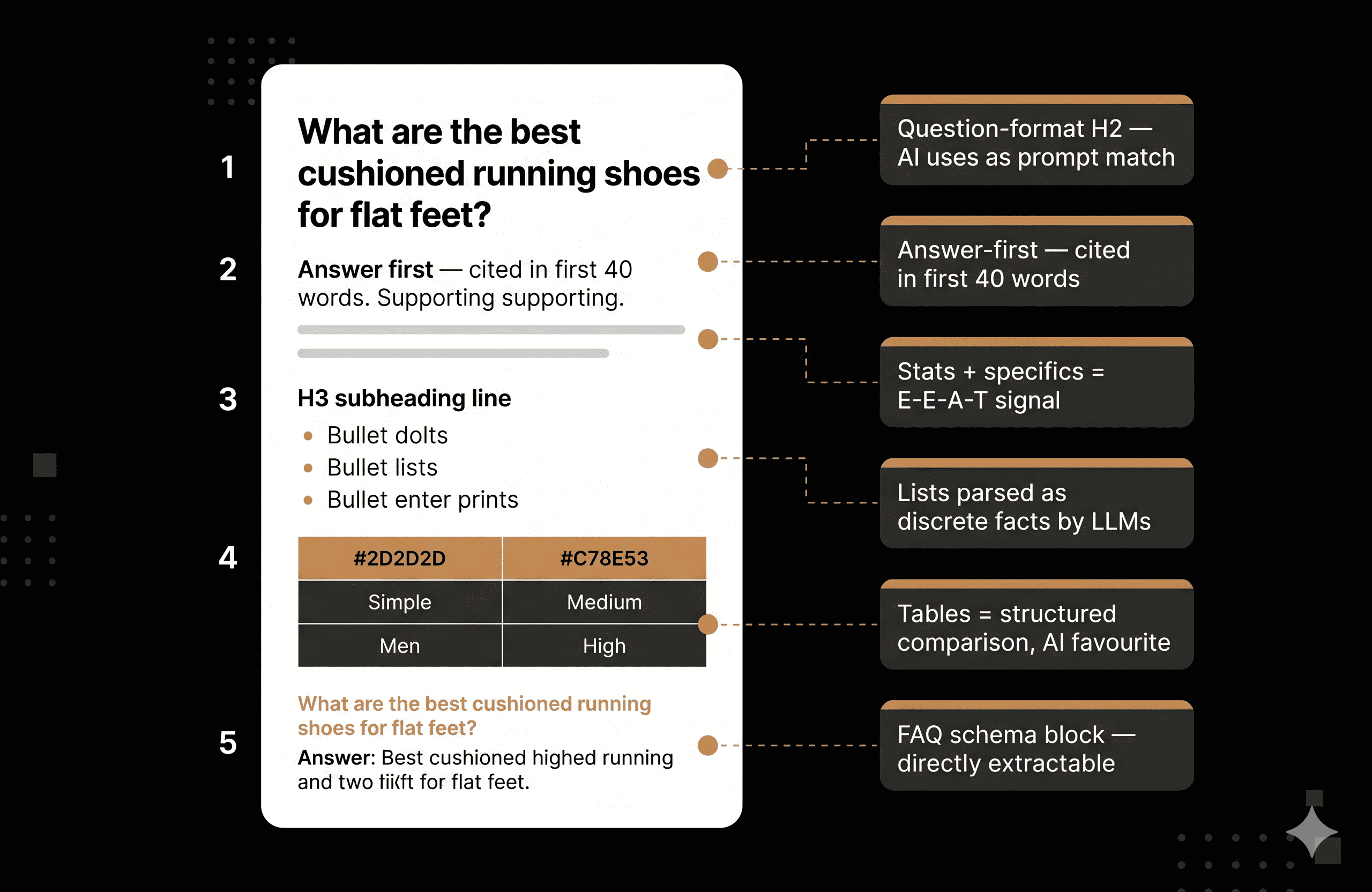
Lead with the direct answer in the first 1 to 2 sentences. Follow with supporting details, stats, and examples. This is core to any solid AEO strategy.
Step 4: Optimize for AI Extraction (Structured Formatting)
Use clear H2/H3 question headings, bullet lists, numbered steps, tables, and definitions to properly structure your page for AEO. Short paragraphs (3 to 4 lines max) help LLMs parse your content easily.
Step 5: Add Entities, Schema, and Context
Mention specific people, brands, dates, and stats. Add Schema.org markup (FAQPage, HowTo, Article). Build topical depth with internal links, so AI sees you as an authority.
Step 6: Publish and Track AI Citations
Hit publish, then track your AEO performance using tools like Perplexity's "Ask with sources," ChatGPT search, or third-party AI trackers. Update content when new data emerges to stay fresh.
How Do You Find AI Search Queries for AEO?
AI query research is the foundation of AEO keyword research. Skip old keyword tools; focus on conversational search instead.
Using People Also Ask (PAA)
Google's PAA boxes are essentially a list of the most popular conversational queries. These questions are exactly how people phrase prompts in ChatGPT.
Mining ChatGPT & Perplexity Prompts
Spend time talking to the bots. See what follow-up questions they suggest. These are your next set of long-tail targets.
Extracting Conversational Keywords
Focus on "How," "Why," "Can I," and "Should I." This is the essence of conversational search.
Using Forums (Reddit, Quora)
Reddit and Quora are the ultimate sources of human-centric queries. AI models are increasingly trained on their data because they reflect real-world problems. Mine these forums regularly.
Identifying Long-Tail AI Queries
The longer and more specific a query, the more likely it is to be entered into an AI tool rather than a traditional search engine. Prioritize these.
How Do You Optimize Content for AI Answers?
AI content optimization is all about making your page genuinely AI-friendly, so it becomes the perfect snippet.
Writing Direct, Concise Answers
Aim for snippet-style blocks of 40 to 60 words that answer a question perfectly.
Using Structured Headings (Question Format)
Your headings are like a table of contents for the AI. An H2 like "What are the main benefits of AEO?" is much better than "AEO benefits."
Adding FAQs and Snippet-Friendly Sections
FAQs are the kings of AEO - they're literally built of questions and answers. It's one of the clearest examples of how FAQs improve AEO rankings, and every page on your site should have a small FAQ section at the bottom.
Using Lists, Tables, and Definitions
If you can put data in a table, do it. AI prefers structured comparisons. Tables are frequently pulled to the top of the page in AI summaries.
Improving Readability for LLMs
Avoid overly flowery language. Use active voice and clear transitions. If a human finds it easy to skim, an AI will find it easy to index.
How Do You Get Your Content Cited by ChatGPT and Gemini?
Here's how you can get your content cited by ChatGPT and Gemini:
Building Authority and Trust Signals
AI models prefer sources with high E-E-A-T (Experience, Expertise, Authoritativeness, and Trustworthiness). Ensure your author bios are detailed and your site has a clear "About Us" section.
Creating Citation-Worthy Insights
To get AI citations, you need to say something new. Don't just parrot existing content. Provide a unique take or a proprietary methodology.
Using Statistics and Original Data
Original research is the holy grail of ChatGPT ranking. If you have original statistics, you are almost guaranteed to get cited. Why? Because facts are easy for AI to verify and share.
Internal Linking and Topical Depth
Topical authority is a stronger driver of AI visibility than individual keywords. Building clusters of related content, linked together in a logical hierarchy, is how you build a real search system instead of a pile of disconnected posts.
Tracking Citations With Tools
Use tools like Brand24 or specialized AI trackers to see when your URL is being used as a reference in LLM responses. This is vital for maintaining AI visibility.
How Long Does It Take to See Results From AEO?
The AEO timeline is often faster than traditional SEO, but it depends on the refresh rate of the AI model. Google might take months to rank a new page. But AI engines that browse the live web (like Perplexity or Gemini) can pick up your content within days of it being indexed. For static models that rely on training data, though, the ranking time can be longer. Before you can call any of this a win, it also helps to know how you're measuring AEO success in the first place.
What Most Brands Get Wrong About AEO?
Most brands treat AEO as a plugin or a one-time task. They buy a bunch of AI tools and expect magic. But the tools do not equal the result. You need a real strategy. You need to understand your customers. Software can't do that for you.
Brands also ignore AI query intent. They just want to rank for big words. They forget that AI search is about solving problems. If you don't answer the user's specific question, the AI will pass you by.
Moreover, they forget that strategy plus execution matters. You can have the best plan in the world, but if you don't write the content and add the schema, nothing will happen. You have to do the work - and it helps to know what to look for in an SEO & AEO partner if you'd rather not go it alone.
If you'd rather skip the trial-and-error, Sagashi Digital is there to help you out. We specialize in AEO strategy services, AI visibility growth solutions, and done-for-you content optimization. So, we can help your brand get cited where it matters most.
Commonly Asked Questions About How to Do AEO
What is AEO and why does it matter now?
AEO, or Answer Engine Optimization, is the practice of structuring content so AI tools like ChatGPT, Gemini, and Perplexity can extract, quote, and cite it directly in their answers. It matters now because more people are turning to AI-generated summaries instead of clicking through traditional search results.
How is AEO different from SEO?
SEO optimizes for rankings on a results page; AEO optimizes for being the source an AI model quotes or links to inside its answer. The two share a foundation, structure, authority, and relevance, but AEO vs SEO really comes down to who's consuming your content: a ranking algorithm or a language model generating a direct answer.
How do I get my content cited by ChatGPT or Gemini?
Focus on answer-first writing, strong E-E-A-T signals, original data, and clear structure (headings, lists, tables). AI models tend to cite pages that state something clearly and back it up with verifiable facts, not pages that bury the answer in filler.
How long does it take to see AEO results?
Live-browsing engines like Perplexity or Gemini can surface fresh content within days. Engines relying on static training data take longer, often lining up with the same 3 to 6 month timelines typical of organic SEO.
Can AI tools do AEO for me automatically?
Not entirely. AI tools can speed up research and drafting, but whether AI can do SEO for you end-to-end is a different question. AEO still needs human strategy: understanding customer intent, prioritizing the right questions, and deciding what makes your content worth citing.
Should I hire an agency for AEO?
If you don't have the internal bandwidth to research queries, restructure content, and track citations consistently, working with dedicated AI SEO agencies can shortcut the trial-and-error and get you cited faster.
Frequently Asked Questions
Neither is better; they are complementary. SEO brings you broad traffic, whereas AEO brings you high-intent authority and captures the growing segment of users who have stopped using traditional search engines.
Absolutely. In fact, it’s often easier for beginners to start with AEO because it rewards clear, direct answering over complex backlink-building strategies.
While you can start with just a browser and a dream, tools like Perplexity, Claude, and Schema generators make the process much more efficient.
Manually search your target queries in ChatGPT, Gemini, and Perplexity. Note which sources get cited. Use emerging tools that scan AI outputs for your brand mentions.
Direct answer pages, comparison tables, step-by-step guides, FAQ sections, and data-rich how-to articles work best for AEO.
Ready to Get Found by More Customers?
We help you generate qualified inbound leads through search - without paying for ads. Our content strategy is built to create a consistent pipeline, shorten sales cycles, and turn organic traffic into revenue.