
What is AEO in Marketing? [2026 Complete Guide]
By
Rushabh Menon
Founder - Sgashi Digital

Summarize this article using AI
You keep asking: what is AEO in marketing? You're not alone. Semrush data shows this exact phrase gets searched 440 times a month, worldwide.
Here's the short answer. AEO in marketing means structuring your content so AI engines like ChatGPT, Perplexity, and Google AI Overviews pick it as the direct answer. It's not about ranking on page one anymore. It's about becoming the answer itself.
Why does this matter now? Bain & Company found that 80% of people already rely on AI for nearly half their searches. That shift is already hurting traditional SEO. Sites are seeing organic traffic drop 15% to 25%.
So if your content isn't built for AEO, AI engines skip you. Buyers never see your brand. That's the real cost of ignoring this shift.
This is the gap Sagashi has been solving for brands - moving past rankings alone and engineering visibility inside AI-generated answers.
In this guide, you'll learn what AEO actually means, how it's different from traditional SEO, and how to start ranking inside AI search results. Let's break it down.
What is AEO in marketing?
Answer engine optimization (AEO) is the practice of structuring your content so AI engines can understand it, trust it, and cite it directly in their answers. Instead of chasing a ranking, you're aiming to become the answer itself.
What are answer engines like ChatGPT, Google AI, and Perplexity?
An answer engine uses large language models to give direct answers, not a list of links. These platforms crawl the web, pull from trustworthy sources, and generate natural-language responses complete with citations.
How search behavior has changed (Google → AI-first discovery)?
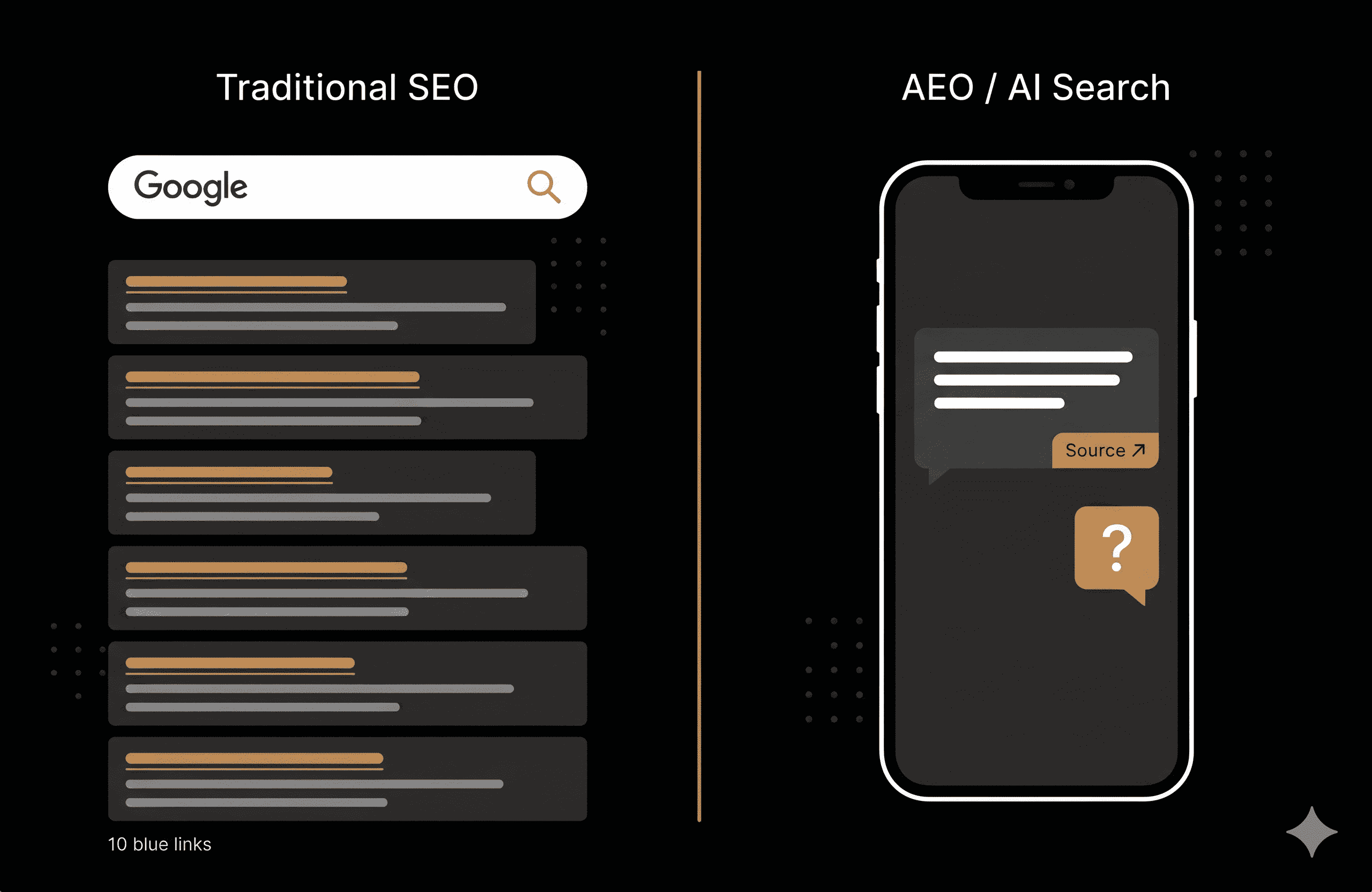
Instead of Googling things, users now ask AI search directly. They type things like "best CRM for small teams under $50 a month" into ChatGPT or Perplexity and get a ready-made answer, citations included. This shift means your brand has to show up inside the answer. Not just on page one.
Why isn't traditional SEO enough anymore?
Traditional SEO still matters for visibility. But it's no longer enough on its own. Search Engine Land found commercial queries jumped from 8% to 18%, and transactional queries from 2% to 14%, in early 2025 [Source: Search Engine Land]. You can rank #1 on Google and still get skipped by AI search if your page isn't structured for machine understanding. That's why smart marketers are layering AEO on top of their SEO work.
Where does AEO fit in the marketing funnel?
AEO works at the top and middle of your funnel. At awareness, it gets you cited in early research queries. At consideration, it shapes the comparison answers that steer buyers your way. Even at the bottom, it can surface your pricing page or case study when AI tools recommend a solution.
Why is AEO becoming the new foundation of organic growth?

Organic growth isn't just about traffic anymore. It's about reputation and brand equity. When answer engines cite your brand again and again, that authority compounds. More citations mean more visibility, and more visibility drives direct visits, sign-ups, and sales.
How does AEO actually work?
Wondering how AEO works? You have to look behind the curtain of the LLM. Unlike a standard search engine that matches keywords to an index, an AI engine looks for context and relationships between data points.
How do AI engines retrieve and generate answers?
AI search ranking works nothing like old-school crawling. Most modern AI tools use a process called RAG, or Retrieval-Augmented Generation. When someone asks a question, the engine finds high-authority, relevant snippets across the web. It retrieves them, then generates a natural-sounding response.
What role do structure and context play?
Clear headings, bullet points, tables, and short paragraphs help AI parse your page fast. Context matters too. Answer engines favor content that defines terms, answers questions directly, and backs itself with data. That's why structuring your page correctly matters more than ever, since AI models reward rich, interconnected information over isolated blog posts.
What makes content citable?
Content earns citations when it's authoritative, current, and easy to extract. Short answer-first paragraphs, real data, credible author bios, and recent update dates all help.
What's the difference between indexing and understanding?
Traditional SEO is about indexing. Search engines crawl and store your page. AEO is about understanding. Indexing just catalogs words. Understanding means the AI grasps concepts, entities, and how they connect. If you're weighing how different this really is from SEO, this breakdown covers it directly.
Example: how a SaaS brand gets cited in ChatGPT
Take the query "best project management tool for remote creatives." AI rewards specificity and structure. If your SaaS blog has a dedicated section built exactly around this topic, the AI pulls your brand name and links to your site as a source.
AEO vs SEO: What’s the real difference (and why you need them)?
Let’s settle the AEO vs. SEO debate. They are two sides of the same coin. To lead the pack, your strategy must leverage both.
SEO (ranking pages) vs AEO (being the answer)
Traditional SEO gets your page to rank in Google’s blue links and drive clicks. AEO makes your content the actual answer displayed in AI search summaries. So, when it comes to traditional SEO vs. AEO, the former drives traffic; the latter drives influence.
Keywords vs intent + entities
SEO chases exact-match keywords. AEO focuses on user intent and semantic entities, such as who, what, where, why, and how. So your content must cover the full picture.
Traffic vs visibility + influence
Traditional SEO measures success in clicks and sessions. AEO measures visibility inside AI answers and the influence those answers create. A single strong citation delivers more value than a dozen low-intent top spots.
Long-form blogs vs structured answers
Long-form blogs still work for SEO. But for AEO, you need scannable, modular content that includes short sections, FAQs, and lists. So, AI can easily parse and quote.
Why businesses need both (not either/or)?
Traditional SEO vs. AI search isn’t a choice. Strong SEO gets you discovered and builds domain authority. AEO turns that authority into AI citations. Combine them, and you dominate both the old search world and the new AI search landscape.
How do you optimize content for AEO?
Start every page with the answer. Structure it for machines. Build authority around it.
Write definition-first, direct answers
Put your most important point in the first 100 words. Define terms upfront so AI immediately reads you as the go-to source.
Structure content for AI parsing
Use H2s, H3s, numbered lists, and tables often. This makes your content machine-readable, which is the whole point of building an AEO strategy in the first place.
Build topical authority through clusters
One pillar page plus 8 to 10 supporting pieces builds the kind of depth answer engines reward with repeat citations.
Use entities and semantic relationships
Name real entities, like Google, HubSpot, or IRS guidelines, and show how they connect. This strengthens how AI understands your expertise.
Optimize for featured snippets and AI summaries
Featured snippets were AEO before AEO had a name. Write concise, factual paragraphs that match common questions, and FAQs pull double duty here by capturing both snippet real estate and AI citations.
What are the key AEO ranking factors?
Quality beats quantity every time. Clarity, depth, and trust decide who gets cited.
- Content clarity and directness: short sentences, active voice, zero jargon
- Topical authority and depth: own the entire topic, not just a slice of it
- Source credibility (E-E-A-T): real author bios, cited sources, regular updates
- Internal linking: shows AI how your knowledge connects across your site
- Consistency across platforms: your website, social posts, and videos should all reinforce the same facts
How is AEO used in real business scenarios?
A 2025 survey found 68% of marketers report improved ROI after integrating AI into their marketing strategy (Source: SeoProfy). Here's what that looks like across industries.
SaaS: long buying cycles and AI research
SaaS buyers research for weeks inside AI search. Comparison tables and use-case deep dives get your tool cited early, shortening the sales cycle.
E-commerce: product discovery through AI
Shoppers ask Perplexity, "best noise-cancelling headphones under $150 with 30-hour battery." Structured product data and review schema put your listings front and center.
Local businesses: intent-based queries
A search like "best Italian restaurant near me open late and kid-friendly" gets answered straight from your Google Business Profile and website content.
B2B: comparison and evaluation queries
B2B buyers use AI tools for comparisons like "HubSpot vs. Salesforce for mid-market teams." Publish honest, structured comparison content, and you have a real shot at being cited.
Example flow: from AI answer → website visit → conversion

AI cites your guide → user clicks through → lands on a page with a tailored lead magnet → signs up for a demo → becomes a customer. That’s the AEO flywheel in action.
What are common AEO mistakes businesses make?
Most AEO failures come down to writing for keywords instead of people.
- Writing only for keywords, not real answers
- Ignoring structure and readability, leaving walls of text
- Skipping topical authority by covering too many unrelated subjects
- Overusing AI-generated fluff with no original insight
- Leaving pages orphaned with no internal links
If you're evaluating outside help to fix these gaps, here's what to look for in an SEO and AEO partner and what red flags to avoid.
How do you get started with AEO for your business?
Follow a simple framework: identify real questions, structure your answers, and track citations over time.
- Identify the top 10 questions your customers ask
- Create a definition block at the start of each page
- Add schema markup for FAQs, products, and articles
- Audit your content for clarity and E-E-A-T
How do you audit content for AI readiness?
Look at your top pages. Can AI summarize them in two sentences? If not, rewrite the intro first.
How do you build your first topic cluster?
Pick one core topic. Build a pillar page with 5 to 10 supporting pages, all linked together. That tells AI you're an expert on that subject.
How do you measure AEO success beyond traffic?
Traffic alone won't tell the full story. Track your AEO performance using brand mentions in AI answers, citation frequency in tools like Perplexity, and branded search volume over time.
Commonly Asked Questions About AEO in Marketing
What are the biggest AEO mistakes that prevent brands from appearing in AI search?
The biggest mistakes include creating thin content, ignoring search intent, publishing outdated information, and failing to build topical authority. AI search favors content that is accurate, well-structured, and genuinely helpful.
Do I need new content for AEO, or can I optimize my existing pages?
You can often start by optimizing existing pages. Update outdated content, improve structure, answer user questions more clearly, and fill content gaps before creating new articles.
What industries benefit the most from AEO in 2026?
Industries with research-driven buyers benefit the most, including SaaS, healthcare, finance, legal, education, eCommerce, and local businesses. Any business that relies on online visibility can gain from AEO.
Can AI search drive leads even if my website doesn't rank #1 on Google?
Yes. AI search can cite authoritative content from websites that aren't the top Google result. High-quality, trustworthy content still has a strong chance of being recommended.
What should I look for in an AEO agency?
Choose an agency that combines SEO with AI search optimization, creates authoritative content, tracks AI visibility, and has a proven strategy for improving citations, mentions, and AI-driven traffic.
Frequently Asked Questions
AEO stands for answer engine optimization. It’s the practice of optimizing content, so answer engines can easily understand and cite it in AI search results.
Not at all. You still need traditional SEO for visibility, but AEO ensures you’re part of the actual answer in AI search.
Voice search optimization focuses on short, conversational queries for devices like Alexa or Siri. Meanwhile, AEO optimizes for full answers, structured data, and citations, not just quick spoken responses.
Absolutely. Small businesses often see faster wins with AEO because they can create hyper-specific, authoritative content that big brands overlook.
Most businesses notice increased AI citations within 8 to 12 weeks. But real revenue impact usually shows up in 4 to 6 months as authority builds.
Ready to Get Found by More Customers?
We help you generate qualified inbound leads through search - without paying for ads. Our content strategy is built to create a consistent pipeline, shorten sales cycles, and turn organic traffic into revenue.