
How to Track AEO Performance (AI Visibility, Citations & Rankings Guide)
By
Rushabh Menon
Founder - Sagashi Digital

Summarize this article using AI
Struggling to track AEO performance? You're not alone - and the data proves it.
McKinsey's 2025 analysis found that just 16% of brands systematically track AI search performance. The other 84% are still optimizing for a search landscape that no longer exists - pouring budget into content while having zero visibility into whether ChatGPT, Gemini, or Perplexity ever cite them.
The cost of that blind spot is real: missed opportunities, invisible brand influence, and competitors quietly capturing share of voice in AI-generated answers while you're still checking rankings that answer engines don't even use.
This guide fixes that. Sagashi Digital breaks down exactly how to track AEO performance - the metrics that matter, the tools to use, and how to turn those insights into measurable AI visibility and brand authority.
What does tracking AEO actually mean?
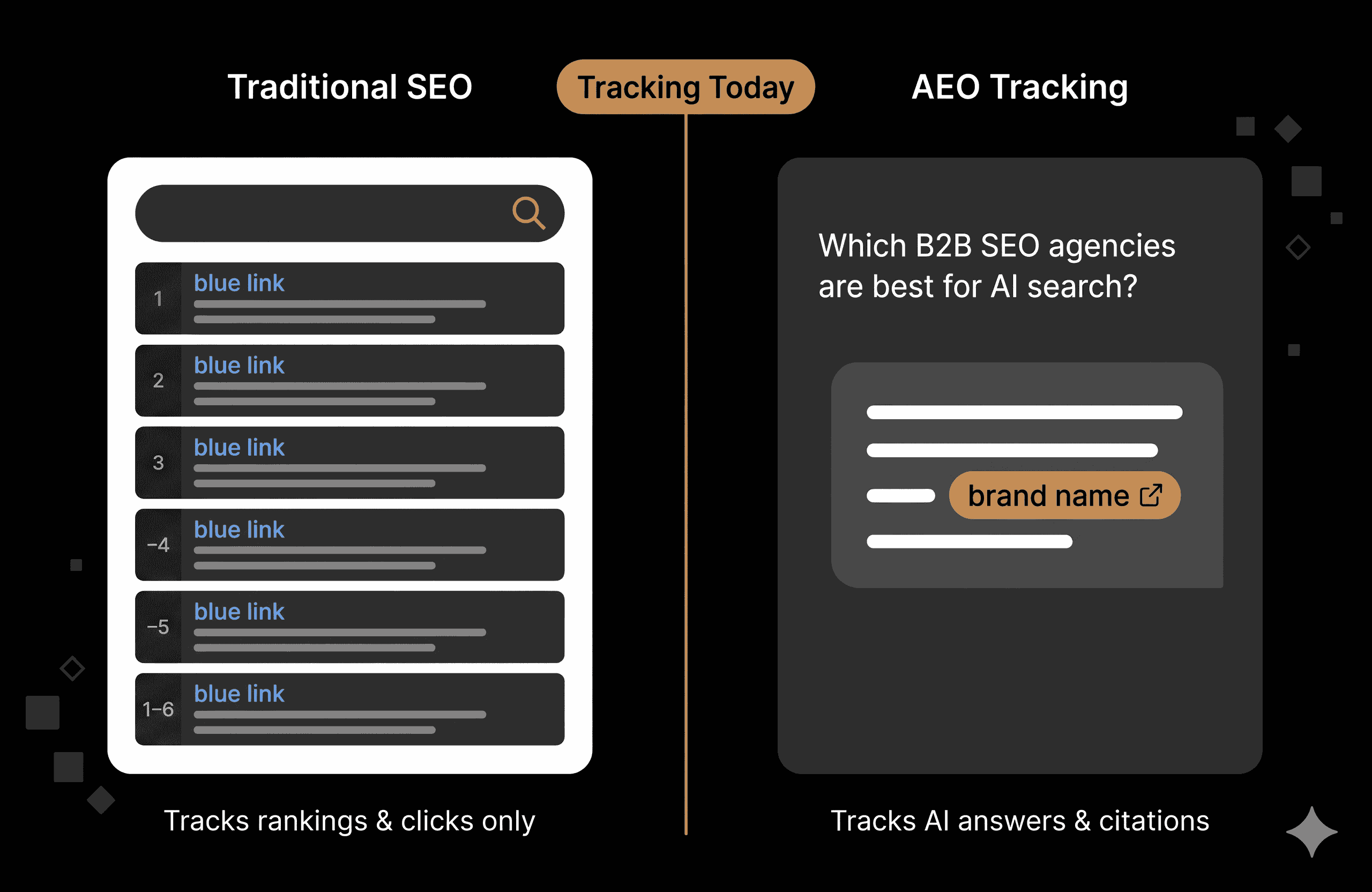
In the old days, tracking meant checking if you ranked first for a keyword. But AEO tracking is a bit more nuanced. It’s the process of measuring how often, how prominently, and how accurately your brand is mentioned by AI-powered search engines.
Only 12% of URLs cited by AI overlap with Google's top 10 results, according to Ahrefs' analysis of 15,000 prompts - and ChatGPT's overlap drops to just 8%.
Unlike traditional SEO, where you track blue links, AI visibility tracking focuses on the share of model responses. That is, whether models like ChatGPT or Gemini are using your content when they answer questions in your niche.
So, effective answer engine tracking involves looking at the conversational ecosystem.
What should you track in AEO (and what actually matters)?
Most AEO dashboards throw a dozen metrics at you. Half of them are noise. Here's what's actually worth building a process around:
AI citations
This is the core metric. When ChatGPT, Gemini, or Perplexity answer a query in your niche, is your brand named as part of that answer? Not every citation carries equal weight, either - a passing mention buried in a list is worth far less than being cited as the source behind a specific claim or data point. Track the AI SEO citation rate, but also log how you're cited, not just how often.
AI visibility across platforms
You can show up in ChatGPT and be completely absent from Perplexity the same week - the models pull from different sources and update on different cycles. Visibility tracking means checking your presence platform by platform, not assuming one good result means you've "made it" everywhere.
Query coverage
Ranking for one flagship question in your niche isn't enough. Users phrase the same intent a dozen different ways - "best CRM for small teams," "CRM software comparison 2026," "which CRM is easiest to set up." Query coverage tells you how many of those variations actually surface your brand, and where the gaps are.
Position within the answer
A citation in the first sentence of an AI response gets read. A citation buried in paragraph six, after the model has already made its recommendation, mostly doesn't. Track where you land, not just whether you land.
Traffic vs. influence
Here's the uncomfortable part: 58.5% of all Google searches now end in zero clicks. AI answers are accelerating that trend - users get their answer and never visit a site at all. Which means click-through rate, the metric most teams still lead with, is measuring a shrinking slice of the picture. Pair it with branded search volume to see whether AEO visibility is actually building recognition, even when it isn't driving traffic.
What are the best tools to track AEO performance?
The market for AEO tracking tools is growing fast. Here are the leading options worth using:
Semrush AI
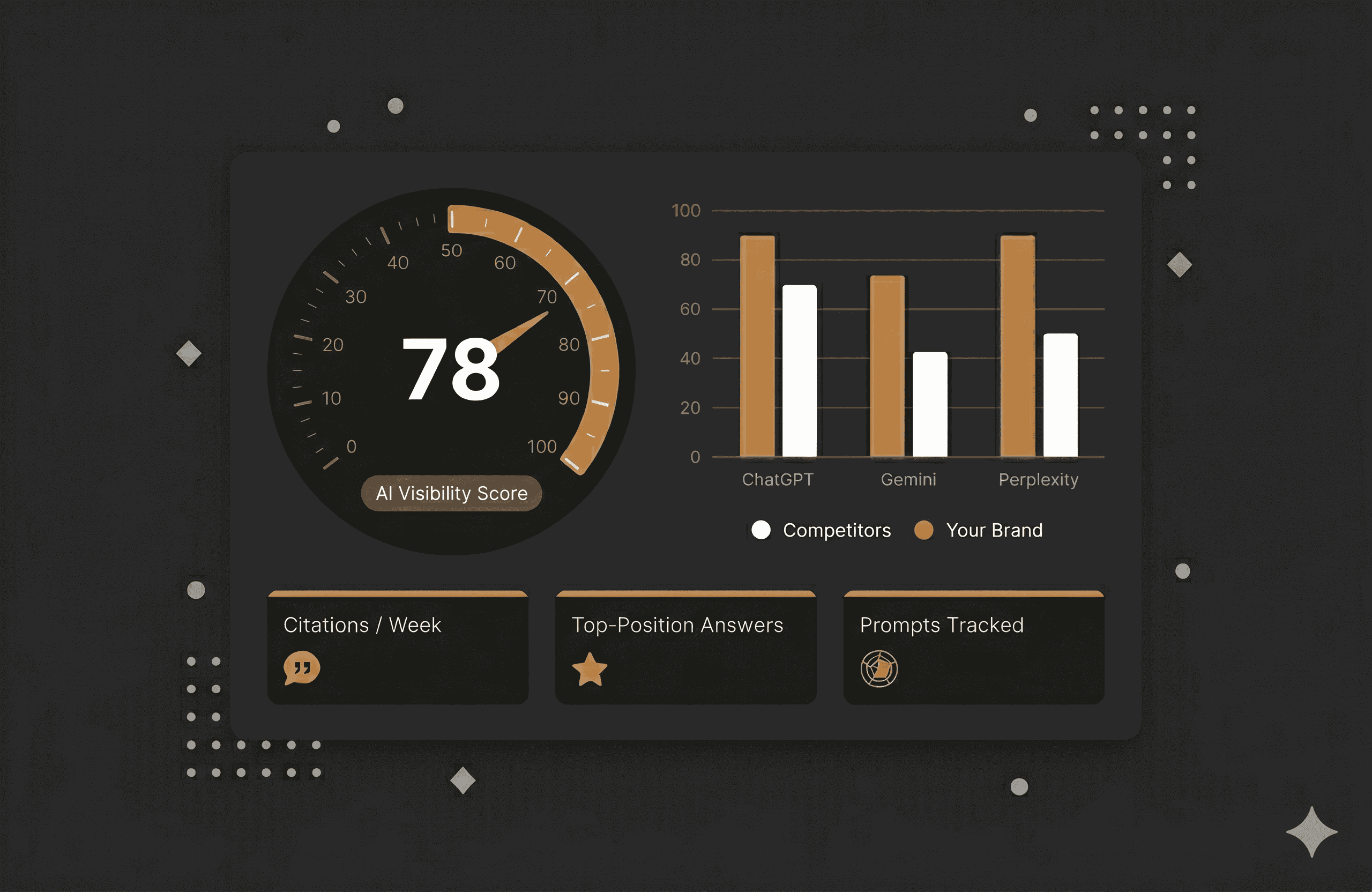
This tool gives you an AI Visibility Score (0–100), tracks mentions across ChatGPT, Google AI Overviews, Perplexity, and more. It also shows monthly audience reach estimates. Semrush AI is ideal if you prefer one dashboard for both traditional SEO and AEO.
Ahrefs
Ahrefs provides robust data on search generative experience (SGE) visibility. It helps identify which snippets of your content are being pulled into AI answers, allowing you to tweak your headers and lists for better extraction.
AI Rank Lab
This one stands out for all-in-one tracking. It monitors your brand across ChatGPT, Claude, Gemini, Perplexity, and Google SEO in the same dashboard. Go for it if you want citation data plus built-in content optimization recommendations.
Profound
Profound is purpose-built for AI search visibility. It tracks how your site gets interpreted by multiple AI engines and provides deep citation analysis. It also includes agent analytics, so you can see how AI crawlers interact with your content.
AthenaHQ
AthenaHQ (Y Combinator-backed) excels at large-scale analytics, prompt clustering, and turning data into strategic playbooks. It’s built for mid-market and enterprise teams that want GEO briefs alongside visibility tracking.
While each of these AI SEO tracking tools is great, the right choice depends on your budget and team size.
How do AEO tracking tools actually work?
Ever wonder what’s happening behind the curtain? AI tracking systems use smart automation, so you don’t have to manually query every AI engine 50 times a day. Here’s the simple breakdown of how AEO tools work:
Prompt monitoring systems
Tools constantly feed thousands of real-world prompts (your target queries plus variations) into live AI models. They run these in the background, often daily, to simulate how actual users search.
Citation extraction & analysis
Once an answer is generated, the system scans for mentions, links, and context. It pulls out who got cited, how prominently, and even the sentiment (positive shout-out or neutral nod)
AI model scraping & simulation
Many tools simulate queries across live LLMs or use safe, ethical data partnerships to capture fresh responses. This keeps everything current as models update daily.
Visibility scoring systems
They crunch all that data into clean scores, such as AI Visibility Score, share of voice, and citation frequency. So, you can see trends at a glance instead of reading every AI answer yourself.
How often should you track AEO performance?
AI models don't update as predictably as the Google index used to. Your cadence needs to be strategic.
Daily tracking (high-priority queries)
For your top 10–20 money-making prompts, such as branded terms, check daily or set up alerts. This catches sudden drops fast.
Weekly tracking (trend analysis)
Check weekly to see if your overall visibility is trending up or down. This is the best time to see if a recent content refresh helped you land more citations.
Monthly tracking (strategy decisions)
Once a month, look at the big picture. Are you losing ground to a specific competitor? Is a new AI model (like a new version of Gemini) treating your site differently? Use this to pivot your content strategy.
How Do I Track AEO Manually Without Tools? (Step-by-Step)
No budget for tools yet? You don't need one to start. A manual process takes about 30 minutes a week and gets you real data faster than most teams expect. Here's exactly how to track ChatGPT rankings and other engines by hand.
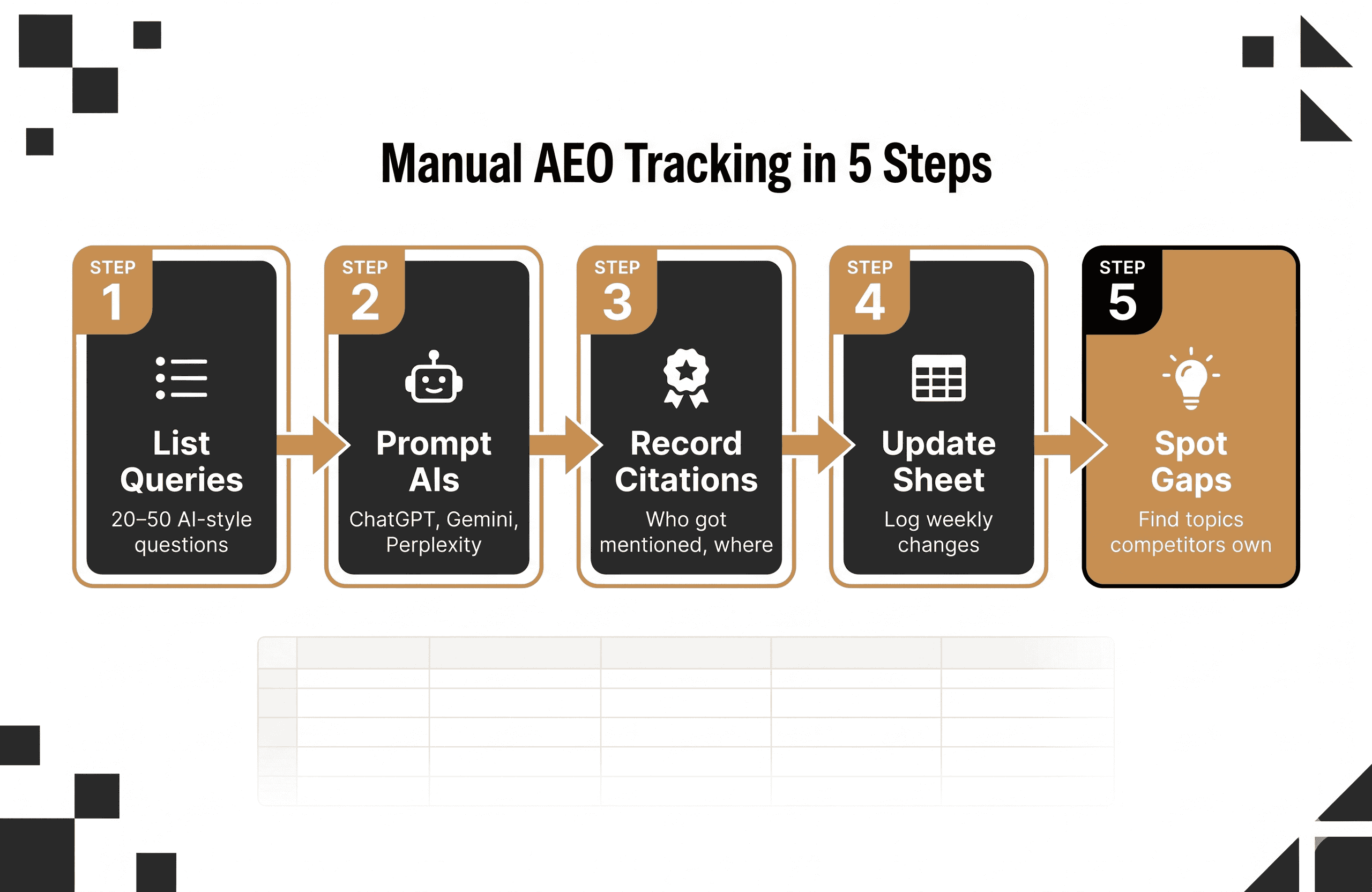
Step 1: Build a List of 20-50 Target Queries
Don't guess at what people ask AI - pull it from what you already know. Check Google Search Console for the actual phrases driving impressions, revisit old customer interview notes for the exact language people use, and add in the questions your sales team hears on repeat.
Step 2: Run Each Query Across ChatGPT, Gemini, and Perplexity
Open a fresh, logged-out chat for every query - not a continued thread. Personalization and chat history skew results, so a new session each time is the only way to get a clean read on what a stranger to your brand would see. Repeat weekly, same queries, same order.
Step 3: Log Who Gets Cited
For each answer, write down every brand, URL, or piece of content that gets a mention - not just yours, competitors too. Screenshot the full response so you have context later, not just the citation. Note where the mention lands (opening line, middle of the answer, buried at the end) and whether the framing is positive, neutral, or negative.
Step 4: Track It in One Sheet, Updated Weekly
Keep it simple: query, date, platform, brands cited, position, notes. Five columns is enough. Color-code rows green for wins and red for gaps so patterns jump out without re-reading every entry.
Step 5: Look for the Pattern, Not the Single Data Point
One week of data tells you almost nothing. Three or four weeks in, you'll start seeing which topics your content consistently owns and which ones a competitor shows up for every single time. That gap is your next content brief - it tells you exactly what to write or rewrite next.
How to improve your AEO performance after tracking?
Insights without action are a missed opportunity. Once you have the data, you need to optimize for AI search. That, in turn, can help improve AEO ranking. Here’s how to do that:
Optimize for answer-first content
Rewrite your top pages so the AI-friendly answer appears in the first 100–200 words. Use clear, conversational language that mirrors how people speak to AI.
Add structured FAQs & entities
Sprinkle in schema-marked FAQs and mention key entities (people, places, products) naturally. AI prefers well-organized data, as it can parse the content easily.
Improve authority & citations
Earn more backlinks, get mentioned in high-authority roundups, and make sure your brand is cited elsewhere on the web.
Refresh content based on AI results
Every month, update top pages with fresh data, stats, and examples pulled from what AI is currently favoring. Outdated content gets buried fast.
Want to skip the trial-and-error and get expert help implementing all of this? Sagashi Digital is worth a look.
We specialize in AI-first SEO and AEO strategies that help B2B and SaaS brands get cited more often across ChatGPT and other platforms. We don't just track insights but transform them into measurable market share.
Commonly Asked Questions About Tracking AEO Performance
How often should I check my AEO metrics?
At Sagashi Digital, we recommend weekly at minimum if you're tracking manually - AI answers shift faster than traditional search rankings because models pull from fresher sources and update citations more frequently. If you're using a dedicated AEO tool, we push clients toward daily or real-time tracking for their highest-priority queries, since a competitor can displace you overnight without warning.
Can I track AEO performance for free?
Yes, at least to start. We've run the manual method ourselves - queries, spreadsheet, weekly logging - and it costs nothing but time. What you lose without paid tools is scale. You can realistically track 20-50 queries by hand, but this is exactly where a lot of the brands we work with hit a wall, since dedicated AEO platforms monitor hundreds of queries across multiple engines automatically and flag changes a manual process would miss.
Why does my brand rank #1 on Google but never get cited by ChatGPT?
This is one of the most common questions we get. Traditional rankings and AI citations run on different logic entirely. Google ranking rewards backlinks, on-page SEO, and domain authority. AI models weigh content structure, clarity, and how directly your page answers a specific question. In our experience, a page can dominate search results and still get skipped by an AI model if it isn't easy to extract a clean answer from - which is usually the first thing we fix when a client brings us this exact problem.
Does AEO tracking replace traditional SEO tracking?
No, and we tell every client this upfront - the two measure different things and both still matter. Rankings and organic traffic tell you how you perform in classic search. AEO metrics tell you how you perform in AI-generated answers, which increasingly satisfy users without a click at all. Most brands we work with end up running both dashboards side by side, not replacing one with the other.
What's a good AI citation rate to aim for?
There's no universal benchmark yet since AEO is still new, and we're upfront with clients about that. What we use internally is a target of showing up in at least 30-40% of your tracked queries within a platform after 2-3 months of consistent content work. The number matters less than the trend - what we actually watch for is steady week-over-week growth in citations, not a single high-water mark.
Frequently Asked Questions
The easiest way is to ask. Just paste your target question into a fresh ChatGPT chat and scan the response for your brand or domain. Do it consistently to spot trends.
Yes, but it's not a "1 to 10" list. You track visibility share, meaning how often you are the cited source compared to your competitors for a specific set of prompts.
It depends on your needs. For most, Semrush is the best starting point because it integrates with existing SEO workflows. However, for dedicated AI insights, AI Rank Lab is considered the best.
Unlike SEO, which can take months, AEO changes can happen in days if the AI model uses real-time web browsing.
Yes. SEO tracks blue links and clicks. Meanwhile, AEO measures brand mentions, citations, and influence inside AI answers. Both matter, but they tell different stories about your visibility.
Ready to Get Found by More Customers?
We help you generate qualified inbound leads through search - without paying for ads. Our content strategy is built to create a consistent pipeline, shorten sales cycles, and turn organic traffic into revenue.