
How Can SEO Agencies Optimize for AI Search? A Practical Guide for 2026
By
Rushabh Menon
Founder | Sagashi Digital
.webp)
Summarize this article using AI
SEO agencies can optimize for AI search by creating content that is not only optimized for search engines but also easy for AI systems to understand, trust, and cite.
For years, SEO success was measured by rankings and clicks. If your content appeared on the first page of Google, you had a good chance of attracting traffic.
Today, that journey is changing.
Users are increasingly turning to Google AI Overviews, ChatGPT Search, Perplexity, Gemini, and other AI-powered search tools to get instant answers. Instead of clicking through multiple websites, they can ask a question and receive a summarized response in seconds.
This shift doesn't mean SEO is dead. It means SEO is evolving.
Traditional SEO tactics like keyword optimization and link building still matter, but they're no longer enough on their own. The good news? Many of the fundamentals remain the same. High-quality content, strong expertise, technical SEO, and brand authority still drive visibility. The difference is that agencies must now optimize for both search engines and answer engines.
In this guide, we'll break down how AI search works, how user behavior is changing, and the practical steps SEO agencies can take to stay visible across Google, AI Overviews, ChatGPT, Perplexity, Gemini, and beyond.
What Is AI Search and Why Does It Matter for SEO Agencies?
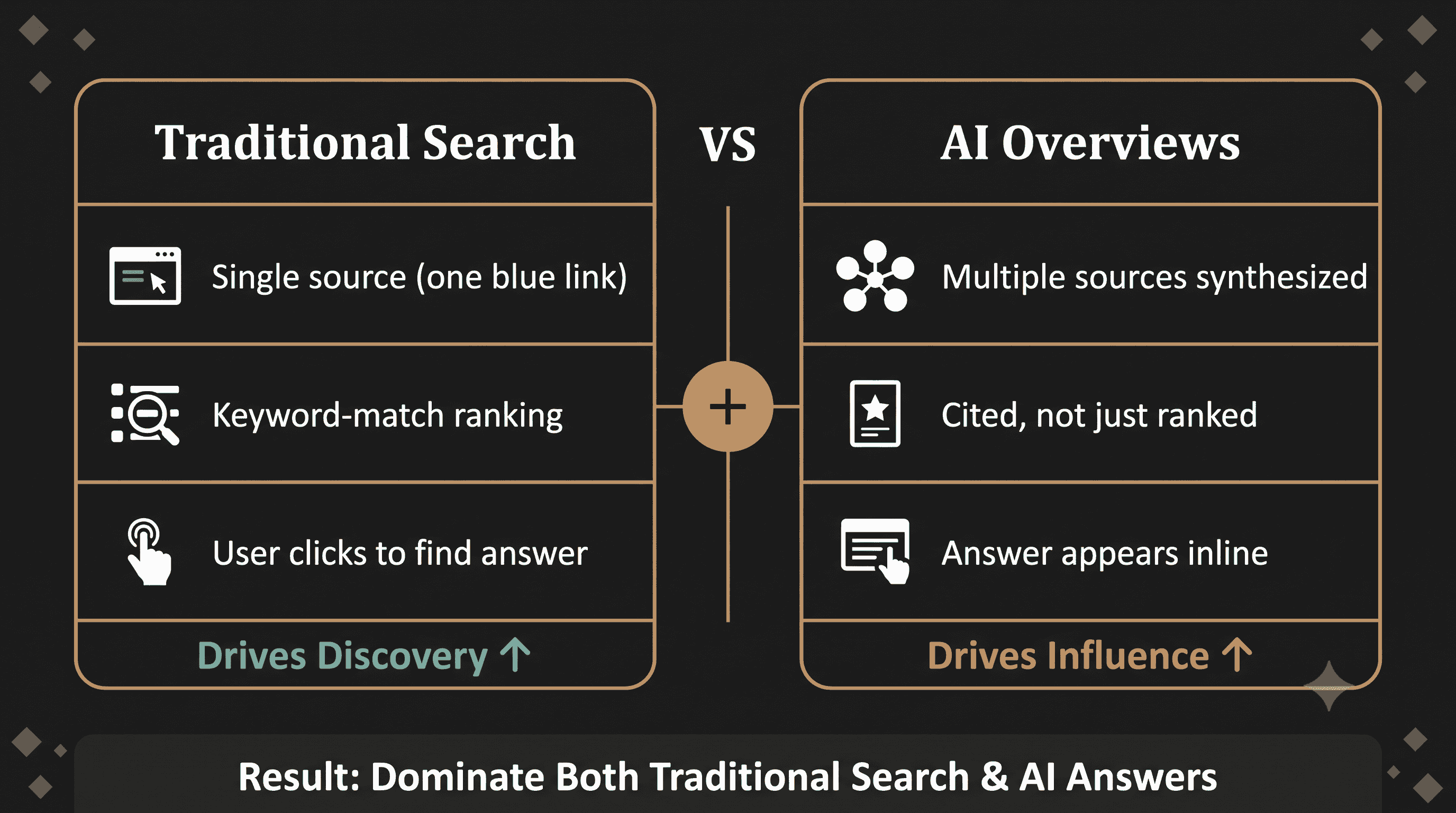
AI search is transforming how people find information online. Instead of displaying a list of webpages and asking users to choose the best result, AI-powered search engines generate direct answers by pulling information from multiple sources across the web.
Approximately, 86% of SEO professionals have integrated AI tools into their search strategy by 2026. [Source - SeoProfy]
Platforms like Google AI Overviews, ChatGPT Search, Perplexity, and Gemini are making search more conversational and answer-focused. For SEO agencies, this shift changes the goal. It's no longer just about ranking on page one. It's about ensuring your content is trusted, understood, and cited by AI systems.
How AI Search Generates Answers
AI search engines don't simply rank web pages. They analyze content from multiple sources, identify the most relevant information, and generate a summarized response.
To do this effectively, they look for content that is:
- Clear and easy to understand
- Well-structured
- Authoritative and trustworthy
- Comprehensive enough to answer the query
- Supported by credible sources
This means content optimized only for keywords may struggle to gain visibility if it doesn't provide genuine value or answer user questions effectively.
The Growing Impact on Organic Visibility
As AI search adoption grows, websites may see changes in how organic traffic is distributed. Users can often get quick answers directly within AI interfaces without clicking through to a webpage.
That doesn't mean visibility is becoming less important. In fact, it may become even more important.
Brands that are consistently cited in AI-generated responses can build trust, authority, and awareness long before a user visits their website. The agencies that adapt early will be better positioned to help clients succeed in both traditional search results and the emerging AI search ecosystem.
How Are Users Searching Differently in the AI Era?
The biggest change in search isn't the technology itself. It's user behavior.
For years, people searched using short keyword phrases, opened several tabs, compared information, and then made a decision. Today, instead of hunting for answers, users increasingly expect answers to come to them.
This shift is changing how people research products, evaluate services, and discover information online.
Conversational Searches Are Replacing Keywords
Users are moving away from simple keyword searches and asking questions the way they would speak to another person.
Instead of searching:
- "best CRM software"
Users now ask:
- "What's the best CRM software for a 20-person SaaS company with a limited budget?"
These longer, more conversational queries give AI systems more context and allow them to generate more personalized answers.
Users Ask Follow-Up Questions
Traditional search often required users to start a new search every time they needed more information.
AI search is different.
Users can ask follow-up questions within the same conversation, creating a more natural research experience.
For example:
- What is the best CRM software?
- Which option is best for startups?
- How much does it cost?
- What are the alternatives?
This means content needs to answer not just one question but the related questions users are likely to ask next.
Research Workflows Are Becoming Faster
AI tools can compress what used to be a 30-minute research process into a few minutes.
A user comparing SEO agencies, software tools, or service providers can now receive summaries, comparisons, pros and cons, and recommendations almost instantly.
As a result, users often arrive at websites later in the decision-making process than they did before.
Reduced Clicks, Higher Intent
One of the biggest changes is that users may click less frequently, but when they do click, they often have stronger intent.
Someone who reaches your website after interacting with AI search has likely already researched the topic, compared options, and narrowed down their choices.
That means traffic may become more qualified even if overall click volume decreases.
How Can SEO Agencies Optimize Content for AI Search?
AI search engines are designed to find, understand, and synthesize information quickly. Unlike traditional search engines that primarily rank web pages, AI platforms such as Google AI Overviews, ChatGPT Search, Perplexity, and Gemini extract information from multiple sources to generate answers.
AI search traffic increased by 527% in just one year between 2024 and 2025. [Source - Semrush]
That means content must be easy to understand, easy to extract, and trustworthy enough to cite.
Answer Questions Directly
AI systems favor content that provides clear, immediate answers to user questions.
Instead of making readers scroll through several paragraphs before finding an answer, provide a concise response near the beginning of a section. This improves the chances of your content being used in featured snippets, AI Overviews, and answer engines.
For example, if the question is "What is AI search?", answer it immediately before expanding on the topic.
Use Conversational Language
People interact with AI differently than they interact with traditional search engines. Queries are becoming longer, more natural, and more conversational.
Your content should reflect this shift.
Instead of optimizing solely for keywords like "AI search optimization," include natural phrases such as:
- How do you optimize content for AI search?
- Can AI search affect SEO rankings?
- What does Google AI Overview look for?
This helps content align with the way users actually ask questions.
Structure Content for Retrieval
AI systems prefer content that is easy to scan and understand.
Use formatting that clearly separates ideas and provides direct answers.
Some effective content formats include:
The easier your content is to parse, the easier it is for AI systems to surface it in responses.
Cover Topics Comprehensively
AI search engines often favor content that demonstrates topical depth rather than content that focuses on a single keyword.
Instead of answering just one question, address related questions users may ask next.
For example, a page about AI search optimization could also cover:
- How AI search works
- How AI Overviews affect SEO
- The difference between SEO and AEO
- How to track AI visibility
Comprehensive coverage helps establish topical authority and increases the likelihood of being cited across multiple queries.
Create Entity-Rich Content
AI systems rely heavily on entities - recognizable people, brands, products, concepts, and organizations - to understand context.
Rather than using vague references, be specific.
For example, mention platforms such as ChatGPT Search, Perplexity, Gemini, and Google AI Overviews when discussing AI search. Reference established concepts like EEAT, schema markup, and Answer Engine Optimization where relevant.
What Technical SEO Factors Support AI Search Visibility?
Great content alone isn't enough to earn visibility in AI search. AI systems can only surface content they can crawl, understand, and trust. Strong technical SEO removes barriers between your content and AI platforms, making it easier for them to discover, interpret, and reference your pages.
The four foundations are crawlability, indexability, structured data, and site architecture.

Schema Markup
Schema markup helps search engines and AI systems understand what your content is about. Think of it as adding labels to your content so machines can interpret it more accurately.
SEO agencies should prioritize schema types such as:
- FAQ Schema
- How-To Schema
- Article Schema
- Organization Schema
- Product Schema
- Review Schema
For example, FAQ schema can help AI systems quickly identify questions and answers, increasing the likelihood of appearing in AI Overviews and answer-based search results.
Internal Linking
Internal links help AI understand the relationships between pages on your website.
A strong internal linking structure:
- Connects related topics
- Reinforces topical authority
- Improves crawlability
- Helps AI discover important pages
For example, a page about "AI Search Optimization" should naturally link to related content about AEO, schema markup, content optimization, and AI Overviews. This creates a clearer content ecosystem for both users and AI systems.
Content Freshness
AI search engines want accurate and up-to-date information.
Outdated statistics, broken examples, and old screenshots can reduce trust in your content. Regularly updating important pages helps maintain relevance and signals that your content remains useful.
This is especially important for fast-moving topics such as AI search, SEO, and digital marketing, where best practices can change quickly.
Fast User Experience
User experience still matters.
While AI systems evaluate content quality, they also rely on signals that indicate a page is useful and accessible. Slow-loading pages, poor mobile experiences, and technical issues can negatively affect visibility.
Focus on:
- Fast page load times
- Mobile-friendly design
- Core Web Vitals
- Clean navigation
- Secure HTTPS pages
A website that is easy for users to navigate is usually easier for AI systems to understand as well.
How Should SEO Agencies Measure AI Search Success?
Traditional SEO metrics such as rankings, clicks, and organic traffic are still important, but they no longer tell the full story.
As AI search becomes more popular, agencies need to understand how often their content is being surfaced, cited, and referenced across platforms like Google AI Overviews, ChatGPT Search, Perplexity, and Gemini.
Tracking AI Overview Presence
Appearing in Google AI Overviews can significantly increase brand visibility, even when users don't click through to your website.
SEO agencies should regularly monitor:
- Which keywords trigger AI Overviews
- Whether client content is being cited
- How often competitors appear
- Changes in AI Overview visibility over time
A page that ranks third but gets cited in an AI Overview may generate more brand exposure than a page ranking first without a citation.
Monitoring Brand Mentions
AI systems often reference brands they consider authoritative and trustworthy.
This makes brand mentions an increasingly important metric.
Track:
- Brand mentions across the web
- Citations in AI-generated responses
- Mentions in industry publications
- Digital PR coverage
Growing brand visibility often increases the likelihood of being surfaced by AI search engines.
Measuring Assisted Conversions
Not every user who discovers your brand through AI search will convert immediately.
Many users interact with AI tools during the research phase and visit a website later through another channel. This means agencies should look beyond last-click attribution.
Instead, monitor:
- Branded search growth
- Direct traffic trends
- Assisted conversions
- Multi-touch customer journeys
These metrics provide a clearer picture of how AI visibility contributes to business outcomes.
Evaluating Topical Authority
AI search engines tend to favor sources that demonstrate expertise across an entire topic rather than a single keyword.
Instead of measuring success page by page, evaluate whether your brand is becoming a recognized authority within its niche.
What Mistakes Should SEO Agencies Avoid When Optimizing for AI Search?
Many agencies are approaching AI search the same way they approached traditional SEO a decade ago. The problem is that AI search engines evaluate content differently. What worked for rankings alone may not be enough to earn citations and visibility in AI-generated answers.
- Treating AI search as a separate channel
AI search isn't replacing SEO. It's an extension of it. The same fundamentals that help content rank - quality, authority, technical SEO, and relevance - also influence AI visibility. Agencies that treat AI search and SEO as completely separate strategies often create fragmented efforts and inconsistent results.
- Publishing generic AI-generated content
AI can speed up content production, but publishing unedited AI content at scale is rarely effective. Most AI-generated content lacks original insights, real-world experience, and unique perspectives. If your content sounds like everyone else's, AI systems have little reason to cite it.
- Ignoring EEAT
Experience, Expertise, Authoritativeness, and Trustworthiness (EEAT) have become even more important in an AI-driven search environment. Content that lacks expert input, credible sources, and evidence of real-world experience is less likely to earn trust from both users and AI systems.
- Focusing only on rankings
A page doesn't necessarily need to rank #1 to influence AI-generated answers. Agencies that measure success only through rankings may overlook important signals such as citations, brand mentions, AI Overview visibility, and assisted conversions.
- Neglecting brand authority
AI search engines often favor recognizable and trusted sources. Agencies that focus solely on content production while ignoring digital PR, thought leadership, and brand-building efforts may struggle to earn consistent visibility in AI search experiences.
- Over-optimizing for keywords
Keyword optimization still matters, but stuffing content with exact-match keywords is no longer a winning strategy. AI systems are better at understanding context, entities, and user intent. Content should be written for people first, with keywords used naturally rather than forced into every paragraph.
How Can SEO Agencies Combine SEO and AEO for Long-Term Growth?
The future of search isn't SEO versus AEO. It's SEO and AEO working together.
Traditional SEO helps websites rank in search results and drive organic traffic. AEO (Answer Engine Optimization) helps content get discovered, cited, and surfaced in AI-generated answers. As search behavior continues to evolve, agencies need strategies that support both.
Start With a Unified SEO + AEO Framework
SEO and AEO share many of the same fundamentals. Both rely on creating useful content, demonstrating expertise, and building trust.
The difference is that SEO focuses on ranking webpages, while AEO focuses on making content easy for AI systems to understand and reference.
A strong framework should prioritize:
- Search intent-driven content
- Topical authority
- Structured content formats
- Technical SEO best practices
- Brand credibility and trust signals
This ensures content can perform well in both traditional search results and AI-generated answers.
Optimize for Google and AI Search Simultaneously
Many agencies still treat AI search as a separate initiative. In reality, the same content can often support visibility across multiple platforms.
For example, a well-researched article may:
- Rank in Google Search
- Appear in Google AI Overviews
- Be cited by Perplexity
- Surface in ChatGPT Search
- Support answers generated by Gemini
The goal should be to create content that works everywhere users search, not just where they click.
Why the Best Agencies Blend AI Efficiency With Human Expertise?
AI can accelerate research, content workflows, reporting, and optimization. However, strategy, positioning, and decision-making still require human expertise.
That's why leading agencies are increasingly adopting AI-assisted workflows while keeping strategy human-led.
At Sagashi Digital, we see AI as an accelerator, not a replacement. Our approach combines AI-powered efficiency with expert-driven SEO and AEO execution, helping businesses build visibility across Google Search, AI Overviews, ChatGPT Search, Perplexity, Gemini, and emerging AI platforms.
Commonly Asked Questions About How SEO Agencies Optimize for AI Search
What is AI search optimization?
AI search optimization is the process of making content easier for AI-powered platforms such as Google AI Overviews, ChatGPT Search, Perplexity, and Gemini to understand, retrieve, and cite. It focuses on creating clear, authoritative, and well-structured content that can be surfaced in AI-generated answers.
Is AI search replacing SEO?
No. AI search is changing how users discover information, but it is not replacing SEO. Traditional SEO remains essential for rankings, traffic, and visibility. AI search optimization builds on those foundations by helping content appear in answer engines as well as search engines.
How do AI search engines choose sources?
While each platform uses different systems, most AI search engines prioritize content that is relevant, trustworthy, well-structured, and authoritative. Strong EEAT signals, topical authority, brand credibility, and clear answers can improve the likelihood of being referenced.
What is the difference between SEO and AEO?
SEO (Search Engine Optimization) focuses on improving visibility in traditional search results. AEO (Answer Engine Optimization) focuses on increasing the chances of content being cited or referenced in AI-generated answers. The most effective strategies combine both approaches.
Can websites rank in ChatGPT Search?
Yes. ChatGPT Search can surface and reference websites when answering user questions. Websites that provide comprehensive, trustworthy, and well-structured information are more likely to appear in responses and citations.
Frequently Asked Questions
There is no guaranteed way to earn citations, but websites can improve their chances by creating high-quality content, answering questions directly, demonstrating expertise, using clear formatting, and building strong authority within their niche.
Schema markup can help search engines and AI systems better understand your content. While schema alone won't guarantee visibility, it provides additional context that can improve content interpretation and retrieval.
Agencies should look beyond rankings and monitor metrics such as AI citations, Google AI Overview appearances, brand mentions, referral traffic from AI platforms, and assisted conversions. These metrics provide a more complete picture of AI search performance.
AI-generated content can be useful when combined with human expertise and editing. However, generic or low-quality AI content often struggles to earn citations because it lacks originality, authority, and real-world experience.
Modern SEO agencies need a combination of traditional SEO expertise and AEO knowledge. This includes content strategy, technical SEO, EEAT optimization, entity optimization, digital PR, analytics, and an understanding of how AI search platforms retrieve and present information.
Ready to Get Found by More Customers?
We help you generate qualified inbound leads through search - without paying for ads. Our content strategy is built to create a consistent pipeline, shorten sales cycles, and turn organic traffic into revenue.