
How to Create an AEO Strategy That Ranks in ChatGPT, Google AI & Perplexity? [2026]
By
Rushabh Menon
Founder - Sagashi Digital

Summarize this article using AI
Curious about how to create an AEO strategy that can help you rank across ChatGPT, Google AI, Perplexity, and beyond? You aren't the only one trying to figure that out.
People are living in a time where they aren’t interested in scrolling through 10 blue links to find a simple fact. They are turning to AI to get answers right away.
Research backs this claim. In the U.S., zero-click searches jumped to 27.2% in March 2025. That is up from 24.4% in 2024. Meanwhile, the EU and UK saw a similar climb from 23.6% to 26.10%.
That means your audience is finding answers, but they aren't necessarily clicking through to your website.
To stay visible, marketers are pivoting toward an answer engine optimization strategy (also known as an AI SEO strategy). This framework moves beyond traditional keywords, focusing instead on becoming the definitive source that AI models trust and cite.
Here, Sagashi Digital will break down the exact steps to master this AEO strategy, ensuring your brand remains the primary answer in an AI-first world.
What is an AEO strategy, and why does your business need one?
An AEO strategy is the practice of optimizing digital content so that AI-powered answer engines can seamlessly parse, understand, and credit your information.
Put simply, the AEO strategy meaning centers on refining your digital footprint. So, AI models pull your information as the most helpful, accurate, and trustworthy answer.
Wondering why you must shift to an AI search strategy? AI engines now heavily influence buying decisions. A study published in Search Engine Land reveals that nearly 4 in 10 people start searching with AI instead of Google.
If you are not part of that initial AI conversation, you have already lost the sale before it even started.
Traditional SEO strategies fall short because they were built for a world where people did the sorting. They focus on keywords and backlinks while ignoring how AI actually reads and summarizes content. Your #1 Google ranking means nothing if AI doesn’t pull your info.
Thinking about where AEO fits in your marketing funnel? It fits in every stage:
How to create an AEO strategy step-by-step?
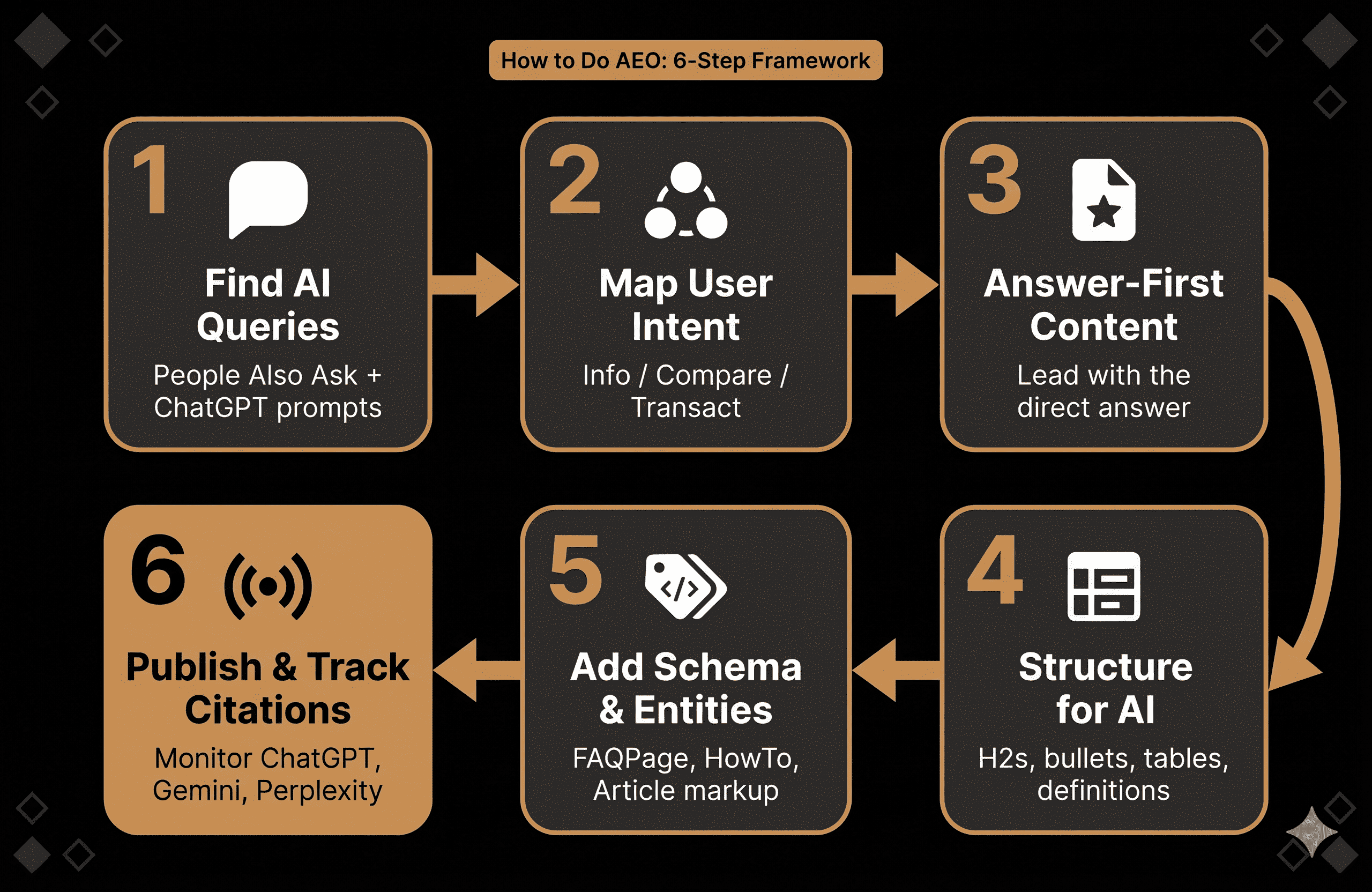
Now that you know why it matters, let’s talk about how to create an AEO strategy that actually works. You cannot just keep doing what you did in 2015. You need a fresh AEO framework that speaks the language of modern machines.
How Do You Build an AEO Framework?
Step 1: Identify Real User Questions and Intent
You need to know how people actually talk. Use tools like Google's People Also Ask, AnswerThePublic, or ChatGPT itself to surface natural-language queries. Focus on [LINK: conversational AI queries] that match real pain points.
Step 2: Build Topic Clusters Around Core Themes
Group related questions into clusters around 4 to 6 core themes - your pillar topics. This helps AI engines see your site as an authoritative source on the subject.
Step 3: Create Answer-First, Structured Content
Write every piece with the answer up front. Use clear headings, bullet points, tables, and numbered lists, and structure every page for AEO so AI can parse and cite your content easily.
Step 4: Optimize for Entities and Semantic Relevance
Mention people, places, products, and concepts (entities) that Google's Knowledge Graph and AI models already understand. This builds semantic depth.
Step 5: Strengthen Internal Linking and Context
Link related pages generously with descriptive anchor text. This builds topical depth and helps AI follow your content threads the way a human researcher would.
Step 6: Improve Credibility Signals (E-E-A-T)
Experience, Expertise, Authoritativeness, and Trustworthiness (E-E-A-T) still rule. Add author bios with real credentials, cite sources, update content dates, and collect customer reviews.
Step 7: Continuously Update and Refine Content
AI engines reward freshness. Set a quarterly refresh calendar, track your AEO performance, and update stats, examples, and answers. Watch what's ranking in ChatGPT and Perplexity, and adjust accordingly.
How Do You Find the Right Questions for AEO?
Solid AEO keyword research is the foundation of any winning AEO strategy. Forget old-school keyword volume — focus on question-based queries.
Using People Also Ask (PAA) data
Google's PAA box is still the best free source. Pair it with the right AEO research tools, type your core topic, mine every question, then test them directly in ChatGPT and Perplexity to see what AI actually answers.
Mining forums and real user queries
Reddit, Quora, Facebook Groups, and even TikTok comments are full of user questions. Tools like RedditSearch or GummySearch pull these at scale.
Extracting questions from sales and support teams
Your sales and support teams know exactly what confuses your customers. Use their insights to create content that solves real-world friction.
Identifying high-intent vs. informational queries
High-intent questions ("best affordable CRM for real estate agents in Florida") convert better than informational ones ("what is a CRM"). Balance both in your AEO strategy.
Grouping questions into clusters
Use clustering tools to organize queries under 5 to 7 core themes. This is how you move from random blogs to a real search system instead of a scattered content calendar.
What Type of Content Works Best for an AEO Strategy?
Not all content performs equally in AI results. The formats below dominate ChatGPT, Google AI, and Perplexity — because they're built to be genuinely AI-friendly content, not just keyword-stuffed pages:
Definition-style content (clear answers)
Start with a clear, one-sentence answer to the question right at the top of the section.
FAQs and Q&A pages
FAQs and Q&A pages are built for the way AI works - each question is a prompt, and each answer is a potential result. This is exactly how FAQs improve AEO rankings: use FAQ schema to tell AI precisely what the question is and what the answer is.
Comparison and "vs." content
Comparison content is powerful for driving sales. A clear table - like an SEO vs AEO breakdown - gives AI the exact data it needs to help users choose you.
How-to guides and step-by-step tutorials
Numbered lists with screenshots and exact, region-specific examples (pricing, tools, platforms) get shared and cited heavily — our own guide on how to do AEO follows this exact format.
Use cases and real-world examples
Specific, quantifiable case studies provide the "Experience" signal - the first E in E-E-A-T. AI systems often cite these examples to support their headline answers, which is why it's worth studying which agencies are actually delivering AEO results before modeling your own.
How Do You Measure the Success of an AEO Strategy?
Measuring AEO success is different from tracking old-school web traffic. Here's what to focus on for AI visibility tracking:
Tracking AI citations and mentions
Manually check ChatGPT, Perplexity, and Google AI weekly for your brand or key phrases. Tools like Originality.ai and Glimpse now offer AI citation tracking.
Monitoring branded search growth
Rising branded searches and direct AI referrals signal you're becoming the go-to answer. Check Google Search Console for branded query spikes.
Engagement vs. traditional traffic metrics
AI-driven visitors often have higher time-on-page and lower bounce rates because they arrive with intent. Track these alongside traditional SEO metrics.
Conversion impact from AI-driven users
Set up UTM parameters or ask "How did you find us?" on forms. Many businesses see 2x to 3x higher conversion rates from AI-sourced traffic.
Tools to track AEO performance
Use Google Analytics 4, Search Console, Semrush's AI Overview tracker, Ahrefs' Content Explorer, and newer tools like Originality.ai or custom ChatGPT dashboards to build a full picture of your AI search visibility.
How to combine SEO and AEO for maximum growth?

Keywords help with SEO, but entities and intent are what get you into the AI's answer. This shift is the core of building true topical authority. When you combine high rankings with AI citations, you become visible everywhere a customer might look.
Ranking Pages vs. Becoming the Answer
Traditional SEO gets you on the results page. AEO gets you cited as the answer. Do both, and you win twice.
Keywords vs. Entities and Intent
Traditional keywords still matter for crawlability, but entities and conversational intent rule AI. Optimizing content for AI search means merging both for content that ranks and gets cited.
Traffic vs. Influence and Visibility
SEO drives volume. AEO drives influence and trust. Together, they form a cycle where being cited by AI models reinforces your brand's credibility and accelerates your SEO performance — which is why it's worth looking at alternatives to traditional SEO metrics that actually capture this.
Building a Hybrid Content Approach
A hybrid approach is the best way forward. Write long, deep articles for the people who want to read every word, but also include clear summaries, bullet points, and tables for the AI bots. This is how your website becomes content that works for both humans and AI.
Need help building this out? The team at Sagashi Digital specializes in exactly this kind of hybrid search strategy. We don't just optimize for a search bar but for the entire journey, from the first prompt to the final purchase.
Commonly Asked Questions About AEO Strategy
What is an AEO strategy?
An AEO strategy is a plan for getting your content cited directly inside AI-generated answers - in tools like ChatGPT, Perplexity, and Google AI Overviews - rather than just ranking on a results page. It centers on creating an AEO strategy built around real user questions, structured answers, and strong topical authority.
How is AEO different from SEO?
SEO is built to earn rankings on a search results page; AEO is built to earn a citation inside an AI-generated answer. The two overlap heavily — both depend on relevance, structure, and authority - but AEO vs SEO comes down to who (or what) is actually reading and rewarding your content: a ranking algorithm or a language model.
Do I need to choose between SEO and AEO?
No. They reinforce each other - AEO citations build brand trust and branded search, which strengthens SEO, and strong SEO fundamentals (structure, authority, technical health) make your content easier for AI to find and cite in the first place. If you're unsure how to balance both, it helps to know what to look for in an SEO & AEO partner before committing to an agency.
How long does it take to see results from an AEO strategy?
Most brands start seeing early AI citations within 4 to 8 weeks of publishing answer-first, well-structured content, though full topical authority — and consistent citations across multiple AI engines - typically builds over 3 to 6 months, similar to organic SEO timelines.
How do I start building an AEO strategy for my website?
Start by mapping the real questions your customers ask, structuring your content to answer them clearly up front, and strengthening internal linking and E-E-A-T signals across your site. From there, most businesses lean on dedicated AEO services to build out the framework, track citations, and refine content on an ongoing basis.
Frequently Asked Questions
The first step is conducting a visibility audit. You must manually query your top 10 to 20 high-intent questions across ChatGPT, Gemini, and Perplexity to establish a baseline of what is currently appearing. Build everything else from there.
The timeline depends on the existing authority. Some brands see their first AI citations in just a few weeks if they update their most important pages. However, for most businesses, it takes about 3 to 6 months to see consistent, high-volume results.
Absolutely! Small businesses often win faster because they can create hyper-specific, authentic content that big brands struggle to match.
One is not better than the other. They are just two different tools in your kit. SEO helps you get traffic from people who are still using traditional search engines. AEO helps you reach people who use AI assistants.
You’ll want AI-specific tracking platforms for citations, plus your usual SEO suite. Free starters like Google’s tools get you going, but dedicated AEO dashboards pay for themselves quickly.
Ready to Get Found by More Customers?
We help you generate qualified inbound leads through search - without paying for ads. Our content strategy is built to create a consistent pipeline, shorten sales cycles, and turn organic traffic into revenue.