
Top AEO Research Tools to Find AI Search Queries & Boost Visibility (2026)
By
Rushabh Menon
Founder - Sagashi Digtal
Summarize this article using AI
When everyone around you is firing questions straight into ChatGPT, Perplexity, Gemini, and Claude, it makes sense to look for AEO research tools.
After all, 56% of search volume is now AI-driven. On top of that, mobile apps drive the lion's share of those 45 billion monthly sessions. That’s what an article published in Search Engine Land says.
After all, the old playbook of finding a keyword and ranking for it doesn't quite cut it when AI is handing users a ready-made answer before they ever scroll. Now, visibility means getting cited. And getting cited means knowing what questions people are asking, which sources AI trusts, and what your content needs to say.
AEO research tools help you discover the exact questions people are asking AI and position your content to get cited as the trusted source.
But finding a tool that provides actionable insights is not that easy. This is why we, at Sagashi Digital, curated this guide. This guide walks you through everything you need to know about AEO tools and which ones deserve a spot in your stack. Dive in, then!
What are AEO research tools, and why do they matter in 2026?
Let's start with the basics: answer engine optimization, or AEO, meaning. AEO is the process of optimizing your content to be the primary source of information for AI-driven answer engines.
Coming to AEO research tools, these are the specialized software suites designed to help you understand how these AI models think. Not just traditional rankings, but answer engine optimization tools also monitor your AI search visibility.
Statistics say about 65% of businesses notice better SEO results when they use AI tools for optimization. [Source - SeoProfy]
Why do they matter? Because AI search visibility is the new "Rank 1." When a user asks an AI a complex question, it doesn't give them ten links but one synthesized answer with a few precious citations.
How is AEO research different from traditional keyword research?
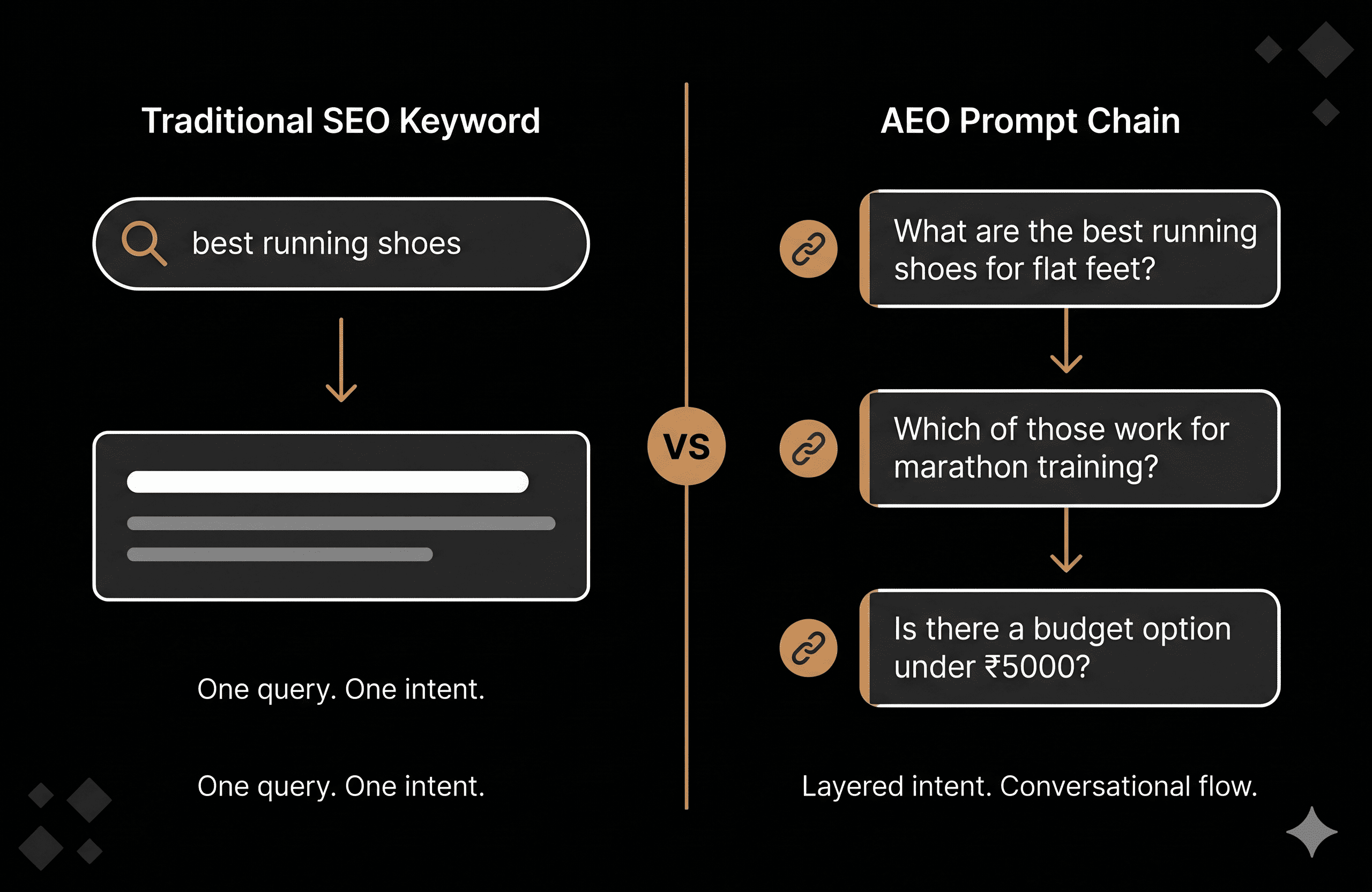
When it comes to AEO vs SEO, the difference isn't just semantic but structural. We’ll break that down here:
SEO keywords vs AI prompts
Traditional SEO tools chase volume-driven terms like “best running shoes.” AEO focuses on complex, multi-layered prompts rather than static phrases. That is, it digs into natural AI search queries and conversational search prompts.
Zero-click search & citation behavior
Google used to send traffic. But Bain & Company reports that 80% of consumers now favor zero-click results for at least 40% of their queries.
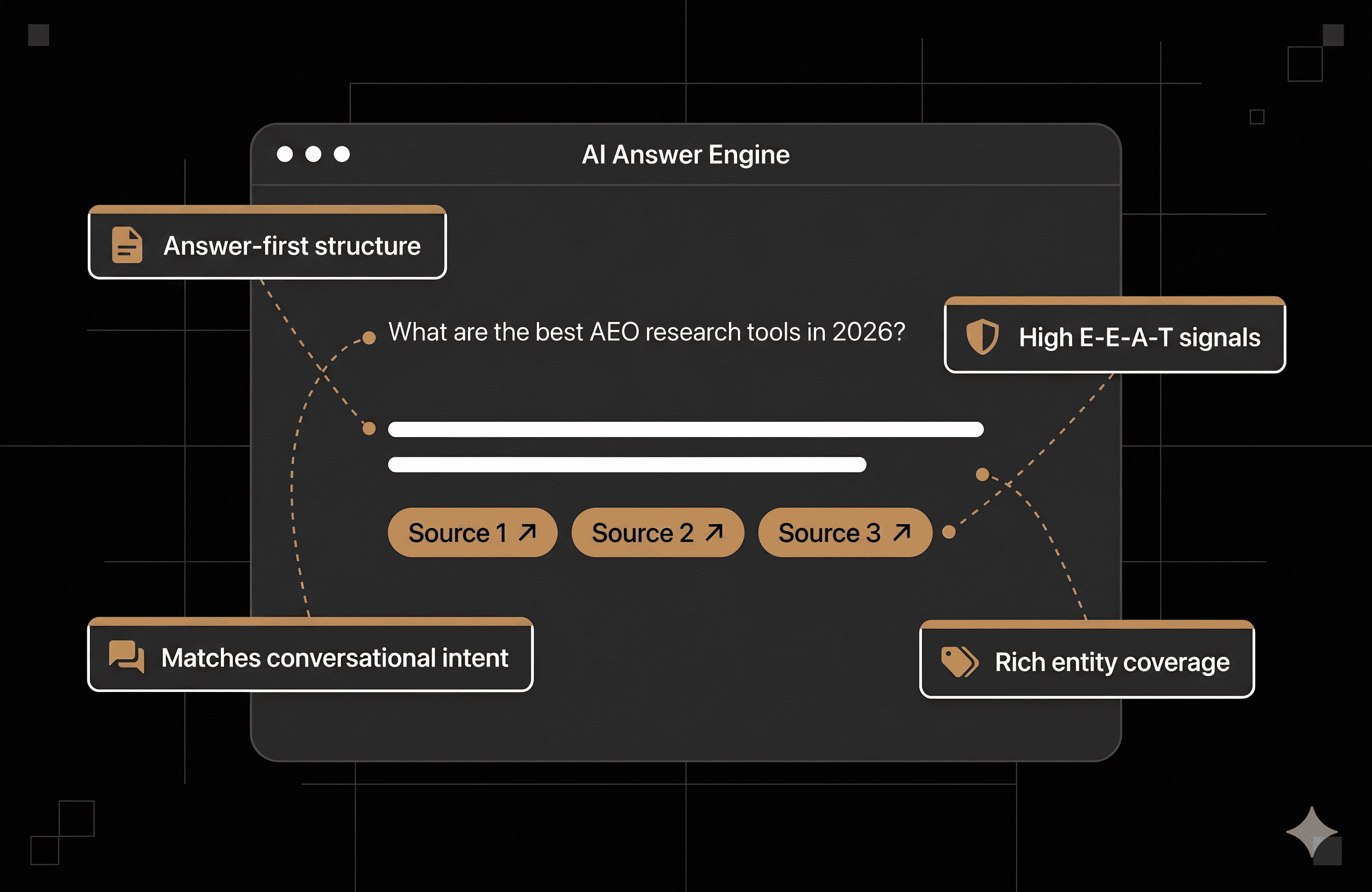
As AI engines summarize and cite sources directly, your goal must shift from ranking #1 to becoming the cited authority. AEO research tools track exactly which sites AI pulls from.
Entity-based search vs keyword-based search
AI engines understand context and entities (people, brands, and concepts). Entity SEO helps you build topical authority around your niche, so AI recognizes you as the go-to expert.
Conversational queries & long-tail intent
Conversational search is long-form. People ask follow-up questions. AEO research involves mapping out prompt chains rather than isolated keywords.
What are the best AEO research tools in 2026?
Here's a breakdown of the best AEO tools across five categories.
AI citation tracking tools
These monitor exactly where and how often your brand or content appears in AI answers.
- AI Rank Lab: Excellent for free and paid audits that scan your site for SEO, AEO, and GEO signals across ChatGPT, Claude, Gemini, and Perplexity. It shows exactly where you’re getting cited and where you’re missing out.
- AthenaHQ: A command-center platform trusted by enterprise teams. It tracks brand mentions across major LLMs, analyzes sentiment, and surfaces content gaps with clear next steps.
- Profound: The market leader for deep AI visibility. It captures real conversation data from 10+ engines, delivers citation analytics, and even helps you benchmark against competitors.
AI query & prompt research tools
These help find the questions people actually ask AI.
- AlsoAsked: Maps out related questions in beautiful branching trees, which makes it ideal for finding follow-up prompts.
- AnswerThePublic: Generates question clouds from real searches across Google, YouTube, Amazon, and more. It’s still a go-to for spotting conversational intent.
- People Also Ask scraping tools: Various plugins now allow you to scrape the search generative experience (SGE) results to see which snippets the AI is pulling into its main answer.
Content optimization tools for AEO
These help you write content that AI engines actually cite.
- Surfer SEO: Updated for AEO with entity and semantic scoring that predicts citation potential.
- Clearscope: Focuses on semantic depth and entity coverage so your content feels authoritative to both humans and AI.
- MarketMuse: Builds topical authority maps that help you own entire subject areas AI engines love to cite.
AI-native AEO platforms
These are built from the ground up for answer engines:
- Writesonic GEO: Combines content generation with a generative engine optimization (GEO) Action Center. It tracks citations, share of voice, and gives prioritized optimization recommendations in one workflow.
- AirOps: Focuses on citation-ready content workflows, schema validation, and freshness tracking.
- AIclicks: End-to-end visibility across six major LLMs with real-time dashboards, citation sentiment, and AI agents that generate optimized content in 100+ languages.
Traditional SEO tools adapting to AEO
These AI SEO tools have integrated LLM tracking and generative engine metrics into their existing ecosystems.
- Ahrefs: Features the Brand Radar and AI Share of Voice (SOV) reports. It shows you which conceptual territories your brand dominates and where competitors are being cited.
- Semrush: Offers the AI Visibility Toolkit, a specialized add-on that tracks brand presence and sentiment across ChatGPT, Gemini, SearchGPT, and Perplexity.
This AEO research tools list covers the full spectrum. Pick based on your budget and team size.
How to use AEO research tools to find high-citation queries?
Here’s how you can leverage these platforms and pinpoint the specific queries to build an AEO strategy that triggers AI citations:
Step 1: Identify question-based queries
Start with AI query research tools like AlsoAsked or AnswerThePublic. Feed in a broad topic and export every conversational variation. Layer in People Also Ask scrapers for Google data.
Step 2: Analyze AI-generated answers (ChatGPT, Perplexity)
Paste the top 20 to 30 queries into ChatGPT, Perplexity, and Gemini. Note which domains get cited most often.
Step 3: Extract citation sources
Use your citation tracking tool (AI Rank Lab, AthenaHQ, or Profound) to see why those sources win. Is it because of schema, freshness, or entity depth?
Step 4: Map content gaps
Compare what your site covers versus what AI is citing. Look for missing angles, outdated stats, or weak entity signals.
Step 5: Build answer-first content
Rewrite with the answer up front, clear headings that match user phrasing, rich schema, and supporting entities. Refresh quarterly. AI prefers fresh, authoritative sources. This is exactly how to rank in ChatGPT and other engines.
What features should you look for in AEO research tools?
Not every tool is up to the task. When shopping for your stack, prioritize these AEO tool features:
AI citation tracking accuracy
Look for tools that monitor real LLM responses (not just simulated ones) and show citation frequency plus sentiment.
Multi-platform coverage (ChatGPT, Gemini, Perplexity)
At a minimum, the AI visibility tracking tool must cover major engines like ChatGPT, Gemini, and Perplexity.
Prompt-level insights
The tool must show which queries you win or lose, plus volume estimates for AI conversations.
Content optimization recommendations
The best citation tools don't just tell you where you stand. They tell you what to do next, whether that is a content gap to fill, an entity to add, or a format to restructure.
Entity & semantic analysis
One of the important AEO tool features is deep entity graphs. It needs to understand AI visibility tracking at a topical level, not just a word level. That way, you can build the kind of content AI trusts.
Are free AEO research tools enough to get started?
Yes, free AEO tools are enough when you’re just testing the waters.
Free tools stack (scraping + manual research)
You’ll need these free AEO tools to build your manual stack:
- Google “People Also Ask” + AlsoAsked free tier
- Manual prompting in ChatGPT/Perplexity
- Free Ahrefs/Semrush trials or limited audits from AI Rank Lab
- Simple PAA scrapers and Google Sheets tracking
Limitations of free tools
The problem with free AEO tools is scale and history. You can't manually check 500 prompts every day, and you won't see the trend lines of your visibility. You also won't get the "why" behind a drop in citations.
When to upgrade to paid tools
Once you're publishing content with AEO intent at scale, or once AI search queries represent a meaningful share of your traffic strategy, paid tools pay for themselves quickly. The switch is worth it when manual tracking becomes a bottleneck.
Still not sure about your AEO plan?
It takes a ton of work to shift your strategy from keywords to getting cited by AI. Relying on a disconnected stack for AEO is inefficient and, frankly, exhausting.
Instead of juggling a dozen different logins and data points, you might find it easier to partner with an agency like Sagashi Digital.
We take the entire AEO workflow, from query research and content strategy to citation tracking, off your plate. That way, you can focus on running your business instead of chasing AI algorithms.
Common Questions Asked About Top AEO Research Tools
How do I choose the right AEO research tool for my business?
Choose a tool that tracks AI visibility, uncovers AI search queries, monitors brand mentions and citations, and integrates with your existing SEO workflow. The best tool depends on your goals and budget.
What metrics should I track when measuring AEO performance?
Focus on AI referral traffic, AI citations, brand mentions, grounding queries, impressions in AI search, and conversions. These metrics provide a clearer picture of your AEO performance than rankings alone.
Do AEO research tools work for local businesses?
Yes. Local businesses can use AEO tools to identify location-based AI queries, optimize local content, and improve their chances of being recommended by AI assistants for nearby searches.
Can AEO research tools help me rank in ChatGPT, Perplexity, and Google AI Overviews?
AEO tools can't guarantee rankings, but they help you identify optimization opportunities, track AI visibility, and create content that's more likely to be cited by ChatGPT, Perplexity, Google AI Overviews, and other AI search platforms.
How often should I use AEO research tools to update my content strategy?
Review your AI search performance at least once a month. If you're in a competitive industry or publish frequently, weekly monitoring can help you spot new AI search trends and update content before competitors do.
Frequently Asked Questions
There isn’t a single best AEO research tool. But Profound, AIclicks, and Writesonic GEO consistently rank at the top because they combine tracking accuracy with actionable optimization.
Start with AlsoAsked and AnswerThePublic for question discovery, then test those prompts directly in ChatGPT and Perplexity. Citation trackers like AthenaHQ automate the process.
Yes. Tools like AI Rank Lab, Profound, and AIclicks monitor how often your brand appears in ChatGPT responses and show citation sources.
They are different, not necessarily better. You must use them together because traditional SEO drives discovery, while AEO drives citations and zero-click authority.
AEO can actually be faster than traditional SEO. As AI models are constantly updated or browse the live web, like Perplexity, high-quality, answer-first content can be cited within days of being indexed.
Ready to Get Found by More Customers?
We help you generate qualified inbound leads through search - without paying for ads. Our content strategy is built to create a consistent pipeline, shorten sales cycles, and turn organic traffic into revenue.