
How to Measure AEO Success? KPIs, Metrics & AI Visibility Tracking
By
Rushabh Menon
Founder - Sagashi Digital

Summarize this article using AI
How to measure AEO success is the key question on the mind of every business owner.
Mastering AEO metrics, AI visibility tracking, and answer engine optimization KPIs helps you move beyond traditional rankings and prove real impact from AI answers.
AI is the new frontier for discovery, but 84% of brands haven't brought a map. Only a small sliver (16%) is systematically tracking how they show up in AI results. That’s according to the findings of McKinsey.
In this piece, we will walk you through everything you need to know to measure AEO success. Dive in, then!

Why is measuring AEO success different from traditional SEO?
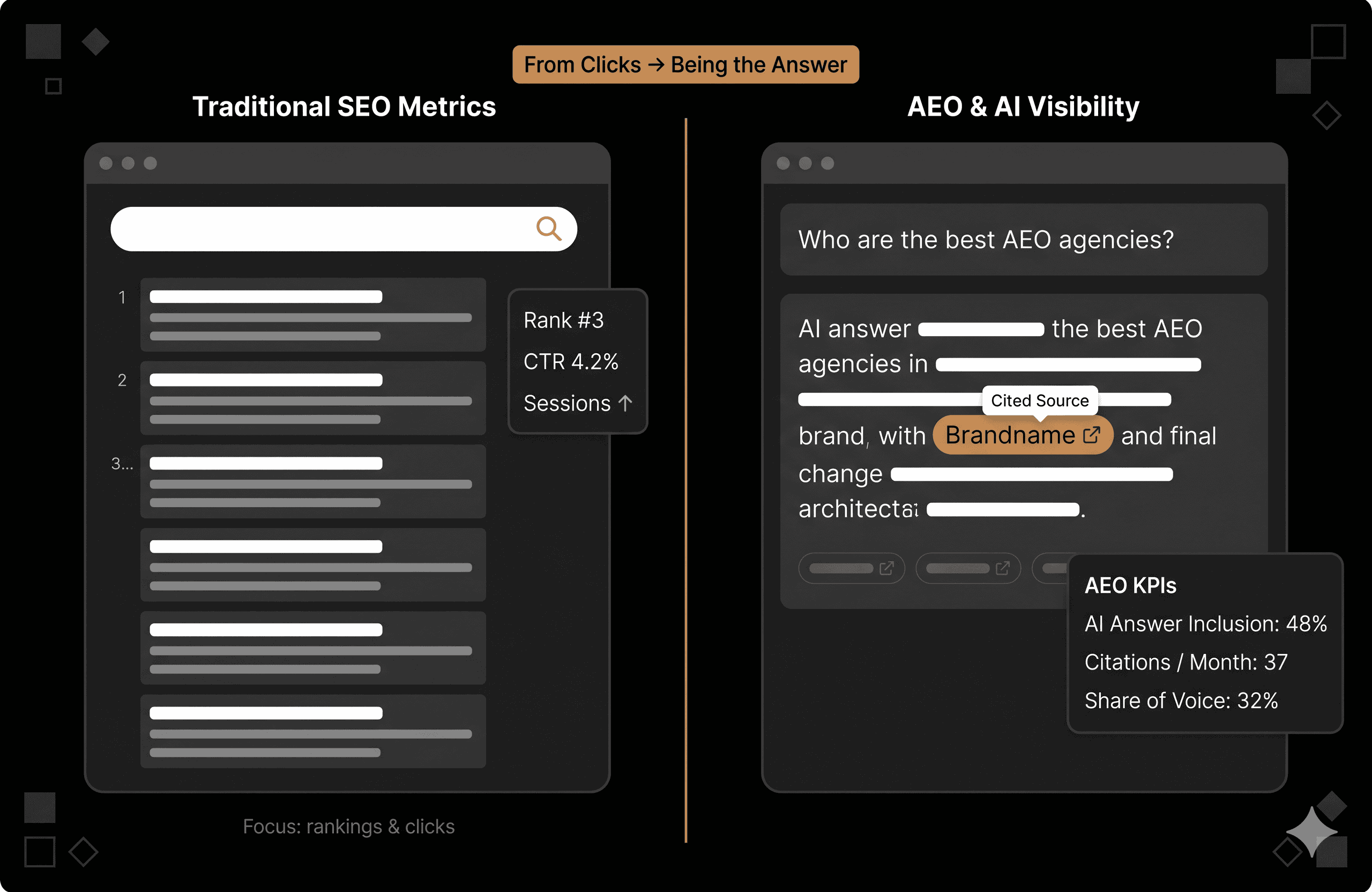
Traditional SEO was simple. You tracked your rank, looked at your click-through rate (CTR), and celebrated the traffic landing on your site. However, when it comes to AEO vs SEO metrics, the fundamental unit of value has changed.
Why rankings alone no longer tell the full story
Rankings on Google still matter, but AI engines like ChatGPT, Perplexity, and Gemini often synthesize answers without sending traffic.
According to McKinsey’s October 2025 report, about 50% of consumers now use AI-powered search intentionally. This shift could redirect up to $750 billion in U.S. revenue by 2028.
Difference between clicks vs AI visibility
The findings of Bain & Company indicate that 4 out of 5 consumers rely on zero-click answers at least 40% of the time. If your brand shows up inside an AI answer, that is a win. You can build massive trust and influence, even if the user never visits your site.
How AI search changes attribution models
Traditional last-click models miss the influence of an AI answer that plants your brand in someone’s mind hours (or days) before they search branded terms. Now you need AI search analytics and zero-click search tracking to understand influence before the click ever happens.
Why impressions and citations matter more now
In AEO, a citation is the new backlink. When Perplexity or ChatGPT provides a source link, it acts as a seal of authority. Even if the user doesn't click, the psychological impact of being the trusted source for an AI’s logic is a powerful top-of-funnel signal.
Shift from SERP traffic to answer inclusion
The goal has moved from getting the click to being the answer. Success in AEO means your data, your brand name, and your unique value propositions are synthesized into the LLM’s (large language model) response.
What are the most important KPIs for measuring AEO success?
The most important KPIs for measuring AEO success are: AI answer inclusion rate, brand mentions in AI answers, share of voice, citation frequency, and conversion impact.
Here’s a clear overview of the top AEO KPIs and AI visibility metrics:
When it comes to AEO KPIs (key performance indicators) and AI visibility metrics, forget vanity numbers. The most important answer engine optimization metrics and AI search performance indicators revolve around how often and how favorably AI engines feature your brand.
AI answer inclusion rate
Track how often your content appears in AI-generated responses across platforms. Aim for consistent inclusion in top-answer slots.
Brand mentions inside AI-generated answers
Unlike a link, a mention within the prose of an AI response has high psychological weight. Tracking the frequency of these mentions across different LLMs helps you gauge your AI search performance.
Share of voice across AI platforms
Share of voice compares your mentions against competitors. If you own 35% of answers in your niche while competitors split the rest, you’re winning the AI conversation.
Citation frequency and source authority
How often is your domain or content actually linked or referenced as the source? Higher-authority citations, from your own site, earned media, or trusted reviews, boost long-term trust with AI engines.
Conversion impact from AI discovery
Ultimately, you need to connect visibility to the bottom line. This involves tracking branded lift. If your AI visibility tracking shows a spike in mentions, do you see a corresponding rise in direct traffic or branded search volume?
How can you track visibility in ChatGPT, Gemini, and Perplexity?
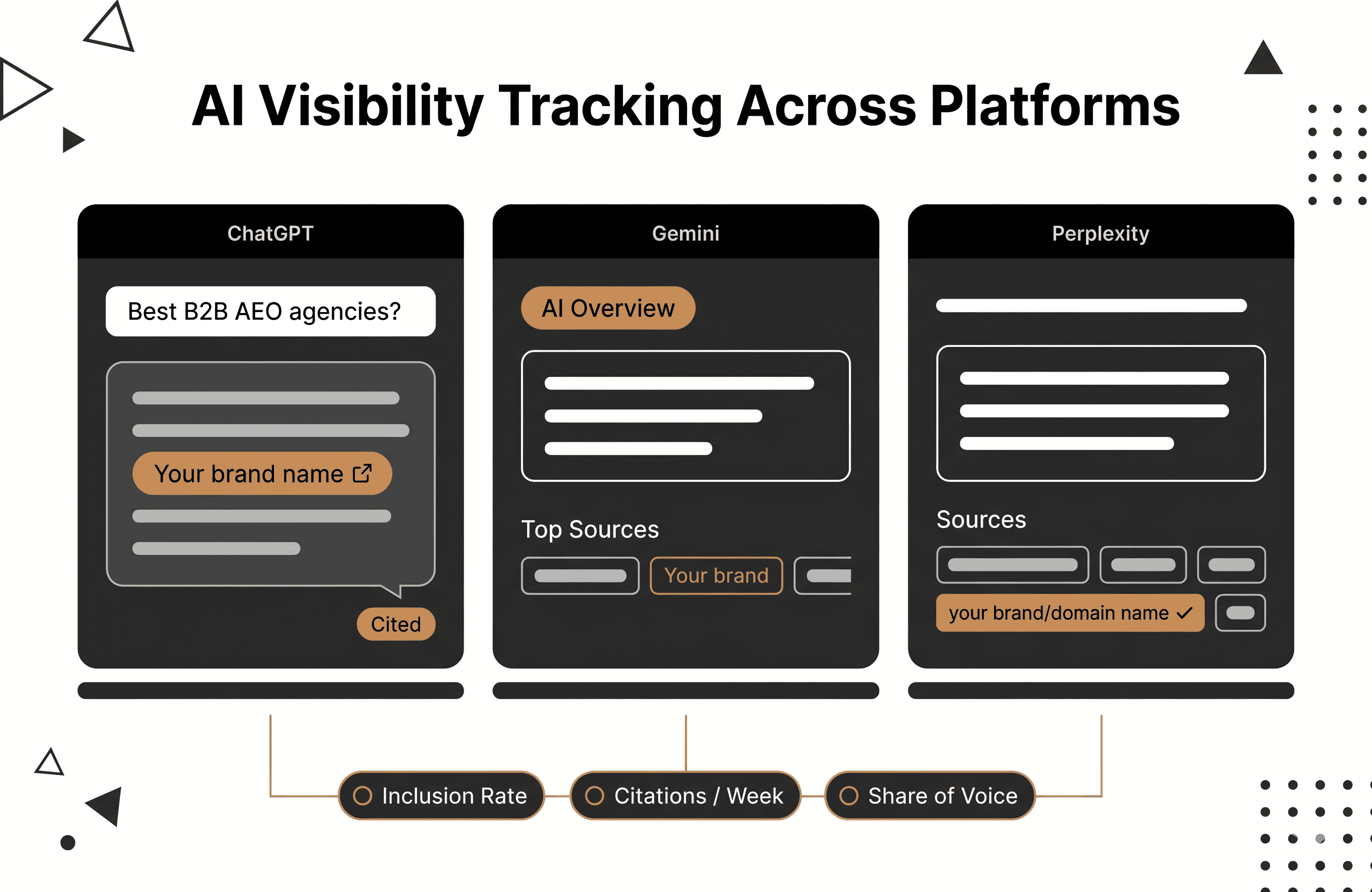
Each platform has a personality and a different way of citing sources. ChatGPT visibility tracking is fundamentally different from tracking Perplexity or Gemini because of how they handle real-time web access.
How AI platforms surface brand mentions differently
ChatGPT favors comprehensive, authoritative sources. Gemini leans on Google ecosystem data. Perplexity loves fresh, cited research. That is why Perplexity citations are often more link-heavy, while Gemini might prioritize structured data.
Tracking prompts and response consistency
As AI results fluctuate frequently based on the exact wording of a prompt, you must track clusters of queries. A single keyword isn't enough. You need to track how your brand surfaces across 10 to 15 variations of a natural language question.
Manual testing vs AI visibility tools
Until the industry standardizes, many brands use secret shopper-style manual testing. However, new AI visibility tracking software is emerging that automates the process of prompting engines and scraping the mentions to provide a unified dashboard.
Importance of conversational query tracking
Don’t forget conversational query tracking. Users now type full sentences and follow-ups. Track long-tail, question-based prompts instead of short keywords.
Why AI results fluctuate frequently
AI results fluctuate frequently because models are constantly updating. One week, you’re top-cited, and the next, a new training data cut changes everything. That is why consistent monitoring is important.
What tools help measure AEO performance?
You can't manage what you can't measure. While the landscape is new, several AEO tracking tools are emerging to help.
AI visibility monitoring platforms
Specialized tools like LLMclicks.ai, Profound, or Conductor’s AEO/GEO suite continuously scan ChatGPT, Perplexity, Gemini, and more. They deliver real-time AI visibility metrics on brand mentions and share of voice.
Prompt tracking and response analysis tools
Otterly.AI and Scrunch specialize in prompt libraries, response sentiment, and trend alerts. They flag when your citation rate drops, so you can react fast.
Schema validation and structured data tools
AI engines rely on entities. To ensure they understand who you are, your technical answer engine optimization KPIs should include Schema health.
Tools like Schema.org’s validator or specialized enterprise tools help ensure your "JSON-LD" is perfect, making it easier for AI to digest your data.
Entity and brand mention tracking systems
Standard PR tools like Mention or Brandwatch are surprisingly useful for AEO. By tracking how your brand is discussed across the broader web, you can predict what an AI (which trains on that data) will eventually say about you.
Traditional SEO tools still relevant for AEO
Don't delete Semrush or Ahrefs. These tools still provide data on "Featured Snippets" and "People Also Ask" boxes, which are the closest cousins to AI answers. If you win the snippet on Google, you are highly likely to be the source for Gemini’s AI Overview.
How do you measure AI-driven traffic and conversions?
Visibility is vanity; revenue is reality. AI traffic analytics is what helps you move past mere impressions to focus on what actually pays the bills.
To measure AI-driven traffic and conversions, you must identify AI referral traffic sources, track branded search lift from AI visibility, measure assisted conversion, and connect AI discovery with pipeline growth.
Identifying AI referral traffic sources
In Google Analytics 4, create custom channel groups for referrers like chatgpt.com, perplexity.ai, gemini.google.com, and claude.ai. Even small referral spikes can signal big AI visibility wins.
Tracking branded search lift from AI visibility
Check your Google Analytics (GA4) for referral traffic from domains such as chatgpt.com, perplexity.ai, or google.com (specifically in the organic overview source). This is your direct conversational search traffic.
Measuring assisted conversions
Use GA4’s attribution models or multi-touch reports to see how AI discovery assists later conversions. A user might discover you via Perplexity, then convert weeks later through email or direct.
How AI visibility influences buying journeys
AI search often happens at the "Consideration" phase. Users use AI to narrow down their choices. By tracking the content that gets cited most by AI, you can see which parts of your funnel are doing the heavy lifting in the discovery phase.
Connecting AI discovery with pipeline growth
The best teams tie AI traffic analytics to CRM data. When marketing-qualified leads increase after a visibility campaign, you know your AEO strategy is working.
What signals indicate your AEO strategy is improving?
Don’t know if your efforts are actually helping improve AEO performance?
More branded mentions in AI answers, an increase in question-based keyword visibility, higher topical authority, recognition, growth in zero-click engagement signals, and improved consistency across AI engines are the clearest AI search growth signals.
Let’s explore more on AI ranking indicators that show you’re successfully improving AEO performance below.
More branded mentions in AI answers
The most obvious signal is frequency. As the AI's trust in your entity grows, it will cite you more often across a wider variety of prompts.
Increase in question-based keyword visibility
Since AEO is built on answers, seeing your site appear in the "Sources" for "How-to" or "What is" queries is a major indicator of success.
Higher topical authority recognition
When an AI engine begins to summarize your site’s core pillars accurately without you having to force the prompt, you have achieved topical authority.
Growth in zero-click engagement signals
This sounds counterintuitive. But a growth in "Knowledge Panel" appearances or "AI Overviews" that feature your content, even without clicks, is a signal that the engines view you as a definitive source.
Improved consistency across AI engines
If ChatGPT, Gemini, and Perplexity all give the same (positive) answer about your brand, your AEO metrics are healthy. Inconsistency usually points to conflicting entity data across the web.
What are the biggest mistakes when measuring AEO success?
Using only organic traffic, ignoring conversational search behavior, focusing only on rankings and impressions and not separating AI visibility from traditional SEO are he common AEO reporting mistakes.
- Using only organic traffic as a benchmark: This is one of the most common wrong SEO metrics for AEO. You might have 20% less traffic but 50% more brand awareness via AI.
- Ignoring conversational search behavior: People talk to AI differently than they type into Google. Don't track keywords; track intents.
- Focusing only on rankings and impressions: These are vanity metrics in the AI world. Focus on intent fulfillment.
- Not separating AI visibility from traditional SEO: You need to separate line items in your reports. Mixing them up confuses stakeholders and makes it hard to see what’s actually working.
- Expecting perfect attribution from AI search: AI is a black box. You will never have 100% perfect data. Focus on trends and correlations instead.
How often should businesses audit and optimize AEO performance?
An effective AEO optimization strategy requires weekly prompt monitoring, monthly entity and citation reviews, quarterly content refresh cycles, competitor AI visibility benchmarking, and continuous schema and structured data improvements. Below, we’ll elaborate more on each of them.
- Weekly prompt monitoring: Check your top 10 most valuable buying intent prompts to see if the AI's answer has changed.
- Monthly entity and citation reviews: Use AI visibility audits to see which sites the AI is citing instead of you. Is there a new competitor gaining ground?
- Quarterly content refresh cycles: AI models favor fresh, accurate data. Refreshing your "Statistics" or "Guides" pages every 90 days keeps you in the retrieval loop.
- Competitor AI visibility benchmarking: At least once a quarter, run a "Share of Voice" report against your top three competitors.
- Continuous schema and structured data improvements: As new schema types are released, update your site immediately to remain the most readable source for bots.
How to Build a Long-Term AEO Measurement Strategy That Drives Revenue?
Building a solid AEO growth strategy is about compounding visibility over time. The more you’re cited, the more AI engines trust you, creating a virtuous cycle.
Unlike a paid ad that stops when the budget runs out, AEO builds momentum. Once you are established as a trusted entity in the AI’s training data or its retrieval-augmented generation (RAG) process, you become the default answer. This leads to huge AI visibility ROI.
As AI search evolves, the brands that win won't just be the ones with the most backlinks. They will be the ones who provide the most digestible, authoritative answers. So, focus on AI search optimization strategy now, and you position your business to be the primary voice in the trillion-dollar conversational economy.
The team at Sagashi Digital specializes in exactly this. We blend classic SEO with cutting-edge AI search optimization strategy for B2B and B2C brands. We help companies build custom dashboards, create citation-winning content, and turn AI visibility into qualified leads and revenue growth.
Frequently Asked Questions
Success is measured by the AI answer inclusion rate, the frequency of branded citations within AI responses, and the lift in branded search traffic resulting from AI discovery.
Yes, but only if the user clicks a link within the "Search" or "Citations" feature of ChatGPT. This will show up in your analytics as a referral from chatgpt.com.
The AI answer inclusion rate is the most valuable KPI. It tells you exactly how often you are part of the solution provided to the user.
Absolutely. High-quality backlinks and strong technical SEO are still the signals that AI engines use to determine who to trust. However, they are no longer the only metrics that matter.
Most brands see noticeable improvements in 4 to 8 weeks with a consistent AEO optimization strategy, though compounding authority takes 3 to 6 months of steady work.
Ready to Get Found by More Customers?
We help you generate qualified inbound leads through search - without paying for ads. Our content strategy is built to create a consistent pipeline, shorten sales cycles, and turn organic traffic into revenue.