
How FAQs Improve AEO Rankings & Help You Get Found in AI Search?
By
Rushabh Menon
Founder - Sagashi Digital

Summarize this article using AI
How FAQs help with AEO has been one of the most searched queries for businesses in the U.S., and why not?
People aren’t just typing keywords on search engines anymore. They are asking chatbots like ChatGPT, Google AI Overviews, and Perplexity full questions. And guess what? They are delivering direct answers.
In 2024, Gartner already predicted a 25% decline in search volume by 2026 due to AI chatbots.
This shift has given rise to a new discipline: AI search optimization. If you want your business to be the one the AI chooses to mention, you need to understand how to feed these machines.
The most potent tool in your AEO content strategy? The humble FAQ. Building a well-structured FAQ for AI search can help you speak directly in the format AI engines prefer.
In this friendly guide, Sagashi Digital will walk through how FAQs boost your AEO rankings, get you cited in AI responses, and drive AI visibility and leads. Let’s dive in, then!
What is AEO, and why are FAQs critical for it?
To get started, we need to cover the AEO basics. AEO, or answer engine optimization, refers to the process of optimizing content so AI models can synthesize the information and present it as a direct answer.
Traditional SEO focuses on ranking a page for keywords. But AEO focuses on being the direct answer that an AI gives to a user. This shift is happening because AI search behavior is changing. Users don’t scroll through blue links on Google anymore. They now use conversational search in tools like ChatGPT or Gemini.
Why AI prefers structured Q&A formats?
AI systems prefer structured Q&A formats because they are easy to parse, summarize, and cite. Instead of scanning long paragraphs for clues, the engine can grab a clear question and its matching answer.
FAQs turn your page into a ready-made knowledge hub that LLMs can parse instantly. They are not just extra content. But they are precise, intent-matched blocks that help AI understand context, reduce hallucinations, and boost your chances of being cited as the source.
How do FAQs help with AEO rankings?
You might wonder how FAQs help with AEO rankings specifically. The secret lies in how AI matches content to a user's intent.
Here’s how it works:
- FAQs match real user queries exactly. AI search engines are trained on natural-language questions. A solid FAQ section speaks the same language users type or speak into tools like Gemini.
- They create structured answers that AI can trust and extract quickly. This helps improve your AI answer ranking potential.
- Clear FAQs improve content clarity and extractability, making it easier for AI to pull your information without guessing. When an AI can pull a fact without errors, it trusts your site more. This trust leads to more citations across ChatGPT, Google AI, and Perplexity.
How do AI search engines use FAQ content?
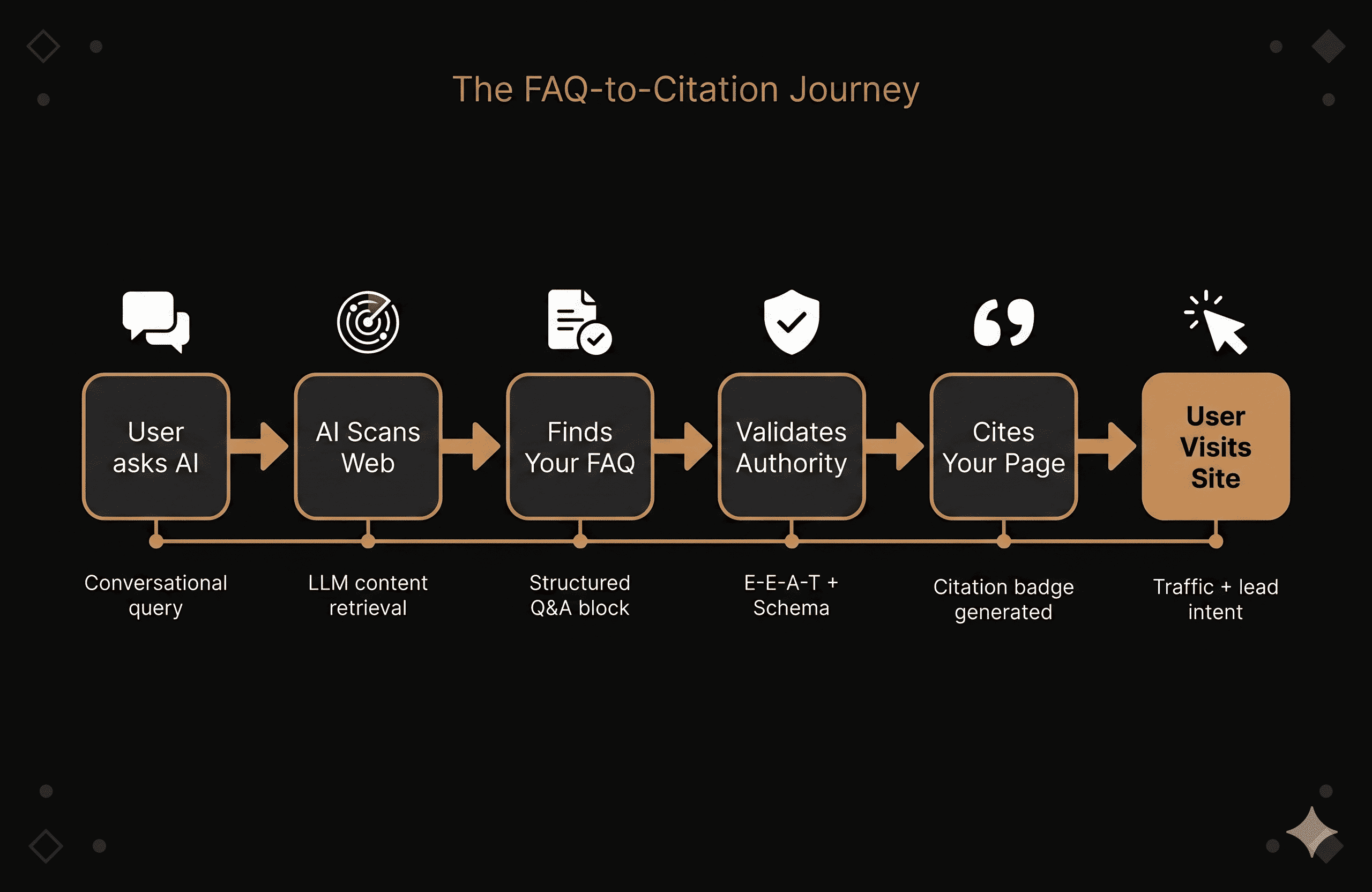
To win, you must know about AI search faq usage. AI engines use a process called large language model, or LLM, content retrieval. This is different from crawling, which only indexes words.
Engines like ChatGPT use AI content parsing and semantic search to break content into meaningful units. It looks for the idea behind a user's question. Then it looks for the content that best fits that idea. FAQs act as a bridge between the two. The AI scans your headings and Q&A blocks first. If it finds a match, it extracts that block.
LLMs have context windows. They can only think about a certain amount of text at once. If your content is too long, the model may truncate the text.
This is why chunking, or breaking data into small, useful parts, is important. FAQs are the best form of manual chunking. You ensure your message stays intact when you give the AI easy-to-retrieve and cited answers.
Research from Search Engine Land shows ChatGPT citations reward ranking, heading precision, and narrow, focused answers. These are exactly what strong FAQs deliver.
Here's the section with anchor texts trimmed to 4 words max:
What Makes an FAQ Section Effective for AEO?
Not every FAQ section earns citations. The ones that do share three things in common: they're structured for extraction, written in plain language, and built around questions people are actually asking - not questions a brand wishes they were asking. Get this right and FAQs improve AEO rankings on their own.
Write Clear, Direct Answers
Keep each answer between 40-60 words. Lead with the specific fact, number, or date instead of easing into it - AI models extract answers, they don't summarize paragraphs. If your answer could apply to any company in your industry, it's too vague to get cited.
Use Natural, Conversational Language
Write the way you'd explain it to a colleague, not the way you'd write a policy document. AI engines generate responses that mimic how people actually talk, and they tend to favor source content with that same register - a stiff, corporate tone rarely survives the rewrite into a conversational AI answer. This is part of making content AI-friendly without sacrificing readability for actual humans.
Cut the Fluff and Skip Keyword Stuffing
The old trick of repeating your target keyword five times in a paragraph doesn't work on AI models the way it once worked on early search algorithms. What works instead is information density - every sentence should add a fact, a number, or a distinction the reader didn't already have. If a sentence isn't doing that, cut it.
Lead With the Answer, Not the Setup
Skip the throat-clearing. Put the direct answer in the first sentence after the question, then use the rest of the paragraph for context or nuance. This answer-first structure is the same principle behind structuring a page for AEO, just applied at the FAQ level instead of the whole document.
Match FAQs to Real Search Intent
Build your FAQ list from what people actually type, not what sounds good in a content brief. Pull from Google's "People Also Ask," the follow-up questions ChatGPT surfaces in real conversations, and your own site search or support tickets. Running this process properly usually means leaning on AEO research tools built for finding what people ask AI platforms, rather than guessing from memory. A FAQ section built on guesses gets ignored; one built on real queries gets cited.
Where should FAQs be placed for maximum AEO impact?
Placement matters for faq placement seo and overall content structure AI. You have two smart options:
- Putting FAQs at the bottom of the page is the classic approach. It keeps the main content focused while giving AI a clean, dedicated section to scan at the end.
- Inline FAQs, which are sprinkled naturally throughout the article, are more powerful. They break up long content, answer questions exactly when readers and AI need them, and create multiple entry points for extraction.
You can also use FAQs as standalone content hubs. This means creating a whole section of your site dedicated to questions.
How do I implement schema markup for AEO?
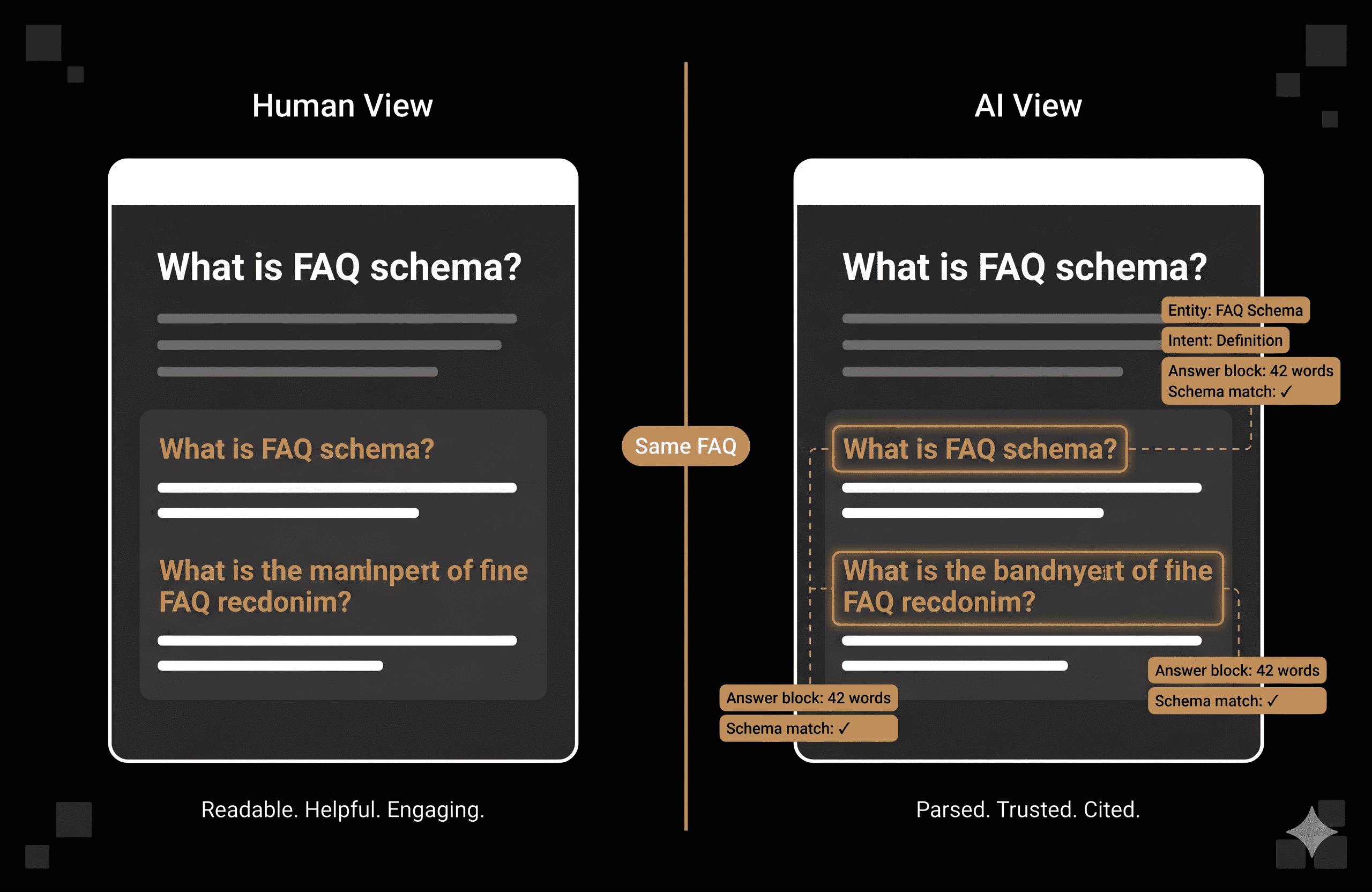
FAQ schema markup for AEO is one of the most direct technical steps you can take to signal your content to search engines. Structured data FAQ (also called FAQpage schema) tells search engines and AI tools exactly which parts of your page are questions and answers.
Most experts use JSON-LD format. It’s clean, easy to add, and doesn’t clutter your HTML. You simply wrap each Q&A pair in the proper schema code.
Schema seo still delivers traditional rich snippets, but its bigger win for AEO is signaling authority and structure to LLMs.
When does it help most? On content-heavy pages where you want AI to confidently cite you.
That said, avoid these common schema mistakes:
- Mismatched questions and answers
- Missing closing tags
- Using a schema on pages with zero actual FAQs.
How to Turn FAQs into a consistent source of AI visibility and leads?
Turning your FAQ section into a lead-generating powerhouse starts with a robust AEO growth strategy.
Audit and expand your FAQ sections, and you create a reliable flywheel of AI visibility and organic growth. Don’t forget to monitor which ones get cited in AI tools. Free tools like Perplexity or ChatGPT can help you test.
Need help? Sagashi Digital can help turn simple FAQs into magnets for AI search engines. Our team crafts smart, intent-driven FAQ systems that get you cited in ChatGPT, Google AI Overviews, and Perplexity. The result? Qualified leads without paid ads.
Commonly Asked Questions About How FAQs Help With AEO
Does FAQ schema markup actually make a difference, or is it optional?
It's not strictly required, but we've seen it consistently outperform plain FAQ text in AI citation rate. Schema removes ambiguity for the model - it doesn't have to guess where a question ends and an answer begins, it's told explicitly. If you're already writing clean Q&A pairs, adding FAQ schema markup is a small technical step with outsized payoff.
Should every page on my site have an FAQ section, or just certain ones?
Not every page needs one. We recommend FAQs on pillar pages, service pages, and any content answering a specific, well-defined question - not on pages that are primarily narrative or brand storytelling. This ties directly into structuring a page for AEO as a whole, since forcing an FAQ onto a page with no natural Q&A fit usually hurts more than it helps.
How do I know if my FAQs are actually getting cited by AI?
Manually test your own questions in ChatGPT, Perplexity, and Google AI Overviews using fresh, logged-out sessions, and note whether your content gets referenced. At scale, this is exactly where AEO research tools earn their keep, since they surface this data automatically across far more queries than you could check by hand. Either way, the goal is the same: track AEO performance consistently enough to know which FAQs are earning citations and which are being ignored.
Do FAQs work the same way across ChatGPT, Gemini, and Perplexity?
Not exactly. Each platform pulls from slightly different sources and weighs freshness, structure, and authority differently. A FAQ that gets cited reliably in Perplexity won't automatically perform the same in ChatGPT. That's why we recommend testing FAQs across multiple platforms individually as part of a broader AEO strategy rather than assuming one win means you're covered everywhere.
What's the most common mistake businesses make with AEO FAQs?
Writing FAQs around what a company wants to say instead of what people are actually asking AI. We see this constantly - a FAQ section full of marketing-friendly questions nobody types into ChatGPT. The fix is simple but often skipped: pull real questions from search data and AI prompts before writing a single answer, which is really just keyword research for Google and AI applied to the FAQ format specifically.
Frequently Asked Questions
Yes! They boost extractability, match user intent, and increase citation rates in AI Overviews when paired with schema.
Aim for 5 to 10 high-quality questions per pillar page. Quality beats quantity, so focus on depth and relevance.
Absolutely. ChatGPT favors precise, heading-matched, structured content. FAQs with clear answers and schema rank higher in their citations.
Update them every 3 to 6 months, or whenever your products, services, or industry info changes. Fresh content helps AI see you as a current, reliable source.
Long-tail, conversational questions that match real user intent perform best because they mirror how people actually search with AI.
Ready to Get Found by More Customers?
We help you generate qualified inbound leads through search - without paying for ads. Our content strategy is built to create a consistent pipeline, shorten sales cycles, and turn organic traffic into revenue.