
AI Search Visibility Report 2026: SERPs Analyzed Across Google, ChatGPT & Perplexity
By
Rushabh Menon
Founder - Sagashi Digital
Summarize this article using AI
Curious how AI is rewriting the rules of search? This AI Search Visibility Report gives you the clarity and revelations you need.
After analyzing search queries across Google AI Overviews, ChatGPT, Gemini, and Perplexity, the data shows that structured, authority-driven, entity-rich content consistently earns more AI citations and visibility than traditional keyword-focused SEO pages.
This change is huge for anyone trying to get noticed online. We wanted to see exactly how these tools pick the websites they talk about. So, we did a study on modern search pages.
We looked at thousands of different searches across Google AI Overviews, ChatGPT, Gemini, and Perplexity, and tracked which websites these systems chose to mention. We looked at their layout, their words, and how trusted they are. The results were clear. The old way of doing things does not work alone anymore.
Let us walk through exactly what our data shows and how you can stay ahead.
What is AI search visibility, and why does it matter in 2026?
AI search visibility is a metric that measures how often AI engines include your brand or content in their generated summaries. It matters because more users are reading AI answers instead of clicking on standard website links.
To understand why this matters so much, we have to break it down into a few basic points:
- AI search visibility measures your share of voice inside AI-generated summaries. It shows whether you are part of the answer or left out completely.
- In the past, SEO was all about getting to position number one on Google. Today, getting an AI citation is different. An AI might skip the top-ranked page if it finds a clearer answer on a lower-ranked page.
- More than half of all searches are now zero-click. This means users read the direct response on the screen and never leave the search engine. If you want to be seen, you have to be the source inside that response.
- Tracking regular keyword ranks does not tell the full story anymore. A website can rank high but still lose traffic because the AI overview takes up the whole screen.
- Marketers now use GEO SEO to adapt. GEO stands for generative engine optimization, which means making content friendly for AI engines. AEO stands for answer engine optimization, which helps computers pull out fast facts.
What did the analysis of SERPs reveal?
Our AI overview analysis of search engine results pages (SERPs) shows that AI engines prefer high-quality, trusted sources. We also found that AI favors websites with fresh, deeply educational layouts, and they cite pages that don't even rank in the top ten of regular Google results.
Here’s what our AI search study showed us across five key areas.
Most-cited industries across AI engines
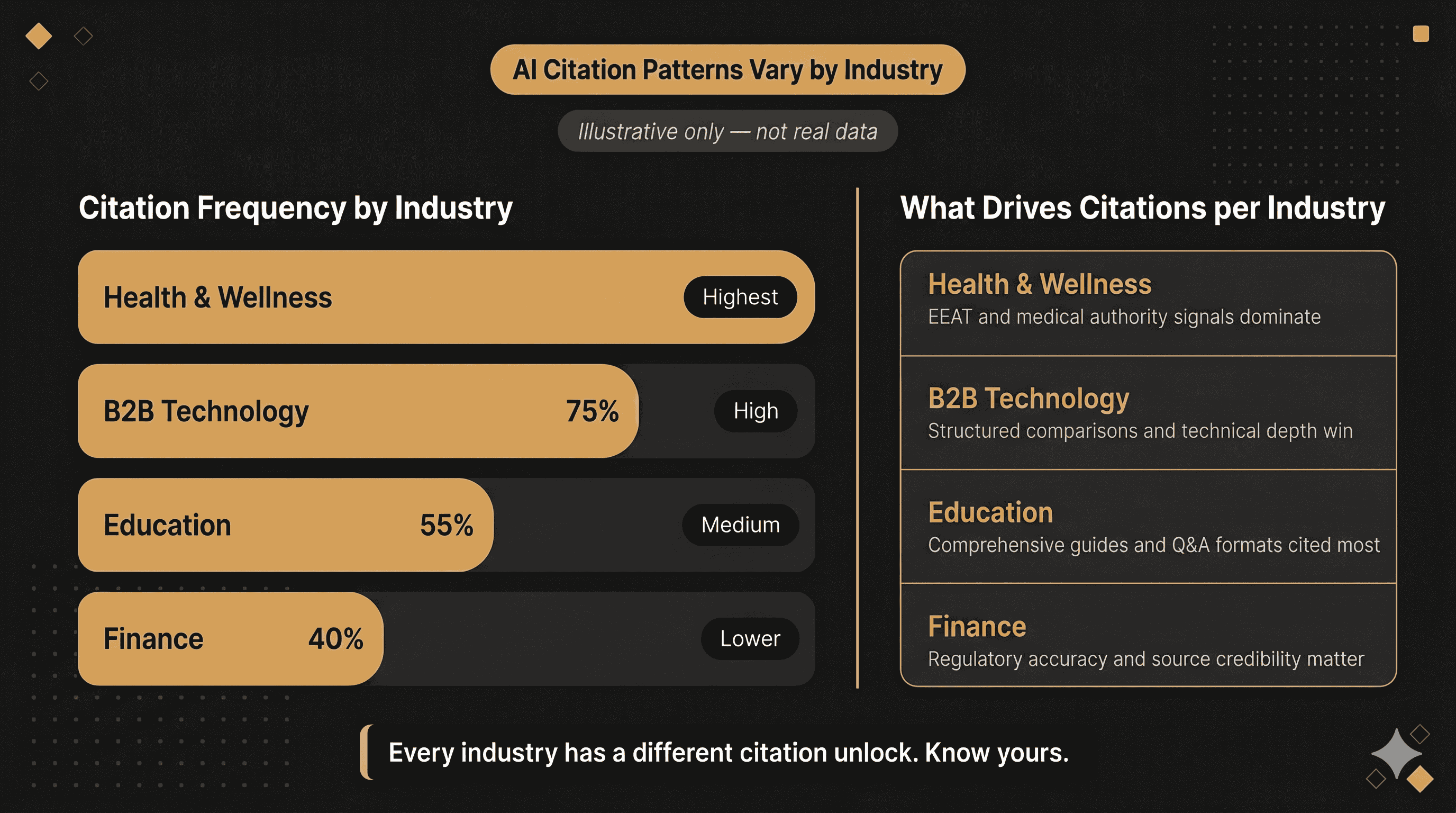
Some topics trigger AI summaries more than others. Health websites get cited the most, followed closely by B2B technology, education, and finance. If your business gives clear advice or explains complex steps, AI tools will use your pages constantly.
Average domain authority of cited websites
You do not have to have the largest site to get cited. Research from Ahrefs shows that only 37.9% URLs cited in AI rank within the first 10 blocks. The rest was almost evenly divided between positions 11–100 (31.2%) and those ranked outside the top 100 (31.0%).
This means smaller, highly specialized websites can easily win citations if they offer great answers. The AI cares more about clear facts than how famous a website is.
Most common content structures
AI engines want information that is easy to digest. Our study found that pages with clear bullet points, ordered steps, and data tables get cited most often. Text with simple headings allows the AI to scan and copy the answers in milliseconds.
Query types triggering AI-generated answers
Informational questions trigger the most AI answers by far. When users ask "how to" or "why," an AI summary appears in almost the majority of cases. Commercial questions, where people compare products, trigger AI answers about 8.69% of the time. Pure shopping searches trigger them much less often.
Differences between Google, ChatGPT, and Perplexity citations
Each platform has its own personality. Google loves to cite sites that already rank well in its old system. ChatGPT prefers highly trusted, deep informational guides. Perplexity loves to pull from a wide mix of different websites to show many viewpoints at once.
What type of content gets cited most in AI search engines?
If you want to build a winning GEO content strategy, you need to know what kinds of pages these bots love to read.
The winners in AI citation content share common traits. They contain research studies and original data, question-answer format, comprehensive, up-to-date glossaries, comparisons, and are entity-rich.
Research studies and original data
AI engines love numbers and hard facts. A recent McKinsey study noted that a brand's own website only makes up 5% to 10% of what AI cites. The rest comes from deep research and third-party reports.
If you publish a study with brand-new data, AI engines will treat your page like a goldmine. They will quote your numbers and leave a link to your site.
Question-answer formatted pages
Think about how people talk to their phones. They ask full questions. Pages that list a clear question as a heading and answer right below perform amazingly well. It makes it simple for the machine to copy your answer.
Definition and glossary content
Clear definitions are highly attractive to AI engines. When a user asks what a complex term means, the AI looks for a short, accurate definition. Clean glossary pages that explain terms simply, without extra fluff, get cited constantly.
Comparison and framework articles
People love to compare things before they buy. Articles that use a clear framework to compare options are highly valuable. AI engines crawl these pages to build their own comparison summaries for users.
Entity-rich educational resources
An entity is a specific person, place, or thing that the AI already knows. Educational pieces that connect these well-known ideas get noticed fast. It proves to the machine that you know the topic deeply.
How does content structure affect AI visibility?
The way you structure your page matters just as much as the words you write. You must create AI extractable content that robots can read in a millisecond.
If you want to structure a page for AEO, you need to combine direct answers, question-based headings, tables, short paragraphs, FAQs, and schema.
- Direct answers improve extraction: Place your short answer right at the top of your section. When a machine finds a perfect summary immediately, it stops looking and uses your text.
- Question-based headings increase visibility: Use headings that match the exact phrases humans type into a prompt. This makes it easy for the AI to connect your section to the user's intent.
- Tables and lists improve summarization: Snippets generate more interaction because they are easy to read. AI engines use these lists to build their own bullet points.
- Short paragraphs perform better: Long walls of text confuse AI encoders. Keep your paragraphs under four sentences so the machine can map the main idea without getting lost.
- FAQs capture conversational searches: A dedicated Frequently Asked Questions section targets the natural way people speak to AI assistants. It mimics a real conversation. Adding them helps you catch natural, conversational searches.
- Schema improves machine understanding: Schema markup is a backend code that tells a computer exactly what your data means. Sites using proper schema see an increase in performance because it removes guesswork for the machine.
How important are entities and topical authority in AI search?
Building deep topical authority and using entity seo is far more important than repeating keywords. AI engines use semantic seo to understand the meaning behind your words.
Years ago, SEO was about typing a single keyword fifty times on a page. Today, AI engines use advanced math to understand concepts. They look at your entire website to see if you are a true expert on a topic. If you write fifty high-quality articles, the AI learns that your site has deep authority.
The engines also look for known entities. They want to see real names, official brand terms, and verified facts. Being talked about by other trusted sites creates a digital footprint that AI engines can verify easily.
How do AI search engines differ in citation behavior?
Each major AI tool has its own personality and its own way of picking sources.
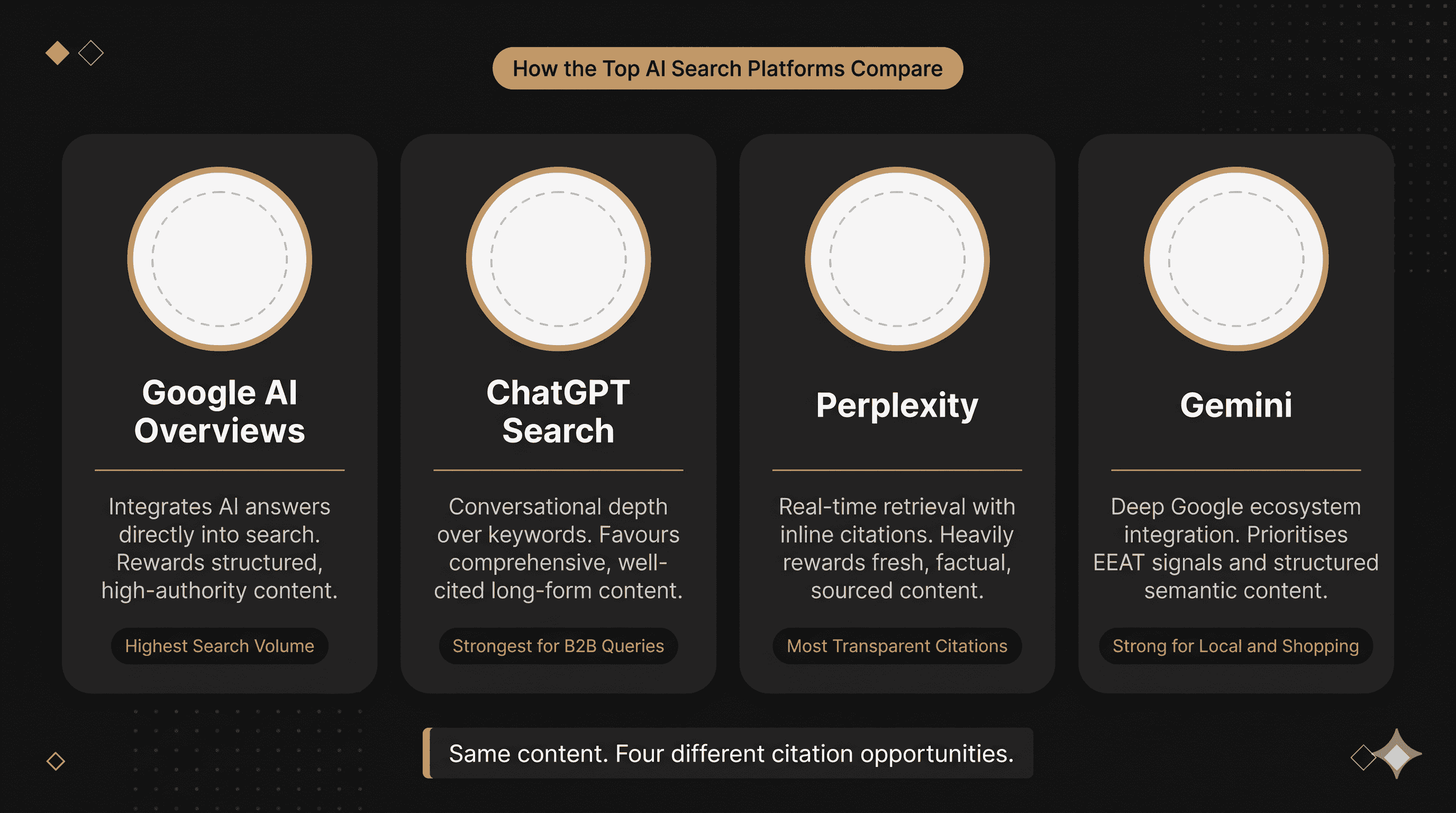
The Google AI overview focuses heavily on traditional domain authority and search ranks. Meanwhile, platforms like Perplexity and ChatGPT prioritize diverse community platforms and direct information extraction.
Here is how the big platforms differ when they choose their sources:
Google AI Overviews favor structured, authoritative pages
Google relies heavily on its traditional web index. It wants to protect its users, so it looks for pages with high trust scores. It heavily favors sites that use clear structure and official data markup.
Perplexity prioritizes source diversity
Perplexity is more like a research assistant. It loves to pull facts from multiple corners of the web at the same time. A single answer might include links from an official study, a news outlet, and a helpful Reddit thread.
ChatGPT relies heavily on trusted informational sources
OpenAI's tool looks for established knowledge. It frequently pulls from massive, trusted databases, major publications, and deeply authoritative platforms. It prefers clear, direct summaries that it can blend into a natural conversation.
Gemini favors entity-connected ecosystems
As Gemini belongs to Google, it has access to a huge map of real-world entities. It favors content that connects seamlessly with Google Maps, YouTube, and official business listings. It loves ecosystems where facts are fully joined together.
Differences in citation freshness and formatting
ChatGPT and Gemini love fresh data. Content updated in the past three months gets twice as many citations as old pages. Perplexity numbers its citations neatly, while Google hides them in dropdown boxes or small link cards.
What are the biggest SEO trends emerging from AI search data?
The future of SEO is shifting away from simple clicks. New AI SEO trends show that brands must focus on being included in the initial answer rather than just winning a spot in a list of links.
That’s because zero-search clicks are rising, original research assets and entity optimization are gaining importance, and EEAT signals are more important than ever.
- Shift from ranking-first to citation-first SEO: Ranking number one is not the main goal anymore. Getting cited inside the AI answer is the new prize.
- Growth of zero-click searches: More people will get their answers without ever visiting a website. Traffic numbers will drop, but the visitors you do get will be highly interested.
- Importance of original research assets: Stock content is dead because AI can write it for free. Sites must produce unique data and real human interviews to stay useful.
- Rise of entity optimization: Marketers will spend less time tracking keywords and more time connecting their brand to known industry concepts.
- Increasing value of EEAT signals: EEAT stands for Experience, Expertise, Authoritativeness, and Trustworthiness. AI models are trained to spot real human expertise and avoid low-effort pages.
- AI visibility is becoming a new KPI: KPI means key performance indicator. Marketing teams are dropping old reports and using new dashboards to track their total share of voice inside AI tools.
How should brands adapt their strategy based on this report?
Knowing the data is one thing. But you also need to understand how to create an AEO strategy to grow your business in this landscape.
To win, you must combine your traditional marketing into a single GEO framework. You must shift your budget toward original research, clean structures, and tools that track your AI presence.
Focus on these adaptations:
- Build research-driven content ecosystems with original insights
- Prioritize topical authority over high-volume publishing
- Optimize every piece for AI extraction with a clear structure and entities
- Combine classic SEO + GEO + AEO into one unified framework
- Track citations and AI visibility metrics religiously (tools are maturing fast in 2026!)
Want a partner to handle this shift for you? Look no further than Sagashi Digital. We are a premier growth agency built specifically for this new era of search. We help both high-growth B2B and B2C brands turn content into a steady stream of inbound revenue.
Our team analyzes your audience's intent, maps out connected article systems, and restructures your digital footprint. So, models like ChatGPT, Gemini, and Perplexity actively trust and cite your brand.
Commonly Asked Questions About AI Search Visibility
Which industries get the most AI citations?
Health sites lead the pack, with B2B tech, education, and finance close behind. These industries share one thing: they answer complex questions clearly. If your niche involves explaining a process or breaking down a hard concept, AI engines are more likely to pull from your pages. Simpler or purely promotional industries see far fewer citations because there is less "answerable" content to extract.
Do you need a high domain authority to get cited by AI?
No. Ahrefs found that only 37.9% of AI-cited URLs ranked in the first ten Google results, with the rest split almost evenly between positions 11 to 100 and beyond. Smaller, specialized sites can win citations just as easily as major brands, as long as the answer is clear and accurate. AI models weight clarity and relevance over raw domain size.
How does ChatGPT pick sources differently than Google AI Overviews?
Google AI Overviews still lean on traditional ranking signals and trust scores from its existing web index. ChatGPT skips that logic and pulls from established, deeply informational sources it already treats as trustworthy, often blending them into a natural, conversational answer instead of a scannable snippet. The result is fewer sources per query but a stronger bias toward long-standing authority.
Does schema markup actually help AI search visibility?
Yes. Schema tells machines exactly what your content means instead of making them guess from raw text. Pages using FAQ, how-to, or list schema saw a real bump in AI performance because the structure removes ambiguity for the model. It is a small technical lift with outsized returns for extractability.
How often should content be updated to stay visible in AI search?
Fresh matters more than people expect. ChatGPT and Gemini cite content updated within the last three months roughly twice as often as older pages. A quarterly refresh cycle, even light edits with new stats or examples, keeps a page in rotation instead of falling out of the citation pool.
Frequently Asked Questions
It is a marketing metric that measures how often artificial intelligence tools include your brand name or website link in their written answers.
AI engines look for text that is highly relevant, easy to extract, and backed by strong authority signals like original data or trusted third-party mentions.
Pages with clear structures perform best in AI search. This includes question-and-answer formats, original data tables, numbered step guides, and clear definition paragraphs.
SEO rankings measure your spot on a list of traditional blue links. AI visibility measures whether your content gets selected and spoken aloud by the AI generator itself.
They are growing because AI summaries give users the exact answer they need right on the search page, so they do not need to click a link.
Ready to Get Found by More Customers?
We help you generate qualified inbound leads through search - without paying for ads. Our content strategy is built to create a consistent pipeline, shorten sales cycles, and turn organic traffic into revenue.