
What Is AEO and GEO? Key Differences Explained for AI Search
By
Rushabh Menon
Founder - Sagashi Digital
Summarize this article using AI
Lately, there has been a lot of buzz about what is AEO and GEO?
In simple terms, AEO (answer engine optimization) is the process of optimizing your content for AI tools to extract and deliver clear, direct answers to user questions.
Meanwhile, GEO (generative engine optimization) helps your brand get cited, referenced, or synthesized into the AI’s generated responses. That turns you into a trusted source rather than just a link.
Now, you must be wondering why AEO and GEO matter. According to a Pew Research Center study analyzing real browsing data from 900 U.S. adults, Google users were far less likely to click on links when an AI summary appeared. They clicked on traditional search results in only 8% of visits with an AI summary.
That makes it clear why traditional SEO isn’t enough anymore. If you want to remain visible, understanding what is AEO and GEO is now essential.
Below, we will break down the key differences between AEO and GEO. Dive in, then!
What is AEO and how does it work in AI search?
Answer engine optimization (AEO) is the practice of crafting content so that AI-powered tools can easily pull out clear, direct answers to user questions.
While traditional search provides a map to find information, AEO puts the information directly in front of users. It prioritizes clarity, brevity, and accuracy to ensure that when a user asks a question, your content is the one the AI chooses to read aloud.
How answer engines differ from search engines?
Traditional search engines show you a list of links and let you decide what to read.
AI answer engines, on the other hand, understand natural language, process your full question, and deliver a summarized response right away. They are built for conversational search and AI search visibility.
Why AI tools prioritize direct answers over blue links?
Users are impatient. They want the answer now. AI tools know this, which is why they prioritize direct answers that save time, reduce friction, and feel helpful. This shift means AI search visibility is now more valuable than ever. Getting featured as the answer can drive huge brand exposure even without traditional clicks.
Platforms where AEO matters (ChatGPT, Gemini, Perplexity, Google AI Overviews)
AEO is the engine driving today's search results, making it an indispensable tool for every platform.
- ChatGPT: AEO determines which snippets are pulled via its integrated search function.
- Google AI Overviews: It dictates which brand gets the top card in generative summaries.
- Perplexity: This platform relies almost entirely on AEO-friendly content to build its responses.
- Gemini: It uses AEO signals to pull real-time data from the web to supplement its training data.
How structured and extractable content influences visibility?
To win at AEO, your content needs to be machine-readable. This means using clear headings, bullet points, and simple sentence structures.
If an AI can’t easily extract the "who, what, where, or why" from your page, it will move on to a competitor who made their data easier to digest.
What is GEO and why is it becoming important?
Generative engine optimization (GeO) is the art of optimizing your content so that generative AI (those clever LLMs) not only understands it but actually weaves it into brand-new, synthesized responses.
Generative engines use Retrieval-Augmented Generation (RAG) to search the live web, interpret multiple sources, and write a new response.
To win at GEO, your content must be so authoritative that the AI feels it cannot provide an accurate summary without including your unique facts.
It evolved from SEO because search has moved from crawling and indexing to retrieval and synthesis. It focuses on information density and contextual authority rather than just keywords.
How generative engines synthesize information?
Generative engines don’t just copy-paste. They read multiple sources, connect ideas, and produce fresh, conversational answers. Your content needs to be trustworthy, unique, and well-supported so the AI feels confident pulling from it when AI-generated search happens.
Why citations and entity mentions matter?
In LLM optimization, citations are the new backlinks. When an AI adds a citation link to your site, it builds your trust score.
Furthermore, entity mentions, which means how often your brand is mentioned alongside industry-specific topics, help the AI build a semantic connection between your brand and that subject.
What’s the Difference between SERP ranking and being referenced by LLMs?
Traditional SEO helped you rank #1 on Google. But GEO gets you named as a source inside an AI answer. Being referenced builds long-term authority even if you’re not the top blue link.
How GEO impacts brand discoverability in AI-generated responses
As AI responses are often conversational, your brand needs to be discoverable within those natural sentences. GEO helps ensure that your brand isn't just a link at the bottom of the page, but a key player in the conversation the user is having with the AI.
What is the difference between AEO and GEO?
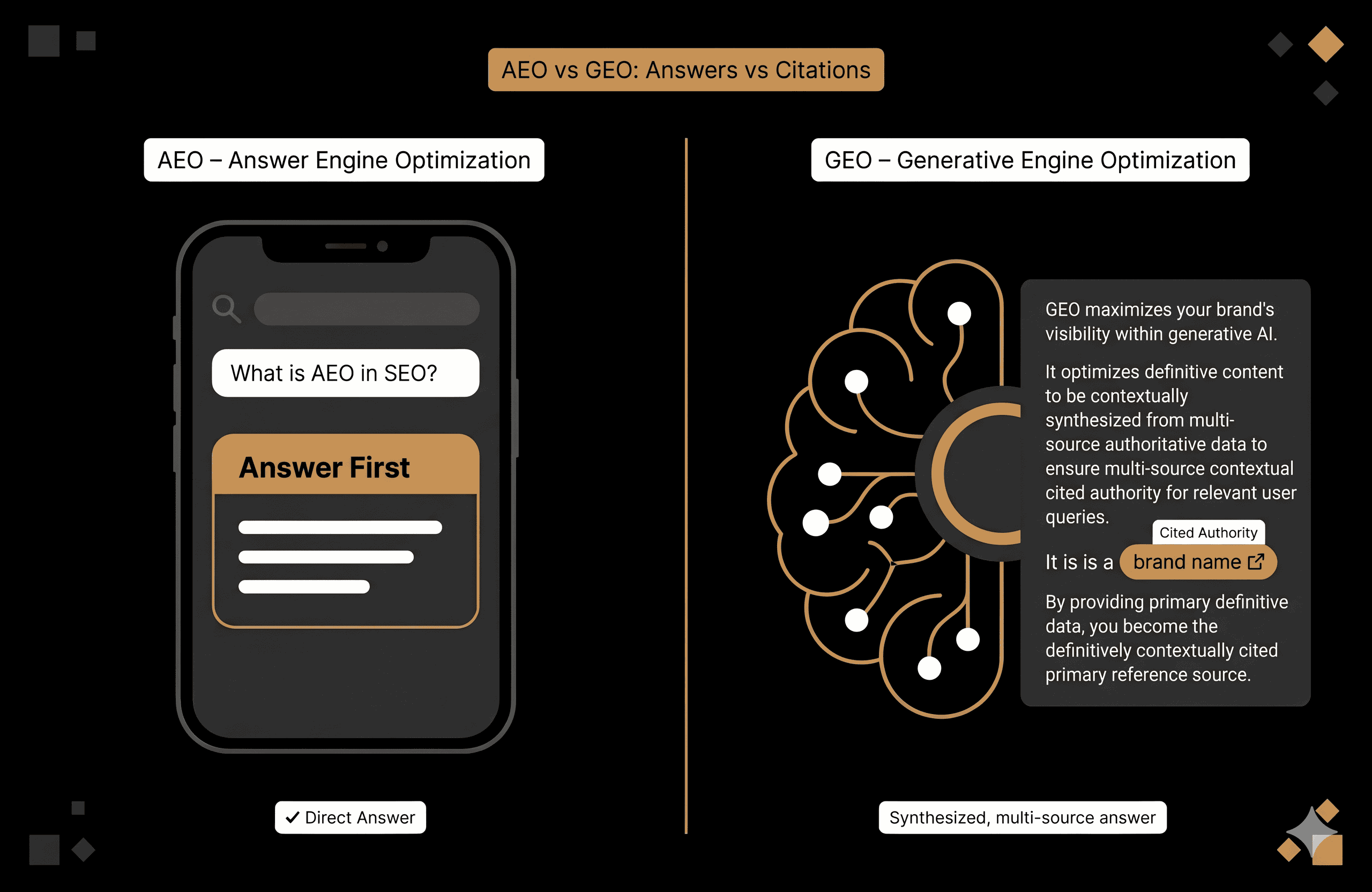
Let’s clear up the AEO vs GEO confusion once and for all. While both fall under AI optimization strategies, they serve slightly different purposes.
AEO helps your content appear as direct AI answers. GEO helps your brand get cited inside AI-generated responses. AEO is answer-focused, while GEO is citation and visibility-focused. Here’s a handy comparison table:
Why are businesses shifting from traditional SEO to AEO and GEO?
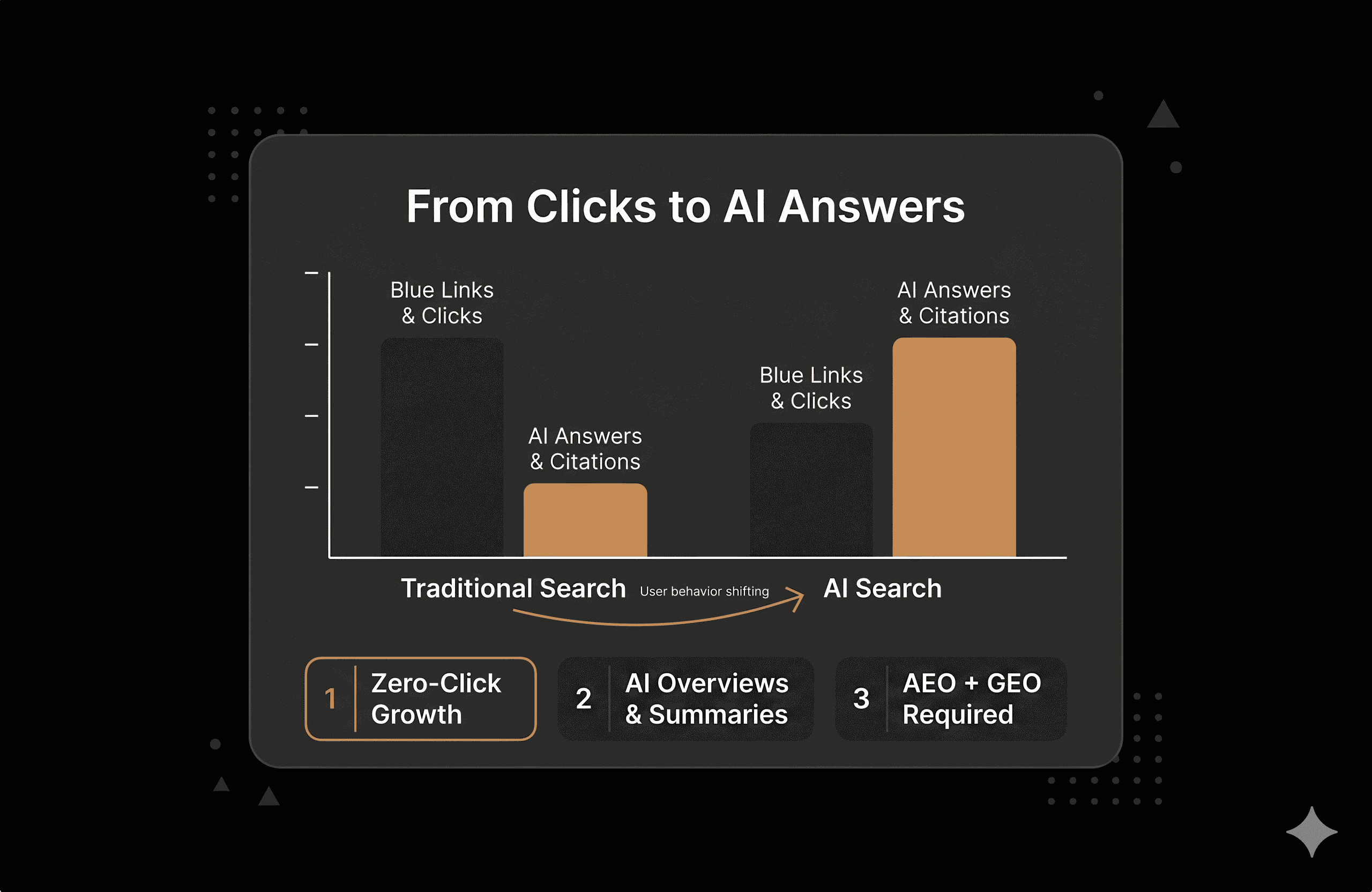
Businesses are shifting to AEO and GEO because AI-driven, zero-click searches and complex user queries are pushing traditional search rankings below the fold.
By optimizing for visibility directly within AI overviews and conversational answers, brands can capture high-intent traffic and adapt to the rising dominance of platforms like ChatGPT and Perplexity.
- Rise of zero-click and AI-assisted search behavior: AI Overviews are significantly disrupting search behavior, leading to a 58% reduction in clicks for top-indexed pages. That’s because users get the info they need from the results page. AEO and GEO allow brands to build awareness within that search experience.
- Declining dependence on traditional rankings alone: AI overviews often push traditional rankings below the fold, making it necessary to be the source for the overview.
- How users now ask full questions instead of typing keywords: Users are moving from typing simple keywords to asking complex, long-tail questions.
- Why visibility inside AI answers is becoming a new traffic channel: Platforms like Perplexity and ChatGPT are becoming major referral sources. Users who click these citations are often pre-sold and further down the sales funnel.
- Industries seeing the biggest impact first: SaaS, healthcare, legal, and travel are leading the charge. When users need a how-to or a comparison, they turn to AI first.
How do ChatGPT, Gemini, and Perplexity use AEO and GEO signals?
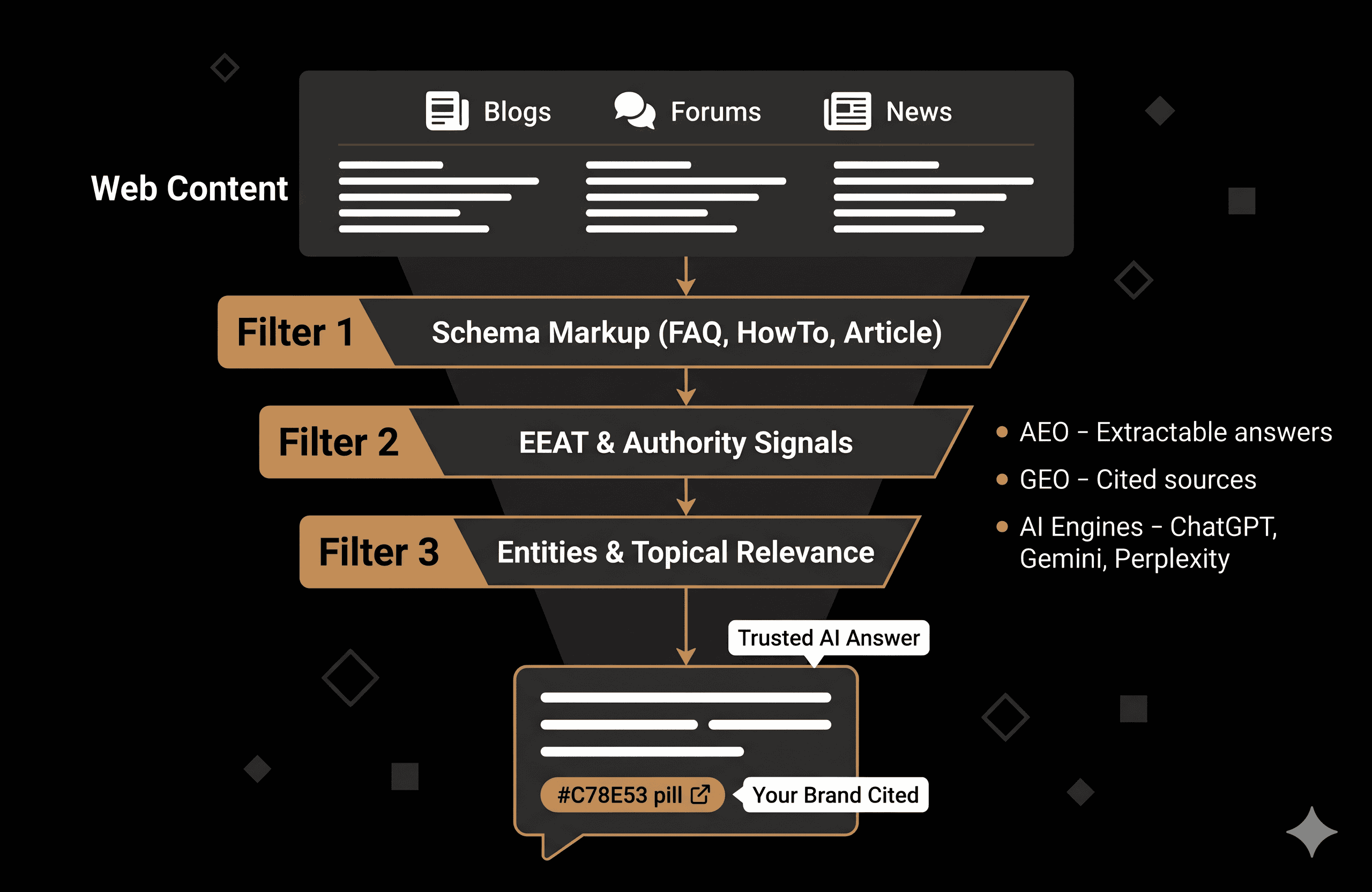
ChatGPT, Gemini, and Perplexity use AEO signals like structured answers, FAQs, and semantic clarity to extract relevant responses. They use GEO signals such as brand authority, citations, entities, and topical relevance to decide which sources and brands to reference in AI-generated answers.
To master ChatGPT SEO or Perplexity optimization, you have to understand how these AI retrieval systems determine LLM search ranking.
- How LLMs retrieve and summarize information: They use semantic search to find relevant chunks, then synthesize them.
- Role of authority, clarity, and structured content: AI prefers content that is easy to parse. Using Schema markup and clear HTML tags helps the AI understand the skeleton of your information.
- Importance of semantic relevance and entities: Mentioning exact entities (people, products, concepts) in context helps AI connect the dots.
- Why brand mentions across the web matter: A single strong page isn’t enough anymore. Consistent brand mentions across review sites, news, forums, and social media create a trustworthy digital footprint that AI loves to cite.
- How AI chooses sources to trust: It prioritizes "EEAT" (Experience, Expertise, Authoritativeness, and Trustworthiness). Freshness, citations, author credentials, and how often other reputable sites reference you all play a role.
What strategies improve AEO and GEO performance?
Ready to take action? Developing a strong AEO strategy and GEO strategy doesn't require deleting your current website. It just requires a pivot in how you present information.
To improve AEO and GEO performance, create clear, structured content that directly answers user questions and covers topics in depth.
Using schema markup, building topical authority, and earning trusted brand mentions also helps AI platforms like ChatGPT and Google understand and surface your content better.
Let’s look into these strategies in detail:
Creating question-first content structures
Start every piece with the exact questions users (and AI) are asking. Use subheadings that mirror natural language.
Using FAQs and concise answer blocks
Dedicate sections to FAQs with answers under 50 words. Using the "Answer First" method, providing a direct snackable answer followed by detail, is highly effective for AI parsing.
Building topical authority and entity relevance
Instead of short posts on random keywords, write comprehensive guides that cover a niche entirely. Use entity SEO by connecting your brand to industry leaders and established concepts to build your entity graph.
Implementing schema and structured data
Use Schema.org (JSON-LD) to tell the AI exactly what your content is, whether it's a price, a review, or a step-by-step guide. This removes the need for the AI to guess.
Earning citations and authoritative mentions
Getting featured in industry news, guest posts, and high-quality directories provides a vote of confidence for LLMs.
How can brands prepare for the future of AI-driven search?
The AI search future isn't coming; it's already here. Brands that ignore AEO and GEO are essentially deciding to be invisible to the next generation of internet users.
Early adoption of an AI visibility strategy creates a compounding advantage. Just as the brands that mastered SEO in 2010 dominated the last decade, those that master AI-first SEO today will own the share of voice in 2026 and beyond.
Aligning content with the needs of generative engines is the best way to build a sustainable brand for the next decade of digital interaction. Businesses can build sustainable visibility across AI platforms by focusing on entity strength, structured data, and consistent brand mentions across the web.
At Sagashi Digital, we specialize in exactly this. We help forward-thinking brands master AEO and GEO with tailored strategies that deliver measurable visibility in ChatGPT, Gemini, Perplexity, and Google AI Overviews.
Frequently Asked Questions
Yes! Traditional SEO is about ranking on search engine results pages. Answer engine optimization is about becoming the direct answer that AI tools serve up. They work together, but AEO focuses on extractability and conversational relevance.
GEO stands for generative engine optimization. In digital marketing, it means optimizing so your content gets cited or synthesized inside AI-generated answers rather than just ranking as a link.
Absolutely; they work best in tandem. AEO handles short, direct queries, while GEO ensures your brand is part of deeper, synthesized conversations.
Yes. ChatGPT (and similar tools) heavily relies on answer engine optimization signals like clear structure, authority, and semantic relevance to decide which sources to pull from.
In-depth, data-driven, and authoritative content like research papers, detailed "how-to" guides, and industry reports perform best because of their information density.
Ready to Get Found by More Customers?
We help you generate qualified inbound leads through search - without paying for ads. Our content strategy is built to create a consistent pipeline, shorten sales cycles, and turn organic traffic into revenue.