
Can AI Do SEO for My Website? What AI Can (and Can't) Do in 2026
By
Rushabh Menon
Founder | Sagashi Digital

Summarize this article using AI
Can AI do SEO for my website? The short answer is yes - but only up to a point.
AI can help with keyword research, content creation, on-page optimization, reporting, and many other SEO tasks that used to take hours. In fact, AI-powered tools are making SEO faster, more accessible, and more affordable than ever before.
That's why more businesses are turning to tools like ChatGPT, Claude, Surfer SEO, and Ahrefs AI features to improve their search visibility. With AI capable of generating content, analyzing data, and identifying optimization opportunities in seconds, it's easy to see why many website owners are asking whether they still need SEO experts at all.
However, the reality is more nuanced. While AI is excellent at automating repetitive tasks and accelerating workflows, it still struggles with strategic decision-making, understanding business goals, interpreting search intent, and creating truly original content. Relying entirely on AI can save time, but it can also lead to missed opportunities, inaccurate recommendations, and content that fails to stand out in competitive search results.
In this guide, you'll learn exactly what AI can do for SEO, where it falls short, how AI affects rankings on Google and AI search engines, and when it makes sense to combine AI tools with expert SEO support to achieve better results.

What SEO Tasks Can AI Handle Effectively?
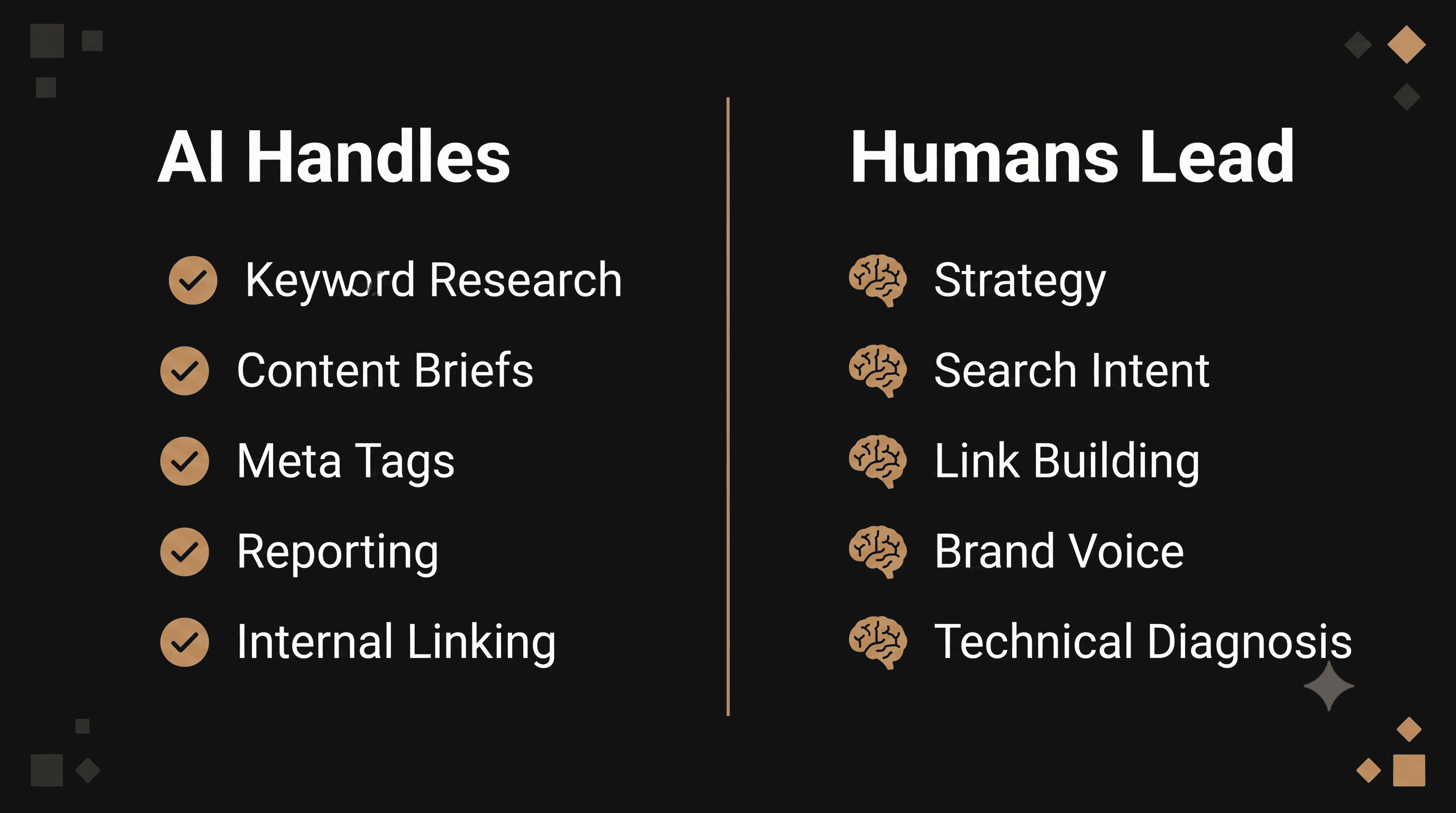
AI is excellent at speeding up repetitive and data-heavy SEO work. It can process large amounts of information in seconds, identify patterns, and generate recommendations that would take humans much longer to produce. While AI cannot replace SEO expertise, it can significantly improve productivity when used correctly.
Approximately, 65% of businesses notice better SEO results when they use AI tools for optimization. [Source - SeoProfy]
Keyword Research and Topic Ideas
Finding the right keywords is one of the most time-consuming parts of SEO. AI tools can quickly perform keyword research, identify related search terms, uncover long-tail opportunities, and suggest content topics based on search intent.
For example, if you enter "email marketing software" into ChatGPT or Claude, they can generate dozens of related topics, questions, and content angles within seconds. Tools like Ahrefs also use AI to surface keyword opportunities and cluster related topics.
AI is particularly useful for:
- Brainstorming content ideas
- Finding long-tail keywords
- Discovering semantic keywords
- Identifying People Also Ask questions
- Creating topic clusters
However, human review is still important because AI cannot always accurately assess keyword difficulty, business relevance, or revenue potential.
Content Brief Creation
Creating a content brief typically requires researching competing pages, identifying subtopics, and structuring content to match search intent. AI can automate much of this process.Tools like ChatGPT, Claude, Surfer SEO, and Clearscope can help create outlines, recommend headings, suggest questions to answer, and identify important topics to cover.
This helps SEO teams:
- Publish content faster
- Maintain consistency
- Cover important subtopics
- Reduce research time
The best results come when human editors refine AI-generated briefs using industry expertise and audience knowledge.
Meta Titles and Descriptions
Writing optimized meta titles and descriptions is a repetitive task that AI handles well. AI can generate multiple title and description variations based on target keywords, search intent, and character limits.
For example, ChatGPT can instantly produce:
- Click-focused title options
- SEO-friendly meta descriptions
- Alternative headline variations
- Featured snippet-friendly summaries
Content Optimization
AI-powered SEO tools can analyze existing content and identify opportunities for improvement. Platforms like Surfer SEO and Clearscope compare your content against top-ranking pages and provide recommendations such as:
- Missing keywords
- Content gaps
- Readability improvements
- Heading suggestions
- Topical coverage enhancements
AI can also assist with:
- Updating outdated content
- Expanding thin pages
- Improving content structure
- Optimizing for featured snippets
That said, optimization suggestions should never be followed blindly. Search intent and user value should always take priority over keyword recommendations.
Internal Linking Suggestions
Internal links help search engines understand website structure and distribute authority across pages. AI tools can analyze site content and identify relevant linking opportunities automatically. For larger websites, this can save hours of manual work.
SEO Reporting and Data Analysis
SEO generates a huge amount of data. AI can help make sense of it. Instead of manually reviewing rankings, traffic reports, and search performance data, AI can summarize trends, identify anomalies, and highlight opportunities.
Tools with AI capabilities can:
- Analyze ranking changes
- Detect traffic drops
- Surface content opportunities
- Summarize SEO performance
- Generate client reports
For businesses managing hundreds or thousands of pages, this can significantly reduce reporting time while helping teams focus on strategy rather than spreadsheets.
What SEO Tasks Should Not Be Left to AI Alone?
AI can automate many SEO activities, but some of the most important decisions still require human expertise. SEO isn't just about generating content or analyzing data. It's about understanding a business, its audience, its competitors, and its goals.
This is where AI often falls short. AI works best as an assistant, not as the person in charge.
SEO Strategy Development
AI can suggest keywords, topics, and optimizations, but it cannot build a growth strategy around your business goals. An experienced SEO professional can prioritize opportunities based on revenue potential, competition, and customer needs rather than search volume alone.
Understanding Search Intent
One of AI's biggest limitations is understanding why someone is searching. A keyword may appear relevant, but the intent behind it could be informational, transactional, or navigational. Human analysis is often needed to ensure content matches what users actually want.
Competitive Analysis
AI can summarize competitor content, but it often struggles to identify strategic gaps and opportunities. SEO professionals look beyond rankings to understand what competitors are doing well, where they're vulnerable, and how a brand can differentiate itself.
Link Building and Digital PR
Building authority requires relationships, creativity, and outreach. AI can help draft emails or identify prospects, but earning high-quality backlinks and media mentions still depends largely on human effort and communication.
Technical SEO Audits
AI-powered tools are great at detecting issues such as broken links, duplicate content, and crawl errors. However, diagnosing the root cause and deciding on the right solution often requires technical expertise and experience.
Brand Positioning and Messaging
AI tends to generate content based on existing patterns across the web. As a result, the output can sound generic. Humans are needed to bring original insights, industry expertise, and a unique brand voice that helps content stand out.
AI SEO vs Human SEO - What's the Difference?
The biggest difference between AI and human SEO experts is that AI excels at execution, while humans excel at strategy. AI can process data, generate content, and identify patterns at scale, but it lacks the business understanding, critical thinking, and industry experience needed to make high-impact decisions.
The most effective SEO strategies don't choose between AI and humans. They combine both.
This gap becomes even more important as AI search platforms like ChatGPT, Perplexity, Gemini, and Google AI Overviews continue to evolve. Optimizing for these platforms requires understanding authority signals, brand mentions, content credibility, and user intent - areas where human expertise remains essential.
Why AI-Generated SEO Content Often Struggles to Rank?
AI can create blog posts, landing pages, and product descriptions in minutes. But publishing AI-generated content without human input is rarely a recipe for long-term SEO success.
The problem isn't that search engines dislike AI content. The problem is that much of it lacks the qualities that make content genuinely useful to readers.
Generic Content
AI generates content by predicting patterns from existing information. As a result, many AI-written articles cover the same points, use similar examples, and offer little that readers haven't already seen elsewhere.
If your content looks like dozens of competing pages on the same topic, there's little reason for Google to rank it above them.
Lack of First-Hand Experience
One of AI's biggest limitations is that it doesn't have real-world experience.
It can explain how to run an SEO campaign or build a marketing strategy, but it can't share lessons learned from actually doing the work. Readers and search engines increasingly value original insights, case studies, examples, and expertise that come from real experience.
Weak EEAT Signals
Google evaluates content using principles known as EEAT: Experience, Expertise, Authoritativeness, and Trustworthiness.
Purely AI-generated content often struggles to demonstrate these qualities because it lacks expert opinions, original research, personal experience, and credible supporting evidence. Without strong EEAT signals, content may find it difficult to earn trust from both users and search engines.
Google's Focus on Helpful Content
Google has repeatedly stated that it focuses on the quality and usefulness of content rather than how it was created. According to Google's guidance, AI-generated content is not automatically against its policies, but content created primarily to manipulate search rankings can violate its spam policies.
The key question isn't whether AI helped create the content. It's whether the content is accurate, helpful, original, and satisfying for users. [Source: Google Search Central]
Can AI Improve Rankings on Google and AI Search Engines?
Yes, AI can improve rankings and visibility when used correctly. It can help you identify keyword opportunities, optimize content, uncover content gaps, and scale SEO efforts more efficiently.
About 86% of SEO professionals have integrated AI tools into their search strategy by 2026. [Source - SeoProfy]
However, AI itself doesn't improve rankings. The value comes from how you use it. Businesses that combine AI-powered workflows with human expertise are often able to produce better content, optimize faster, and respond more quickly to search trends.
Google Search
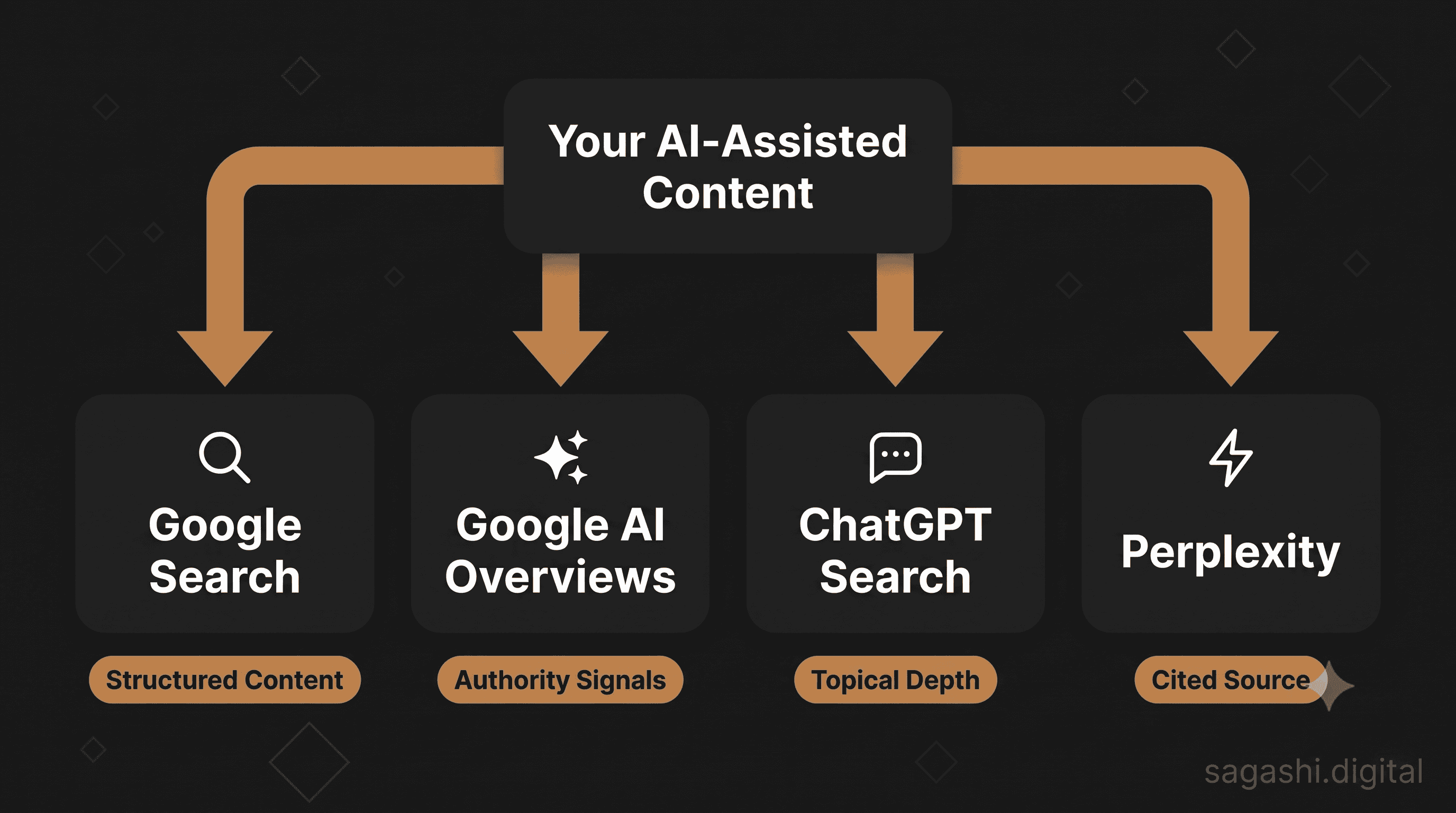
AI can help improve traditional Google rankings by streamlining many SEO tasks. For example, AI tools can identify related keywords, suggest missing topics, and help create more comprehensive content that better satisfies search intent. They can also assist with refreshing outdated pages, which is often an effective way to improve rankings without creating new content from scratch.
That said, rankings still depend on factors like content quality, backlinks, user experience, and authority - areas where human expertise remains essential.
Google AI Overviews
Google's AI Overviews generate answers by pulling information from multiple trusted sources across the web. To increase the chances of being cited, your content needs to be clear, authoritative, well-structured, and focused on answering specific user questions. AI can help identify common questions and optimize content for featured snippets and answer-style formats.
ChatGPT Search
ChatGPT Search often references websites that provide clear, trustworthy, and comprehensive information. AI can help create content that addresses common customer questions, covers topics in depth, and improves topical authority. These factors can increase the likelihood of your content being surfaced when users ask relevant questions through ChatGPT.
Perplexity
Perplexity places a strong emphasis on sourcing and citations. It frequently references websites that provide direct answers, credible information, and well-organized content. AI can help structure content around specific questions, improve readability, and ensure key information is easy for both users and AI systems to understand.
Gemini and Other AI Search Engines
Platforms such as Gemini and emerging AI search tools are changing how users discover information online. Instead of returning a list of links, they often provide summarized answers generated from multiple sources.
This means businesses need to think beyond traditional rankings. Success increasingly depends on creating content that is accurate, trustworthy, easy to understand, and worthy of being referenced by AI systems.
As AI search continues to evolve, brands that invest in both SEO and Answer Engine Optimization (AEO) will be better positioned to maintain visibility across multiple search experiences.
How to Use AI for SEO Without Hurting Your Website?
AI can be a powerful SEO assistant, but using it incorrectly can create more problems than it solves. Many businesses make the mistake of publishing AI-generated content without reviewing it, relying entirely on AI recommendations, or chasing scale at the expense of quality. The safest and most effective approach is to use AI to enhance your SEO efforts, not replace human expertise.
- Start with human strategy
Before using any AI tool, define your goals, target audience, and SEO priorities.
- Use AI for research and drafting
AI is excellent at speeding up keyword research, content ideation, outline creation, and first drafts. Instead of spending hours staring at a blank page, you can use AI to create a strong starting point and then build on it.
- Add original insights
This is where human expertise makes the difference. Include real-world examples, case studies, industry knowledge, customer insights, and unique perspectives that AI cannot generate. Originality is often what separates content that ranks from content that gets ignored.
- Fact-check everything
AI can make mistakes, cite outdated information, or present inaccurate claims with confidence. Always verify statistics, examples, and recommendations before publishing content or implementing SEO changes.
- Optimize for EEAT
Google increasingly rewards content that demonstrates Experience, Expertise, Authoritativeness, and Trustworthiness.
- Monitor performance regularly
SEO is not a set-it-and-forget-it process. Track rankings, traffic, conversions, and user engagement to understand what's working. Use those insights to refine both your AI-assisted workflows and your overall SEO strategy.
When Should You Hire an SEO Agency Instead of Relying on AI?
AI can help you generate content, research keywords, and identify optimization opportunities. For small websites with limited competition, that may be enough to make incremental improvements.
However, if organic search plays a meaningful role in generating leads, sales, or revenue, relying on AI alone can become limiting. At that point, strategic expertise often matters more than automation.
Competitive Industries
If you're competing in industries like finance, healthcare, legal services, real estate, or B2B software, chances are your competitors are already investing heavily in SEO.
In these markets, ranking isn't just about publishing content. It requires deep competitor analysis, content strategy, authority building, technical optimization, and ongoing refinement. AI can support these activities, but it rarely delivers a competitive advantage on its own.
Ecommerce SEO
Ecommerce websites often have hundreds or thousands of pages that need optimization. Managing category pages, product pages, technical SEO, site architecture, internal linking, and conversion-focused content requires a level of expertise that goes beyond what most AI tools can provide. Small mistakes can impact rankings, traffic, and revenue across an entire website.
SaaS SEO
SaaS SEO is particularly challenging because it involves targeting different stages of the customer journey, from awareness to product comparisons and purchase decisions.
Success requires a combination of content strategy, search intent analysis, technical SEO, and product positioning. While AI can help create content faster, it cannot replace the strategic thinking needed to build sustainable organic growth.
Businesses Targeting AI Search Visibility
Search is no longer limited to Google's traditional results. Users are increasingly finding answers through Google AI Overviews, ChatGPT Search, Perplexity, Gemini, and other AI-powered platforms.
Ranking in these environments requires more than traditional SEO. Brands need strong authority signals, structured content, topical depth, and content that AI systems can confidently cite and reference. This is where Answer Engine Optimization (AEO) becomes just as important as SEO.
Why Many Businesses Combine AI With Agency Expertise?
The most successful businesses don't choose between AI and SEO professionals. They use both.
AI helps automate research, content workflows, reporting, and optimization tasks. Human experts provide the strategy, creativity, and business understanding needed to turn those efficiencies into measurable growth.
At Sagashi Digital, this combination sits at the core of our approach. We use AI-powered workflows to accelerate research and execution, while keeping strategy, quality control, and decision-making firmly human-led.
This allows us to help businesses improve visibility across both traditional search engines and emerging AI search platforms through a unified SEO and AEO strategy.
Commonly Asked Questions About Can AI Do SEO for My Website?
Can ChatGPT do SEO for a website?
ChatGPT can assist with many SEO tasks, including keyword research, content outlines, meta descriptions, content optimization, and topic ideation. However, it cannot fully manage an SEO strategy on its own. Human expertise is still needed for search intent analysis, technical SEO, link building, and strategic decision-making.
Is AI-generated content bad for SEO?
No. Google does not automatically penalize content because it was created using AI. What matters is the quality of the content. Helpful, accurate, and original content can perform well regardless of how it was created, while low-quality content is unlikely to rank.
Can AI replace SEO experts?
Not completely. AI is excellent at automating repetitive tasks and speeding up workflows, but it lacks the business understanding, strategic thinking, and industry expertise required for long-term SEO success. The best results usually come from combining AI tools with human expertise.
Which AI tools are best for SEO?
Some of the most popular AI-powered SEO tools include ChatGPT, Claude, Surfer SEO, Clearscope, and Ahrefs' AI features. Each tool serves a different purpose, from content creation and keyword research to optimization and performance analysis.
Can AI help websites rank in Google AI Overviews?
Yes. AI can help create content that is well-structured, comprehensive, and optimized for common user questions. However, earning visibility in Google AI Overviews also requires strong authority, expertise, and trust signals that go beyond AI-generated content.
Frequently Asked Questions
For many small businesses, AI can reduce costs and improve efficiency by automating research, content creation, and optimization tasks. However, businesses in competitive industries may still need expert guidance to achieve meaningful SEO growth.
AI recommendations can be helpful, but they are not always accurate. AI tools may misunderstand search intent, recommend outdated tactics, or overlook important business context. It's important to review and validate AI-generated suggestions before implementing them.
The biggest limitation is the lack of strategic judgment. AI can analyze data and generate recommendations, but it cannot fully understand your business goals, target audience, competitive landscape, or brand positioning in the way an experienced SEO professional can.
Google's guidance focuses on content quality rather than content creation methods. AI-generated content is allowed as long as it is useful, accurate, and created to help users rather than manipulate search rankings. Poor-quality content can struggle to rank regardless of whether it was written by AI or a human.
AI-powered SEO tools can identify many common technical issues, such as broken links, missing metadata, crawl errors, and duplicate content. However, interpreting those findings and implementing the right fixes often requires technical SEO expertise, especially for larger or more complex websites.
Ready to Get Found by More Customers?
We help you generate qualified inbound leads through search - without paying for ads. Our content strategy is built to create a consistent pipeline, shorten sales cycles, and turn organic traffic into revenue.