
The GEO Strategy Framework for 2026: How Brands Rank in ChatGPT, Gemini & Perplexity
By
Rushabh Menon
Founder - Sagashi Digital
Summarize this article using AI
GEO (generative engine optimization) is the process of optimizing content so AI search engines like ChatGPT, Gemini, Perplexity, and Google AI Overviews can discover, understand, extract, and cite your brand accurately.
In 2026, GEO is emerging rapidly as users increasingly rely on conversational AI for answers instead of traditional search. Brands now compete not just for clicks, but for valuable citations in AI-generated responses.
The key difference? Traditional rankings place you in blue-link SERPs, while citations make you part of the actual answer users see and trust. Not surprisingly, the global GEO market is expected to reach $1,089.3 million in 2026. It will then grow at 40.6% per year until 2034, reaching $17,148.6 million.
Below, we’ll break down exactly what the GEO strategy framework is and how these smart AI engines think. We’ll also share how you can make sure your brand gets the spotlight it deserves in this brave new AI world.

What is GEO, and how is it different from traditional SEO?
GEO (generative engine optimization) is the process of optimizing content so that AI search engines like ChatGPT can discover, understand, extract, and cite your brand.
Don’t view GEO SEO as a completely different strategy. Instead, consider it the next evolutionary step in search optimization. Unlike traditional SEO, which focuses on algorithms like PageRank and keyword matching for search engine results pages (SERPs), GEO targets how AI systems generate natural-language answers.
To paint a clear picture of how this looks in practice, let’s lay out the structure of AI search optimization side-by-side with its predecessor:
Table: SEO vs GEO
How do AI search engines choose which brands and pages to cite?
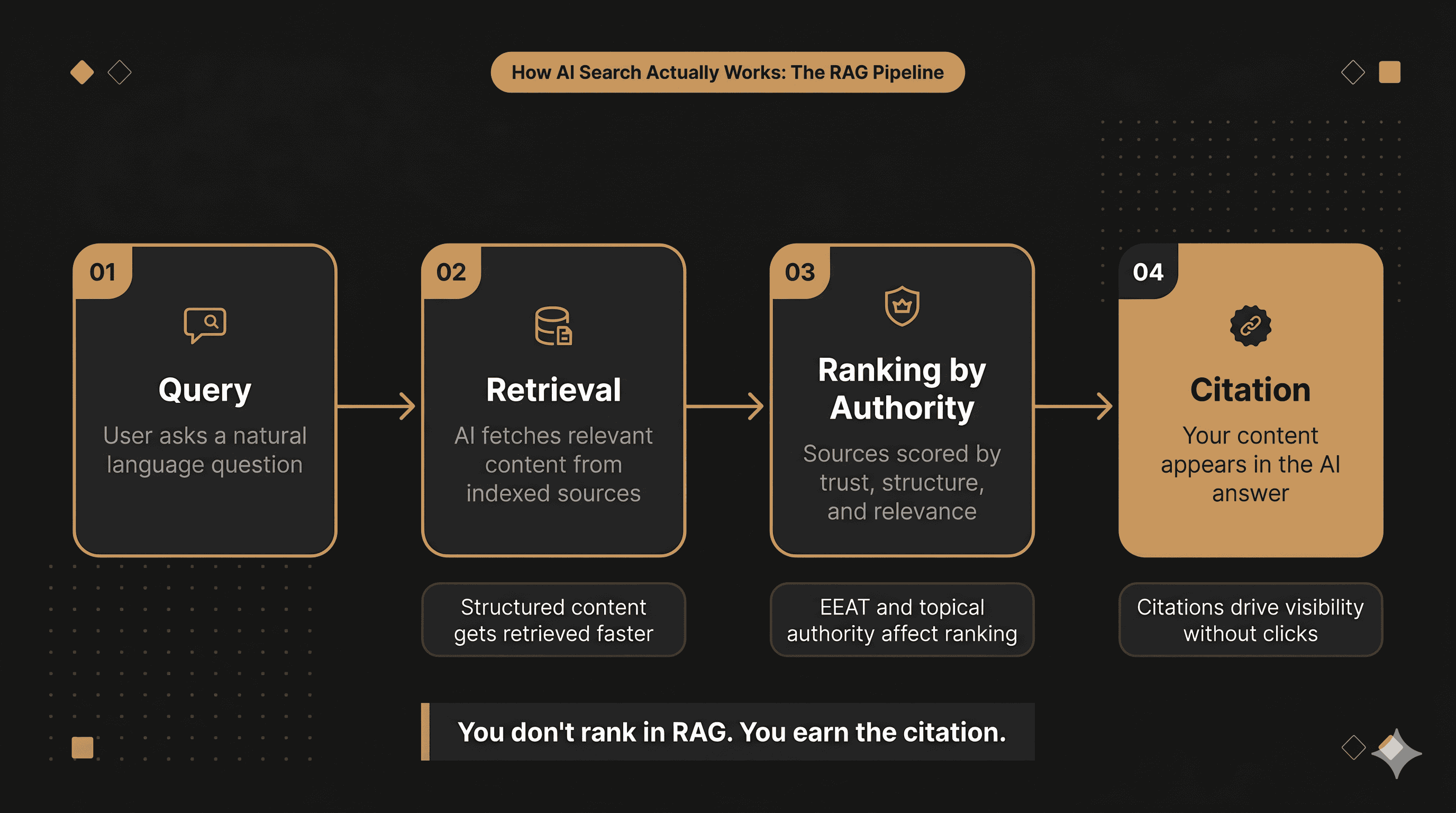
AI engines choose sources using a multi-step retrieval-augmented generation (RAG) pipeline. They break down the prompt, search repositories, rank results by clarity and trust, extract key snippets, and generate the answer.
Primarily, topical authority and entity recognition, structured formatting, concise answer-focused, and freshness and relevance signals are AI search ranking factors that determine which pages get cited.
Topical authority and entity recognition
AI engines don’t evaluate your website as an isolated island of text. They view it through the lens of semantic graphs.
They constantly match your content against recognized entities (established real-world people, places, tools, and brands). You’re more likely to earn AI citations if your site demonstrates deep, interconnected expertise on a single topic.
Importance of trusted sources
Models are trained to avoid hallucinating, meaning they favor information backed by verifiable proof.
The KDD 2024 Princeton-led study revealed that simply adding authoritative sources, external citations, and peer-reviewed data to your content can improve your visibility in generative engines by over 30%. AI loves to cite sites that cite other trustworthy authorities.
Why structured formatting matters
Large language models are excellent readers, but they are also deeply fond of efficiency.
Content that utilizes clear H2 and H3 structures, bulleted lists, clean Markdown tables, and machine-readable JSON-LD schema markup makes it incredibly easy for an AI to parse. If your data is easy to extract, it is easy to cite.
So, learning how to structure a page for AEO and GEO is more important than you think.
Role of concise answer-focused content
AI search queries are fundamentally conversational, often averaging over 20 words in length compared to traditional 3-word keyword searches.
To capture these, you must practice a citation-first writing structure. Lead with a crystal-clear, direct answer to the user's implicit question in the very first paragraph, then follow up with deeper analysis.
Freshness and relevance signals
Live-retrieval AI engines (like Perplexity and Gemini) cross-reference real-time web results to build answers for current queries.
Content that is frequently refreshed with up-to-date data, breaking industry research, and modern insights sends a strong relevance signal that older, static pages simply cannot match.
What content formats perform best in GEO?
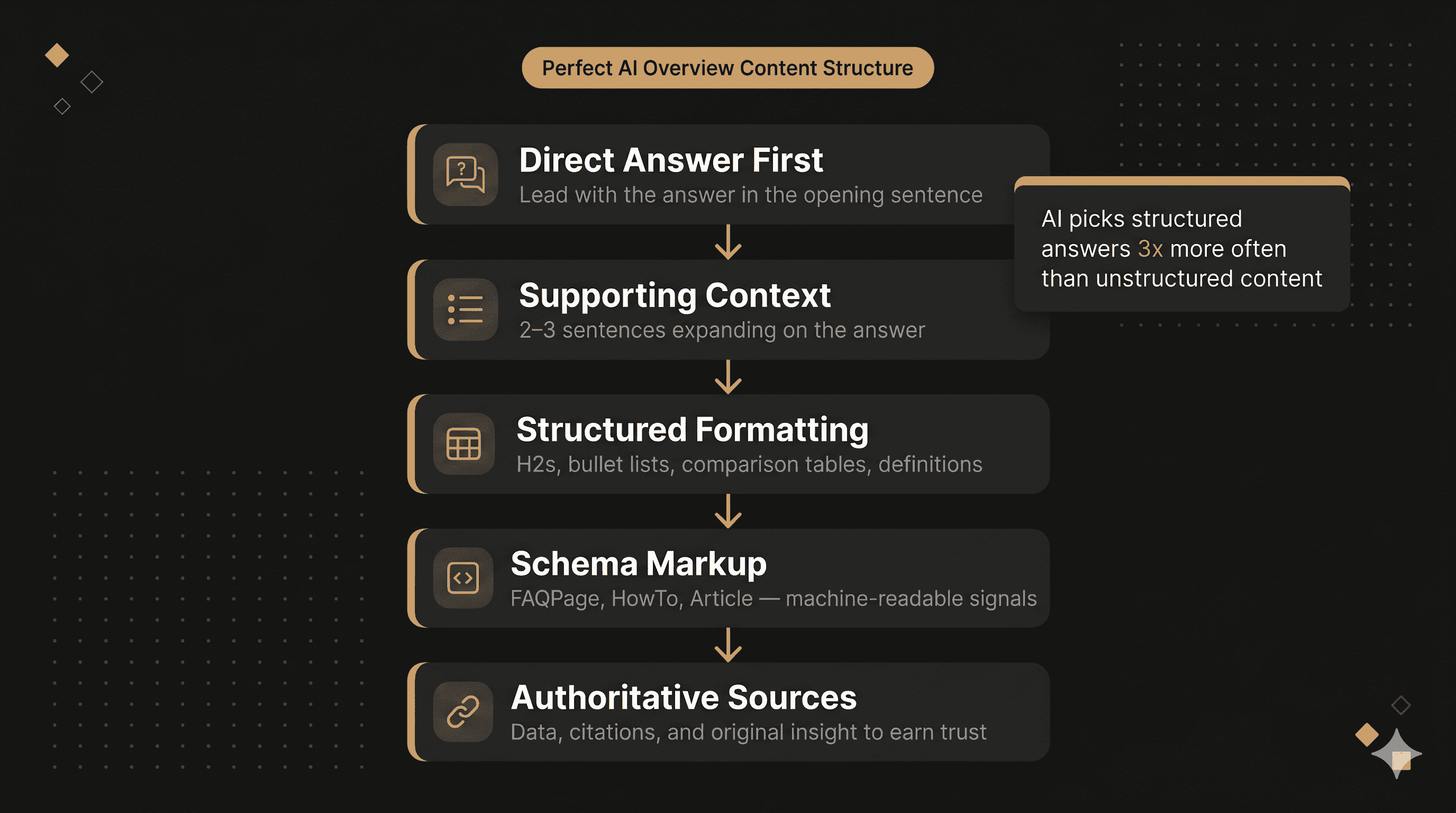
Content formats that dominate citations are highly structured, asset-rich, and information-dense.
AI models gravitate toward pieces that feature research studies and data, Q&A formats, comparisons, definition-style explanations, and expert-led long-form guides. Your GEO content strategy pays off the most when you focus on these core formats.
Research studies and data-backed content
If you want to become completely unignorable to an AI model, publish original data.
When you publish a proprietary industry report full of fresh statistics, AI engines take notice. They naturally grab your numbers to back up their claims and link directly to your study as the ultimate source of truth.
Question-answer content structures
Users speak to AI in full sentences, so your content should mirror that conversational flow. Understanding how FAQs improve AEO rankings highlights why this format is so powerful.
Format your content to directly mimic the natural, conversational questions users type into ChatGPT or Perplexity. Follow it with a direct answer, and you create perfect text snippets that LLMs can instantly pull into their summaries.
Comparison pages and frameworks
When users ask an AI to compare products, the AI reads existing web matrices to build its answer. Providing detailed, objective, and deeply structured comparison tables on your site ensures the AI uses your criteria to formulate its response.
Definition-style educational content
AI engines are constantly explaining complex concepts to users. Creating definitive, clear resources that break down complex terms makes your site a premier destination for AI bots looking for a reliable definition template.
Expert-led long-form guides
Conciseness matters for the initial answer, but depth matters for validation. Comprehensive guides featuring direct quotes from recognized industry practitioners perform exceptionally well.
In fact, the Princeton study reveals that adding direct, expert quotations to content can boost AI search visibility by an incredible 41%.
What role do entities and topical authority play in GEO?
Entities and topical authority are core to GEO. Topical authority signals to AI engines that your site is a trusted expert in a subject, increasing citation chances. Entities help AI models accurately understand, match, and reference your content. Together, they boost visibility and selection in AI-generated answers.
- Why AI engines rely on entities: LLMs use entity graphs to cross-reference facts. When your brand is frequently mapped alongside elite, trusted entities in your space, the AI learns that your brand is a legitimate, real-world force, not just an anonymous domain name.
- Building authority around topics: AI engines rarely cite websites that only have a single, isolated post about a topic. They look for comprehensive topical coverage. To win, you must transition your content methodology from random blogs to search systems. That is to say, you must build robust content clusters that cover a subject from every angle.
- Importance of semantic relationships: AI models excel at understanding context, synonyms, and natural human intent. Semantic optimization means writing naturally about a topic, automatically including all the naturally co-occurring words, subtopics, and concepts an expert would use.
- Why topical depth beats isolated blogs: Publishing 20 disconnected, shallow blog posts does nothing for an LLM. However, building 4 or 5 deeply researched, highly interconnected topical hubs signals to the AI that your site offers genuine, comprehensive depth.
- How entities improve AI understanding: When you use clear entity nouns, name specific software platforms, reference actual academic studies, and cite known industry figures, you eliminate ambiguity. The cleaner your language, the faster the AI can categorize your content and safely serve it up to users.
How can brands increase visibility in ChatGPT, Gemini, and Perplexity?
To optimize for ChatGPT, Perplexity, or Gemini, you must publish citation-worthy research and educational content, build branded topical ecosystems, and increase brand mentions. Your ChatGPT, Perplexity, and Gemini SEO strategy must also focus on optimizing for conversational queries.
Publishing citation-worthy research
Commit to launching at least two proprietary data reports or surveys every year. Fill them with clean, structured quantitative statistics. When other sites reference your numbers, and AI engines scrape those pages, your off-site trust footprint expands exponentially.
Creating structured educational content
Revamp your high-value pages to follow a strict information hierarchy. Knowing how to make content AI‑friendly is a prerequisite here.
Use clean headers, summarize complex ideas in bullet points, and place a 2-3 sentence executive summary right at the top of every guide to make it effortless for an AI model to extract.
Building branded topical ecosystems
Audit your content to identify gaps in your core subject matter. Create internal linking webs that tightly connect your detailed sub-articles back to your main pillar pages. This makes it incredibly easy for both human readers and AI scrapers to navigate your knowledge base.
Increasing brand mentions across the web
AI engines don't just look at your website; they look at what the rest of the web says about you.
Focus heavily on earned media, public relations, podcast appearances, and third-party reviews. The more your brand entity is mentioned alongside your industry keywords on other authoritative sites, the more the AI trusts your relevance.
Optimizing for conversational queries
Analyze your customer support logs and sales conversations to uncover the exact phrasing your buyers use.
Shift your content targeting away from rigid fragments like "B2B CRM features" and move toward long-tail, conversational triggers like "How can a remote marketing team track sales pipeline in a B2B CRM?"
What are the biggest GEO mistakes brands are making right now?
The costliest GEO mistakes involve treating conversational engines like a classic search index and flooding the web with low-value text.
Failing to provide the explicit data structures that machines require to verify facts, a lack of proper structure, and focusing only on keyword density are also common AI search SEO mistakes.
- Treating GEO exactly like SEO: The biggest pitfall is running the old playbook on a new field. If you are solely focusing on meta-description length, backlink counts, and keyword density without structuring your text for easy AI data extraction, you will miss out on AI citations.
- Publishing generic AI-generated content: If you use basic, unedited AI prompts to mass-produce generic blog posts, you are creating an echo chamber. AI search engines look for novel data, unique insights, and human expertise. They will bypass rehashed content every single time.
- Ignoring entity optimization: Failing to claim your brand profiles, neglecting your corporate Wikipedia footprints, and leaving your JSON-LD schema unconfigured leaves your entity disconnected in the digital ether.
- Writing without a clear extraction structure: Burying your brilliant insights deep within a 1,000-word essay with no subheaders or formatting is a surefire way to get overlooked. If the AI can't easily isolate and pull out the answer, it will simply move on to a site that handed it to them on a silver platter.
- Focusing only on keyword density: Keyword stuffing is dead. AI search engines operate in vector spaces and think in concepts, not word counts. Repeating a phrase ten times will only hurt your human readability while doing absolutely nothing to impress the algorithms.
How should businesses prepare for the future of AI search?
Navigating the future of seo requires an integrated approach that weaves together traditional ranking strategies with advanced AI search strategies and an agile GEO framework.
Focus heavily on building an undeniable digital authority, so your brand is naturally chosen by autonomous AI agents. This means gracefully integrating SEO (to capture classic searchers), GEO (to win citations in LLM summaries), and AEO (to dominate direct voice and text answers).
Soon, you’ll build a strong, unshakeable digital presence across every layer of the modern information ecosystem.
Need expert help implementing the GEO strategy framework? Check out Sagashi Digital. We help build custom, future-proof frameworks that protect your digital visibility, strengthen your organic authority, and position your brand as the definitive answer for AI engines in your industry.
5 Commonly Asked Questions About GEO Strategy Framework
How long does it take to see results from a GEO strategy?
Most brands start seeing early citation gains within 8 to 12 weeks, especially if they publish original research or restructure existing pillar content. Full topical authority, the kind that gets you cited consistently across ChatGPT, Gemini, and Perplexity, typically takes 6 to 9 months of sustained, interconnected content work. Unlike traditional SEO, where rankings can shift quickly, AI engines need repeated exposure to your entity across multiple trusted sources before they treat your brand as a reliable citation.
Can small businesses compete with large brands in GEO?
Yes, and often more easily than in traditional SEO. AI engines prioritize clarity and depth over domain size, so a small business with a tightly focused, well-structured resource can outrank a much larger competitor's shallow page. The key is picking a narrow enough topic that you can genuinely dominate with original data, clear formatting, and expert-level detail, rather than trying to compete broadly across an entire industry.
Does GEO replace the need for traditional SEO?
No, GEO works alongside traditional SEO rather than replacing it. You still need solid technical SEO, backlinks, and keyword targeting to rank in classic search results and feed the web index that AI engines pull from. GEO adds a second layer on top, structuring and enriching that same content so it also gets picked up and cited inside AI-generated answers. Think of it as an evolution of your existing strategy, not a separate one.
How do you measure whether GEO efforts are actually working?
Track brand mentions and citations directly inside AI tools like ChatGPT, Gemini, and Perplexity by running your target queries manually or using emerging AI-visibility tracking tools. Beyond citation frequency, watch for increases in branded search volume and referral traffic from AI platforms, since users who see your brand cited often search for it directly afterward. Traditional rank tracking alone will not capture this, so you need to build a separate measurement habit specifically for AI answers.
What is the biggest mistake brands make when starting with GEO?
The most common mistake is publishing more content instead of restructuring what already exists. Brands assume GEO means writing new blog posts, when in reality, most gains come from reformatting existing pillar pages with clear headers, direct answers, and structured data. Piling on more shallow content without fixing structure or adding original insight just adds noise, it does not improve citation chances.
Frequently Asked Questions
GEO stands for generative engine optimization. It is a new extension of search marketing focused on optimizing web content. So, AI-driven search tools and large language models can easily find, extract, and cite your brand within their conversational answers.
Traditional SEO focuses on ranking your web pages high up in a list of blue links on search engine results pages to drive direct clicks. Meanwhile, GEO focuses on getting your brand cited and synthesized directly inside the AI-generated answers provided by conversational engines.
AI engines prioritize content that is semantically clear and structurally organized (using clean tables and headings). They also favor factually dense content with original statistics, authored by verified entities with strong topical authority and credible external validation.
The best-performing formats include original research papers, data-backed reports, and clear question-and-answer structures. Content that features objective product comparison matrices, definition-style educational resources, and long-form guides packed with authentic expert commentary also performs best in GEO.
Focus on creating highly structured content that directly answers natural, conversational questions. Include original data, use clear semantic headers, back up your claims with reputable sources, and make sure your technical foundation is easy for AI bots to crawl.
Ready to Get Found by More Customers?
We help you generate qualified inbound leads through search - without paying for ads. Our content strategy is built to create a consistent pipeline, shorten sales cycles, and turn organic traffic into revenue.