
Why 10 Well-Cited Articles Beat 100 Blog Posts for AI Visibility In 2026?
By
Rushabh Menon
Founder | Sagashi Digital
Summarize this article using AI
AI visibility doesn't come from how many blogs you publish. It comes from how many times AI engines trust your content enough to cite it. Ten deeply researched, well-linked articles will out-perform a hundred generic posts in Google AI Overviews, ChatGPT, and Perplexity every time.
AI engines pull answers from pages that show depth, structure, and credible sourcing. Volume-first content strategies dilute your authority across too many thin pages. A focused library of authoritative articles builds the topical depth and citation-worthiness AI systems actually look for.
The rest of this article breaks down why quality beats quantity, what "well-cited" really means, and how to restructure your content plan around it.

What is AI visibility and why does it matter more than blog volume?
AI visibility is how often your content gets pulled into AI-generated answers, not just how it ranks on a results page.
Traditional SEO rewarded publishing frequency. More blogs meant more keywords covered, which meant more chances to rank.
AI search traffic increased by 527% in just one year between 2024 and 2025. [Source - Semrush]
AI search doesn't work that way. Tools like Google AI Overviews, ChatGPT, and Perplexity synthesize answers from a small set of trusted sources per query, not from every page that mentions the topic.
That shift changes the math entirely:
- A hundred shallow posts spread your authority thin across a hundred weak signals.
- Ten deep, well-cited articles concentrate authority into a few strong signals AI systems can actually trust.
- AI engines re-use the same handful of trusted pages across multiple related queries, so one strong article earns visibility again and again.
Publishing volume was never the goal. Getting cited was. This is part of a broader shift toward GEO and AEO strategy that most content teams are still catching up to.
Why do AI engines prefer citing fewer, well-researched articles?
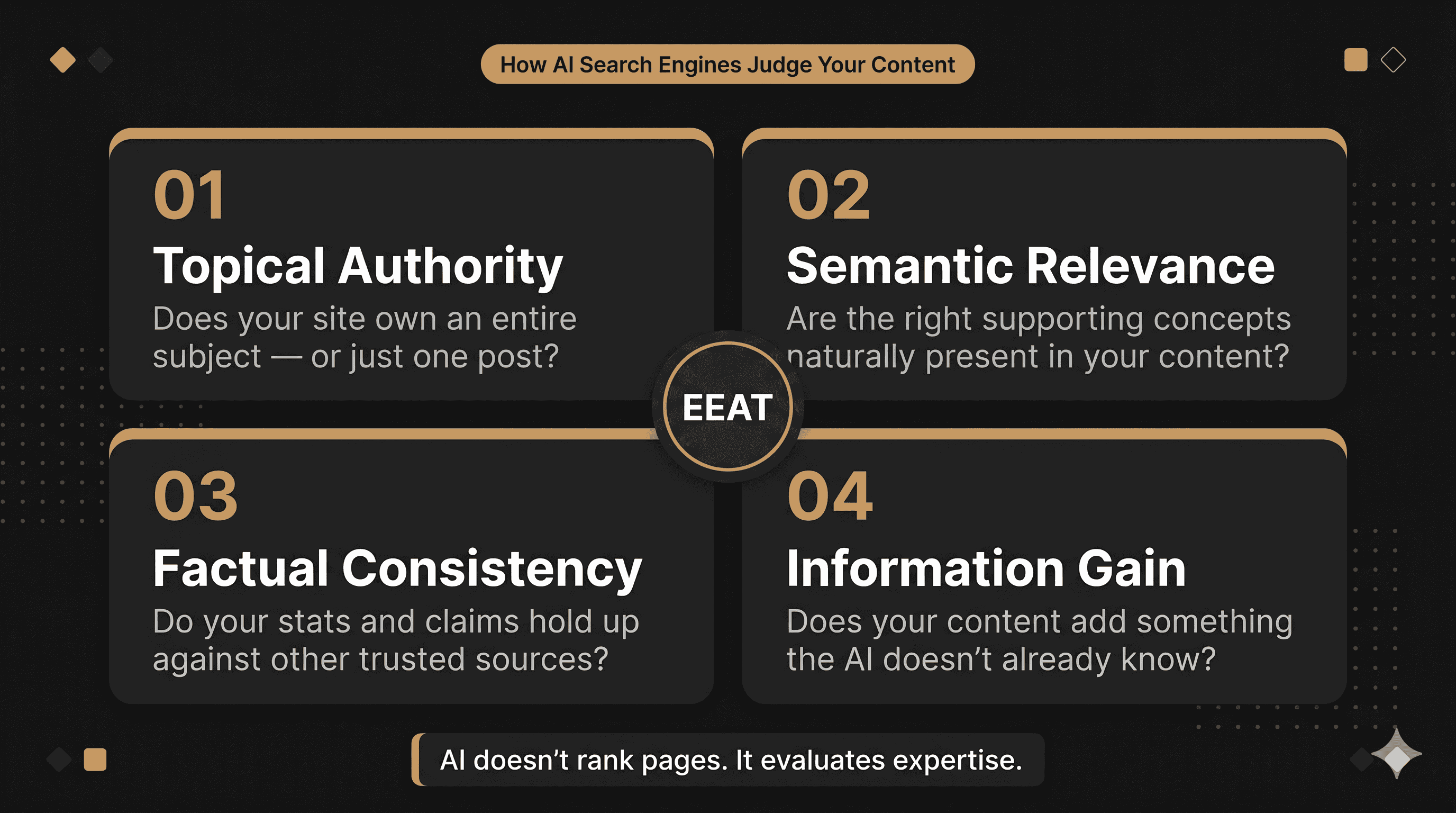
AI models are trained to reduce hallucination risk. That means they lean toward sources that already look reliable, structured, and specific.
A well-researched article usually has original data, clear sourcing, and a logical structure the model can extract cleanly. A rushed post written to hit a content calendar rarely has any of that. When an AI system has to choose between a thin post and a detailed, sourced one, it picks the one it can quote with confidence.
This is also why Google's AI Overview documentation keeps emphasizing structured, authoritative pages over keyword-matched ones.
How does content quality outperform content quantity in AI search?
Quality wins because AI extraction rewards clarity, not coverage. A single article that fully answers a question, backs it with data, and links out to credible sources gives the model everything it needs in one place.
Here's how the two approaches actually compare:
Every row favors the same pattern: fewer pages, done properly, win more often than many pages done quickly.
What makes an article "well-cited" in AI search results?
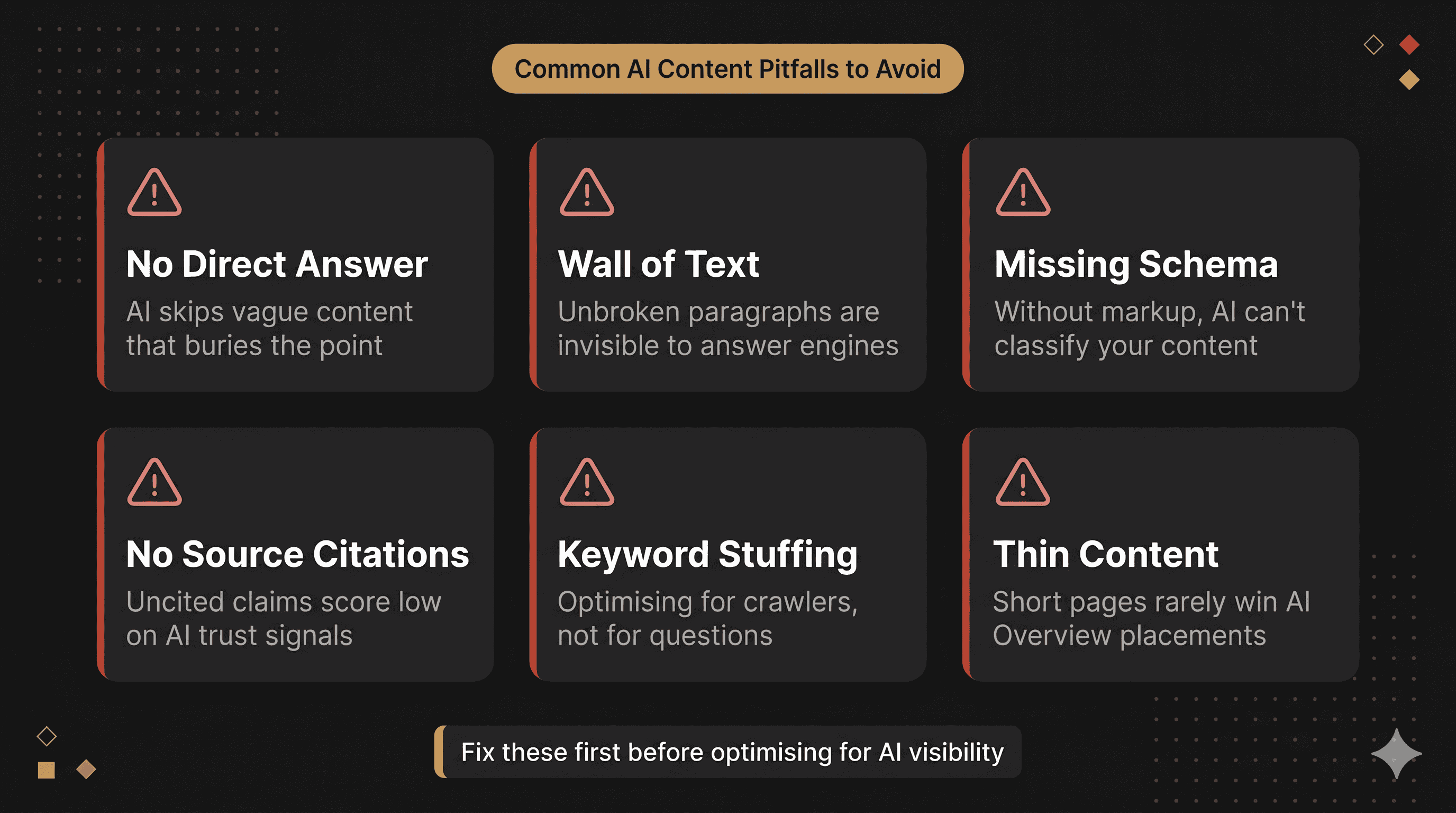
A well-cited article usually shares a few traits, and none of them are about length for its own sake.
- Original data or a clear point of view, not a rehash of what's already ranking.
- Direct, extractable answers placed right under each heading.
- Credible external sourcing, like research from Ahrefs' AI search studies, supports the claims.
- Clean structure with tables, FAQs, and scannable sections instead of long paragraphs.
- Consistent internal linking into a broader topic cluster, built around entity SEO principles, so AI systems can trace context beyond one page.
If an article checks these boxes, it earns repeat citations across related queries, not just one.
How many blog posts should you actually publish for AI visibility?
There's no universal number, but the principle holds: publish only what you can research and support properly.
For most brands, that means shifting from a high-frequency calendar to a smaller set of cornerstone articles per quarter, each backed by real research. A brand publishing four thoroughly researched pieces a month will usually out-cite a brand publishing twenty rushed ones.
What's the ROI difference between 10 authority articles and 100 average posts?
Ten well-cited articles keep earning visibility long after publishing, because AI systems reuse them across dozens of related queries. A hundred average posts mostly get published once and forgotten, contributing little beyond their initial index.
The maintenance cost tells the same story. Ten strong articles are easy to keep updated and technically sound. A hundred thin ones become a backlog no team can realistically maintain, which quietly erodes trust signals over time.
Fewer, stronger assets almost always compound. Many weak ones just accumulate. Tracking that compounding effect is easiest through AI citation and mention tracking, rather than traffic numbers alone.
How should brands adapt their content strategy for AI visibility?
Shifting from volume to authority takes a deliberate content strategy, not just a smaller publishing calendar.
- Audit existing content and consolidate thin, overlapping posts into fewer authoritative pages.
- Prioritize original research, data, or first-hand insight over rewritten SERP summaries.
- Structure every article for extraction: short answers under headings, tables, and FAQs.
- Build internal links between related articles to strengthen topical clusters.
- Track AI citations and mentions, not just rankings, as a core performance metric.
This is exactly the shift Sagashi Digital help brands make: moving from scattered, high-volume publishing to a smaller set of research-backed assets built to earn AI citations, not just impressions. It's less about writing more and more about writing what actually deserves to be trusted.
Commonly Asked Questions About AI Visibility
What does AI visibility mean in SEO?
AI visibility measures how often a brand's content gets cited or referenced inside AI-generated answers, like Google AI Overviews or ChatGPT responses, rather than just where it ranks on a traditional results page.
Is AI visibility replacing traditional SEO?
Not entirely. Traditional SEO still drives clicks from search results pages, but AI visibility is becoming a parallel metric brands need to track, since more searches now end in an AI-generated answer instead of a page visit.
Why do fewer blog posts sometimes perform better?
Fewer, well-researched posts perform better because they concentrate authority, backlinks, and internal links into pages strong enough for AI systems to trust and reuse across multiple related queries.
Does publishing frequency still matter for SEO?
Frequency still matters for freshness and topic coverage, but it matters far less than depth. A slower publishing pace with stronger research usually outperforms a fast pace with shallow content.
What industries benefit most from a quality-over-quantity content strategy?
Research-heavy and expertise-driven industries, like SaaS, finance, healthcare, and professional services, benefit most, since AI engines lean heavily on credible, well-sourced content in these spaces.
Frequently Asked Questions
You can check by searching your target queries directly in Google AI Overviews, ChatGPT, or Perplexity and noting whether your domain appears as a source. Some SEO tools are also starting to track AI citation mentions directly.
Yes, and it's often more effective. Updating an existing article with fresh data, better structure, and stronger sourcing can boost its AI citation potential faster than publishing a brand-new, unproven page.
Yes. Internal links help AI systems understand topical relationships and depth across your site, which strengthens the perceived authority of every linked page in the cluster.
It varies, but well-researched, well-linked content typically starts showing citation activity within a few months, especially if it's part of a connected topic cluster rather than a standalone page.
Not every single article, but your core, cornerstone pieces benefit the most from original data or a genuinely new angle, since that's what AI engines consistently favor when choosing what to cite.
Ready to Get Found by More Customers?
We help you generate qualified inbound leads through search - without paying for ads. Our content strategy is built to create a consistent pipeline, shorten sales cycles, and turn organic traffic into revenue.