
Your Schema Markup Strategy Is Probably Broken for AI Search (Here's the Fix)
By
Rushabh Menon
Founder | Sagashi Digital

Summarize this article using AI
Schema markup for AI search isn't the same job it was three years ago. If your schema strategy was built to win star ratings and FAQ dropdowns in Google, you built it for a feature Google doesn't even show anymore.
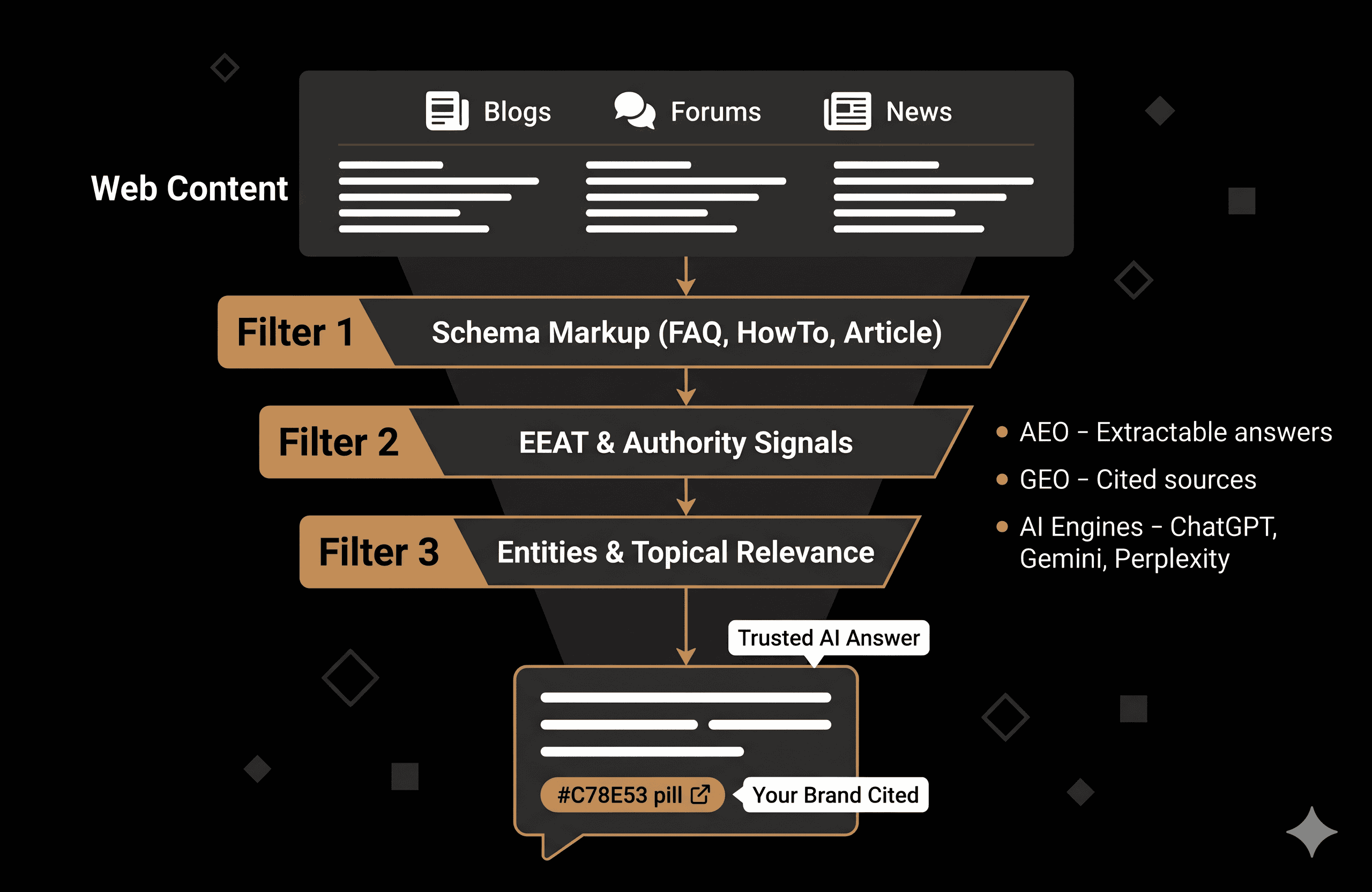
That means a big chunk of the schema work brands have been doing for years was aimed at the wrong target the whole time. Meanwhile, AI engines like ChatGPT, Perplexity, Gemini, and Google's own AI Overviews are reading your structured data for a completely different reason: to decide if your content is trustworthy enough to cite.
This guide breaks down exactly what changed, why your current schema setup is probably misaligned, and how to rebuild it around what AI search actually rewards.

What does schema markup for AI search actually mean now?
It means your structured data has shifted from a visual decoration tool to the primary fact layer AI systems use to understand and trust your content.
For years, schema's main job was earning rich results: star ratings, event dates, recipe cards, FAQ dropdowns. It was a SERP appearance game. Add the markup, hope Google shows the pretty version of your listing, get a better click-through rate.
AI search doesn't work off appearance. When ChatGPT, Perplexity, or Google AI Overviews generate an answer, they're pulling from a mix of live content and structured signals to figure out what your page is about, who wrote it, and whether it's credible enough to quote or link.
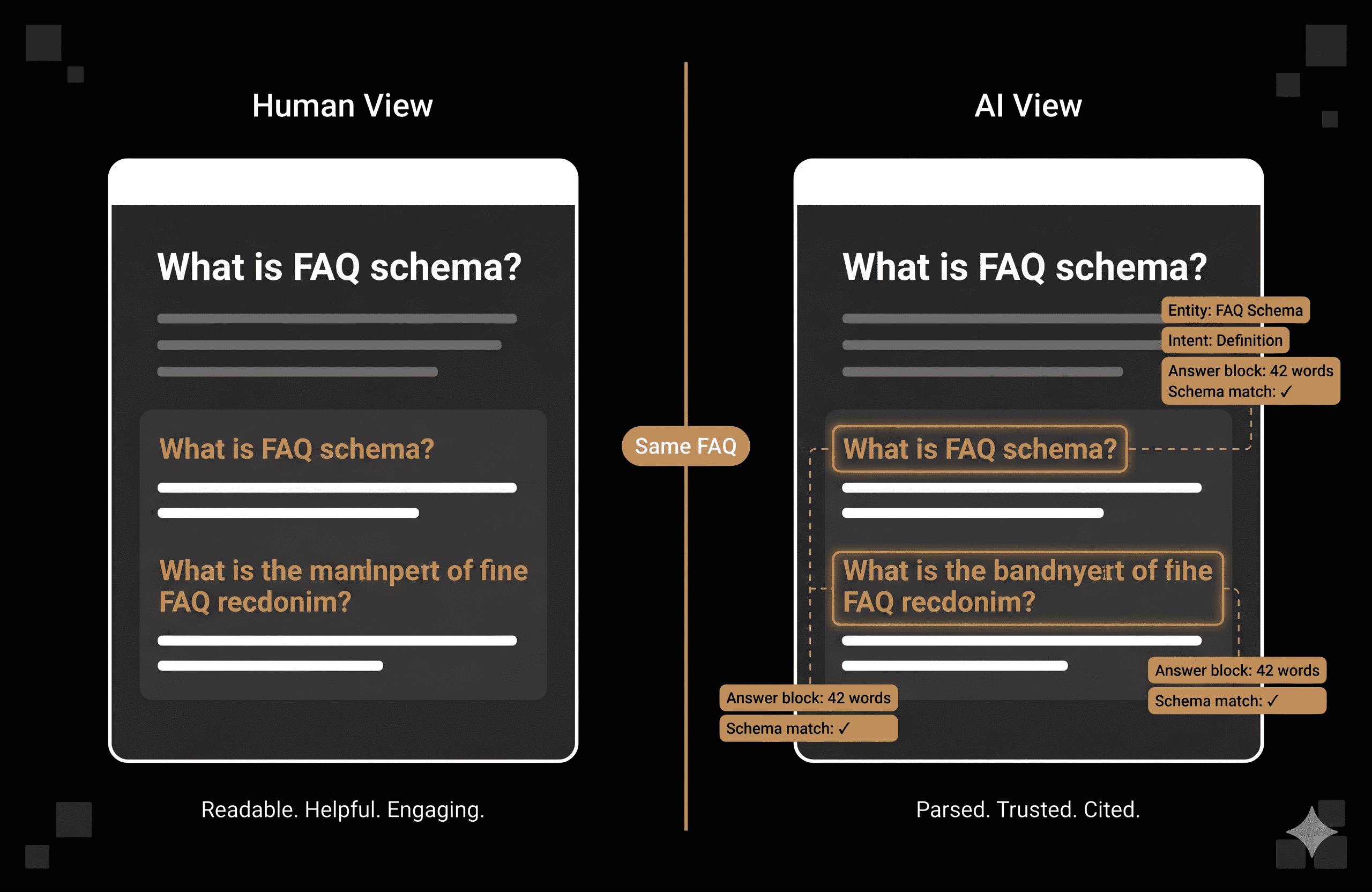
Schema is one of the clearest, most machine-readable ways to answer those questions directly instead of hoping the AI parses your paragraphs correctly.
Why did Google's FAQ rich results removal break so many schema strategies?
Because a huge share of schema strategies were built almost entirely around chasing FAQ dropdowns, and Google just pulled that feature.
Search Engine Journal's coverage of the change confirms Google added a deprecation notice showing FAQ rich results stopped appearing in search as of May 7, 2026, closing out a rollback that started back in 2023. Search Console reporting for FAQ data follows in June, and API support ends in August.
Here's the part that trips people up: FAQPage schema itself isn't gone or broken. It's still valid, and AI search systems still read it as a citation signal.
What's dead is the visual SERP dropdown. If your entire schema strategy existed to chase that dropdown, you've been optimizing for a feature that no longer exists, while ignoring the machine-readability benefit that actually matters now.
What's the biggest mistake brands make with schema for AI search?
The biggest mistake is treating schema as a checkbox instead of an accuracy layer, meaning the markup gets added but never matches what's actually on the page.
AI systems check for consistency between your schema and your visible content. If your Article schema lists one publish date and the page shows another, that's a red flag, not a shortcut.
Same goes for generic markup that adds almost no real information, like a bare-bones Organization tag with no properties filled in beyond a name.
Other common mistakes:
- Adding every schema type available instead of the most specific one that fits the page
- Never updating schema after content gets revised
- Treating schema as a one-time technical task instead of an ongoing part of content maintenance
- Skipping foundational schema (Organization, WebSite, Article) while over-investing in niche types
None of these are exotic problems. They're maintenance problems, and they compound the longer they go unfixed.
Which schema types actually matter for AI citations?
A small set of foundational types matter for almost every site, with content-specific types layered on top based on what you actually publish.
Start with the foundational row before adding anything else. A site with clean Organization, WebSite, and Article schema across every page beats a site with scattered, exotic schema types applied inconsistently.
How do you know if your schema is actually being read correctly?
You test it against both traditional validators and the actual visible content on the page, not just one or the other.
Run your key pages through a schema validator to catch syntax errors first. Google's own structured data documentation is worth reviewing here too, since it lays out exactly which properties are required versus recommended for each type.
That step only tells you the code is technically valid, not that it's useful. From there, manually compare what's inside your JSON-LD against what a visitor actually sees on the page. Mismatched author names, outdated dates, or missing reviews are common gaps that a validator won't flag but an AI system will notice.
It's also worth prompting AI tools directly with questions related to your content and checking whether the details they surface (author, publish date, key facts) match your schema. If they don't, that's a sign your structured data isn't being trusted or read as the source of truth.
How do you actually fix a broken schema markup strategy?
You rebuild around three things: foundational entity schema, content accuracy, and ongoing maintenance instead of a one-time setup.
Step by step:
- Audit your current schema against what's visible on the page. Fix mismatches first.
- Make sure Organization, WebSite, and Article schema exist site-wide before touching anything niche.
- Fill in optional properties, not just required ones. A thin Article schema with three fields does far less work than one with author, date, publisher, and topic all filled in.
- Stop treating FAQPage schema as a rich-result tactic. Keep it where it genuinely helps users, and let it do its quieter job as an AI extraction signal.
- Put schema on a maintenance schedule tied to your content calendar, so it updates every time the page does.
Structured data ages the same way content does, and treating it as "set it and forget it" is exactly how strategies end up broken in the first place.
At Sagashi Digital, schema audits like this usually turn up the same pattern: teams that invested in AI-ready content structure but never went back to make sure the machine-readable layer told the same story as the page itself.
Commonly Asked Questions About Schema Markup for AI Search
Is schema markup still worth doing after Google removed FAQ rich results?
Yes. The rich result was only the visual reward layer. AI search engines still read FAQPage and other schema types as signals for understanding and citing content, even without the SERP dropdown attached.
Does adding more schema types always improve AI visibility?
No. Adding schema types that don't match your actual content can create noise instead of clarity. The most specific relevant type, filled in completely, outperforms a page stacked with generic or irrelevant schema.
Can bad schema actively hurt your AI search visibility?
It can. Mismatches between your schema and visible content are treated as red flags by AI systems checking for accuracy, which can undermine trust in the page rather than help it.
Do you need a developer to implement schema correctly?
Not always. Many CMS platforms and plugins can generate valid JSON-LD automatically, though someone still needs to check that the output matches the actual page content and gets updated when the content changes.
How often should schema markup be reviewed?
Review schema any time the underlying content changes, and do a broader audit at least twice a year. Structured data that's accurate on launch day can quietly go stale as pages get updated.
Frequently Asked Questions
They're effectively the same thing in practice. Structured data is the broader concept of machine-readable page information, and schema markup (usually written in JSON-LD) is the specific vocabulary and code format used to add it.
Reporting on the change pointed to widespread misuse as the root cause, where sites added artificial FAQ sections purely to grab more SERP space rather than to answer real user questions.
JSON-LD is the most widely recommended format since it's kept separate from the visible HTML, making it easier for both search engines and AI crawlers to parse cleanly without interference from page layout.
Not based on anything Google has confirmed. Structured data unlocks specific features and helps machine understanding, but it isn't itself a direct ranking signal in traditional search.
Nothing breaks. The markup stays valid code and won't cause errors or penalties. It simply won't produce the old rich result dropdown anymore, though it can still support AI extraction.
Ready to Get Found by More Customers?
We help you generate qualified inbound leads through search - without paying for ads. Our content strategy is built to create a consistent pipeline, shorten sales cycles, and turn organic traffic into revenue.