
Sprinto SEO & AEO Audit: Cited Everywhere, Named Rarely [2026]
By
Rushabh Menon
|
November 11, 2026
|
India | Bangalore
Founder | Sagashi Digital

Summarize this article using AI
What happens when AI loves your content but forgets your name? Our Sprinto SEO and AEO audit answers that. Sprinto’s pages are quoted across ChatGPT, Gemini, and Google’s AI features, yet in Google’s AI answers, the brand rarely gets credit.
At the same time, Sprinto is losing non-branded traffic, even with one of the strongest backlink profiles in compliance automation.
This audit uses Semrush data pulled on July 26, 2026. It covers rankings, AI citations, search intent, and competitors, and ends with a recovery plan.
What did the Sprinto SEO and AEO audit find?
Takeaway: Sprinto has the authority to win, but its traffic is sliding. Organic visits are down 8.6% worldwide and 14% in the US. Its SEO health scored 62/100, and its AEO readiness scored 58/100.
- Authority Score: 44
- Backlinks: 960K+ from 6.6K referring domains
- Worldwide organic traffic: down 8.6%
- US organic traffic: down 14%, now about 16.7K visits a month
- Paid traffic: down 20%
- US traffic cost: down only 1.85%
Here’s the twist. Sprinto lost 14% of its US visits but less than 2% of their value. So the pages that drive revenue are fine. The bleeding is in cheaper, top-of-funnel traffic.
What does “cited but not named” mean for Sprinto?
Takeaway: AI engines use Sprinto’s pages as sources but often leave the brand out of the answer. In Google’s AI Overview and AI Mode, Sprinto gets roughly one mention for every five pages cited.

Picture a buyer asking, “What does SOC 2 compliance require?” Google’s AI answer pulls from Sprinto’s guide. The buyer gets the answer. They never see the word “Sprinto.”
Here’s how often each engine names the brand, compared with how many Sprinto pages it cites:
- Gemini: 260 mentions, 268 cited pages, about 97%
- ChatGPT: 165 mentions, 402 cited pages, about 41%
- Google AI Overview: 253 mentions, 1,200 cited pages, about 21%
- Google AI Mode: 240 mentions, 1,200 cited pages, about 20%
Semrush tracks mentions and citations separately, so read these ratios as directional, not exact.
Gemini almost always credits Sprinto. Google’s own AI features mostly don’t. That’s where most of the lost credit sits.
There’s a competitor angle too. In Sprinto’s US topic set, vanta.com is the third most-cited domain (90 mentions), behind sprinto.com (218) and reddit.com (106). Vanta is earning citations on Sprinto’s home turf.
Why does a mention matter more than a citation? A mention puts your name in the buyer’s head. A citation alone may never get clicked. That’s why 10 well-cited articles can beat 100 blog posts for AI visibility.
Why is Sprinto’s informational traffic shrinking?
Takeaway: US non-branded informational traffic is down 18%, while branded and commercial traffic hold steady. That points to AI Overviews and competitors absorbing explainer searches, not a sitewide ranking problem.
Explainer queries like “what is ISO 27001” are exactly what Google’s AI features answer on the results page. Sprinto still ranks, but fewer people need to click.
This is now a common pattern across B2B SaaS. Our Google AI Overview SEO study breaks down how often these answers show up and who gets cited. Google also explains how its AI features work with websites.
What’s the lesson for Sprinto? Stop judging informational content by clicks alone. Measure mentions and citations too. These are the SEO metrics brands should track after the 2026 Google updates.
Where is Sprinto’s hidden traffic upside?
Takeaway: Transactional keywords. They make up just 1.7% of Sprinto’s rankings but drive about 17% of its traffic. Per keyword, they bring roughly 16 times more visits than informational terms.
Here’s how traffic per 1,000 keywords stacks up by intent:
- Transactional: about 8,760 visits (1.7% of keywords, 17% of traffic)
- Navigational: about 3,750 visits (4.7% of keywords, 20% of traffic)
- Commercial: about 750 visits (15.3% of keywords, 13% of traffic)
- Informational: about 546 visits (78.3% of keywords, 49% of traffic)
Sprinto already ranks for 445 transactional keywords, but many sit beyond page one. Push 50 of them into positions 4-8, and you could add an estimated 1,500-2,500 monthly visits. No new keywords needed.
How should Sprinto position itself against Vanta and Drata?
Takeaway: As the middle path. Independent reviews already frame Vanta as speed and Drata as depth. Sprinto’s connected compliance, risk, and trust workflows fit between them, but third parties are telling that story instead of Sprinto.
Here’s how outside comparisons describe the market today:
- Sprinto: fastest, lowest-cost route to a first certification
- Vanta: easiest trust motion for buyers
- Drata: best fit for mature, multi-framework programs
Sprinto already has a comparison hub covering Vanta, Drata, Scrut, Secureframe, and Delve. But third-party pages, including Drata’s own comparisons, win more citations on those queries.
The fix isn’t more comparison pages. It’s sharper ones, built around the “speed plus depth” story.
How can Sprinto get named in AI answers?
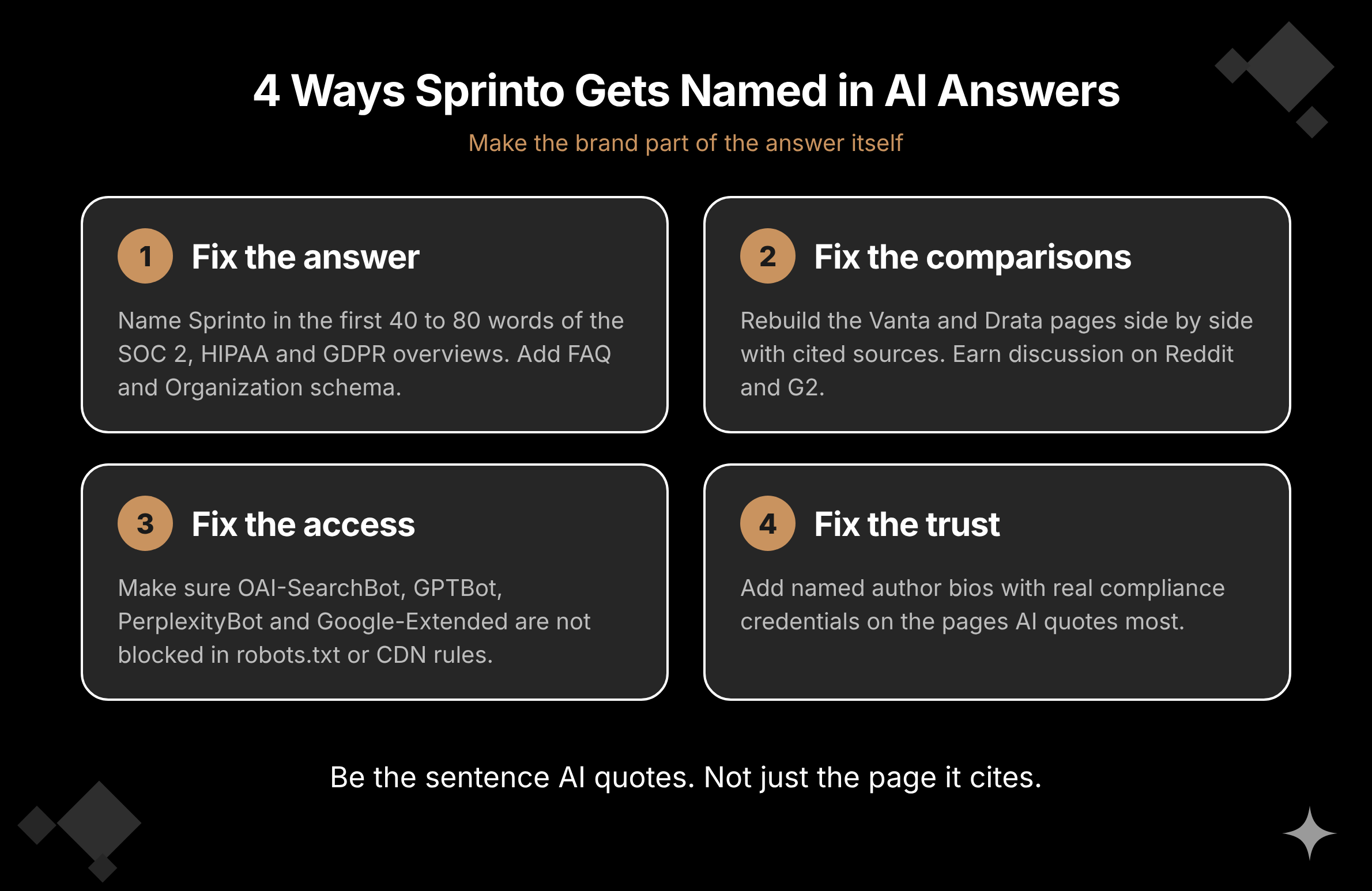
Takeaway: Make the brand part of the answer itself. Put “Sprinto” in the opening lines AI quotes, rebuild the key comparisons, open the door to AI crawlers, and show who wrote the content.
Fix the answer
- Rewrite the first 40-80 words of the SOC 2, HIPAA, and GDPR overviews as direct answers. Name Sprinto in the first sentence. Here’s how to make content AI-friendly without ruining it for humans.
- Add and validate FAQ and Organization schema on the top 20 informational URLs. See this schema markup strategy for AI search.
Fix the comparisons
- Rebuild the Sprinto vs Vanta and vs Drata pages with clear side-by-side comparisons and cited sources.
- Earn discussion where LLMs already look, like Reddit threads and G2 comparison pages.
Fix the access
- Check robots.txt and CDN rules. Make sure OAI-SearchBot, GPTBot, PerplexityBot, and Google-Extended aren’t blocked. OAI-SearchBot is the one that controls ChatGPT search visibility, per OpenAI’s crawler documentation.
Fix the trust
- Add named author bios with real compliance credentials.
- Point new content at decision-stage and transactional searches.
What content should Sprinto publish next?
Takeaway: A 30-topic plan across five pillars, tilted toward buyers. Start where Sprinto already ranks partly, so early wins come faster.
- Certification and readiness: SOC 2, ISO 27001, HIPAA, GDPR, PCI DSS
- Compliance automation and vendor comparisons
- GRC and risk management
- AI governance, including newer frameworks like ISO 42001
- Industry-specific compliance
First up: SOC 2 risk assessment, “define SAQ,” and chief compliance officer. Sprinto already has partial rankings for all three. Plan the clusters with a clear GEO strategy framework so each page supports the others.
What could Sprinto’s search recovery look like in 12 months?
Takeaway: A realistic plan brings US traffic back to 19K-22K monthly visits, a 15-30% recovery. The best case depends on reclaiming comparison citations and on how far AI Overviews spread in compliance.
- Conservative: 15.5K-17K monthly visits, about flat against today’s 16.7K
- Realistic: 19K-22K, a 15-30% recovery
- Optimistic: 24K-28K, if comparison pages win back citations and AI Overviews stop expanding in the category
These ranges come from the pulled data and standard CTR curves. They’re directional, not a formal forecast. Core Web Vitals, schema coverage, and crawler access still need a full site crawl to confirm.

Frequently Asked Questions
No. A citation means the AI used your page as a source, often shown as a small link. A mention means the AI actually named your brand in its answer. Mentions build recall, because buyers read the answer and may never open the source link. Sprinto earns plenty of citations but far fewer mentions in Google’s AI features.
Each engine builds answers differently. In this data, Gemini named Sprinto in almost every answer where it cited Sprinto’s pages. Google’s AI Overview and AI Mode pulled from many more Sprinto pages but blended them into general answers without naming the source brand. Putting the brand name directly in the quotable sentence improves the odds across all engines.
Partly. Some explainer clicks won’t come back, because Google now answers those questions on the results page. But you can win them back in other ways: earn brand mentions inside AI answers, rank higher for transactional and comparison searches, and track AI visibility alongside clicks. Sprinto’s realistic plan targets a 15-30% recovery this way.
Not on its own. GPTBot collects data for training OpenAI’s models. OAI-SearchBot is the crawler that decides whether your pages can appear in ChatGPT search results. Many sites block one without realizing the other exists. Check both in your robots.txt and in any CDN or firewall bot settings.
Rewriting the opening lines of its top compliance explainers. These pages are already cited by AI engines, so the content is trusted. Adding a clear 40-80 word answer that names Sprinto in the first sentence gives AI a quotable line with the brand built in. It’s a small edit on pages that already have reach.
Ready to Get Found by More Customers?
We help you generate qualified inbound leads through search - without paying for ads. Our content strategy is built to create a consistent pipeline, shorten sales cycles, and turn organic traffic into revenue.