
What Should Brands Measure in SEO After the 2026 Google Updates?
By
Rushabh Menon
Founder | Sagashi Digital
Summarize this article using AI
Traditional SEO metrics aren't dead. But they no longer tell the full story.
Ranking #1 on Google doesn't guarantee visibility like it used to. AI-powered search tools like Google AI Overviews, ChatGPT, Perplexity, and Claude often answer questions directly. Your content can shape a buying decision without earning a click. At the same time, a page might see fewer organic visits while gaining valuable AI citations, brand mentions, and referral traffic from AI platforms.
Yet many brands still measure success with KPIs built for a blue-link internet — keyword rankings, click-through rates, and organic traffic alone. Those metrics still matter. But they can't capture how people discover and interact with brands in AI search.
In this guide, you'll learn:
- Which traditional SEO metrics are losing reliability
- Which ones still deserve a spot on your dashboard
- The new AI search metrics that matter in 2026
More importantly, you'll learn how to build a measurement framework that reflects how search actually works today. That way, you can make smarter decisions and prove the real impact of your SEO and AI search efforts.
How Search Has Shifted From Clicks to Answers?
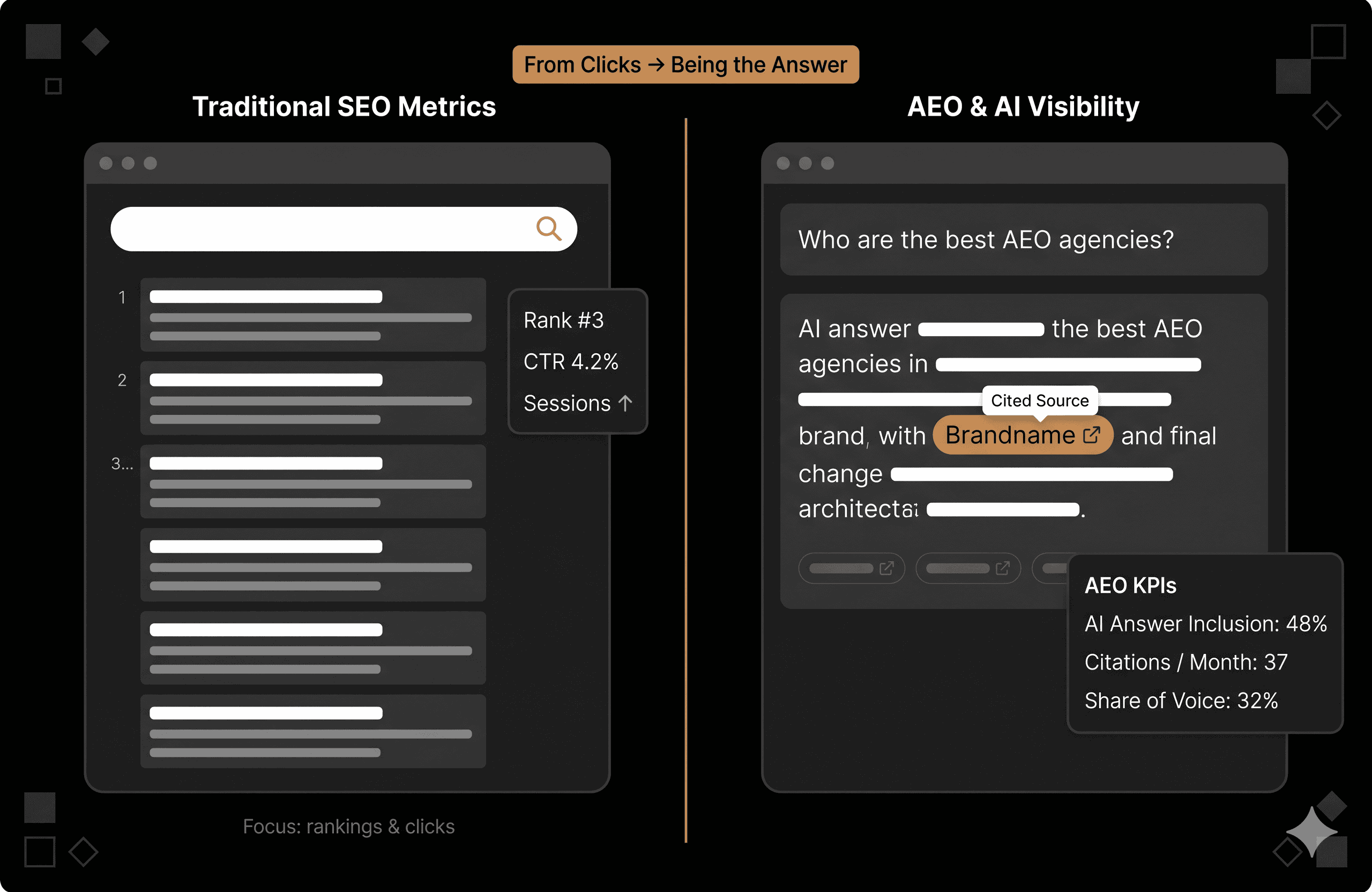
For decades, search followed a simple journey: users searched for a query, scanned a list of blue links, clicked a result, and visited a website. Success was easy to measure because every search aimed to generate a click.
Today, that journey looks very different.
AI-powered search engines and assistants answer questions directly by synthesizing information from multiple sources. Instead of clicking through several websites, users often receive a complete answer in seconds. In many cases, the search journey ends without a website visit.
Approximately 60% of all Google searches now end without a click because AI Overviews answer questions directly.[Source - Semrush]
This shift means your content can influence a user's decision even if they never click your page. Your brand may be cited, referenced, or recommended inside an AI-generated response, creating visibility that traditional SEO metrics can't measure.
Why Ranking #1 No Longer Guarantees Visibility?
Ranking at the top of Google's search results was once the ultimate SEO goal. Today, it's only one piece of the puzzle.
A page that ranks first organically can still appear below an AI-generated answer or be completely absent from the sources AI models choose to cite. At the same time, another page ranking fifth or even outside the top ten may be referenced because it provides clearer, more authoritative, or better-structured information.
AI systems don't simply reward the highest-ranking page. They prioritize content that best answers the user's question while drawing information from multiple trusted sources.
As a result, ranking #1 no longer guarantees that your brand will be the first thing users see or trust.
The Rise of Zero-Click Searches and AI Overviews
Zero-click searches have been growing for years, but AI has accelerated the trend.
Features like Google AI Overviews provide detailed answers directly on the search results page, reducing the need to visit individual websites. AI assistants such as ChatGPT, Perplexity, Claude, and Bing Copilot go a step further by generating conversational responses that summarize information from across the web and recommend products, services, and brands.
This changes how visibility should be measured.
Instead of asking, "How many clicks did this page receive?", brands also need to ask:
- Was our content cited by AI?
- Was our brand mentioned in AI-generated responses?
- Did AI platforms send referral traffic to our website?
- Are we visible for high-intent commercial queries?
These questions reflect how users search in 2026 and why traditional SEO metrics alone can no longer measure the full impact of your content.
Which Traditional SEO Metrics Still Matter in 2026?
Traditional SEO metrics aren't dead. They just need more context.
Many of the KPIs marketers have relied on for years still provide valuable insights into website performance and business growth. The difference is that they should no longer be viewed in isolation. AI-powered search has changed how people discover content, making it important to combine traditional SEO metrics with newer AI visibility metrics.
Here's how the most common SEO metrics stack up in 2026.
What Should Brands Measure Instead in 2026?
If rankings no longer tell the full story, what should brands measure instead?
The answer is AI visibility. As search shifts from blue links to AI-generated answers, success depends less on where you rank and more on whether AI platforms discover, trust, cite, and recommend your content. The brands that win in 2026 will measure how often they appear in AI-generated responses, how much qualified traffic those responses drive, and whether that visibility leads to business outcomes.
According to data, AI search traffic increased by 527% in just one year between 2024 and 2025.[Source - Semrush]
Here are the metrics that deserve a place on every modern SEO dashboard.
AI Traffic to Commercial Pages
Traffic is still one of the most important SEO metrics, but where it comes from matters more than ever.
Instead of looking only at overall organic traffic, start measuring AI referral traffic to your high-value commercial pages. These are the pages that generate leads, demo requests, product sign-ups, or purchases.
Ask questions like:
- Which landing pages receive visitors from AI platforms?
- Which AI-generated referrals convert into customers?
- Which commercial pages have the highest engagement from AI users?
You can track this using Google Analytics 4 (GA4), Semrush AI Toolkit, and server logs, which help identify referral sources and measure the quality of AI-driven traffic.
The goal isn't simply to generate more AI traffic. It's to attract AI users who are ready to take action.
AI Citations
Backlinks have long been a signal of authority for search engines. In AI search, citations are becoming just as important.
When platforms like Google AI Overviews, ChatGPT, and Perplexity generate answers, they often cite the sources they trust most. Every citation increases your brand's visibility and reinforces your authority on a topic.
Unlike traditional rankings, AI citations put your brand directly inside the answer users are reading.
That's why many marketers now view citations as the new backlinks. They indicate that AI systems recognize your content as reliable enough to reference, even if users never visit your website.
Brand Mentions Across AI Platforms
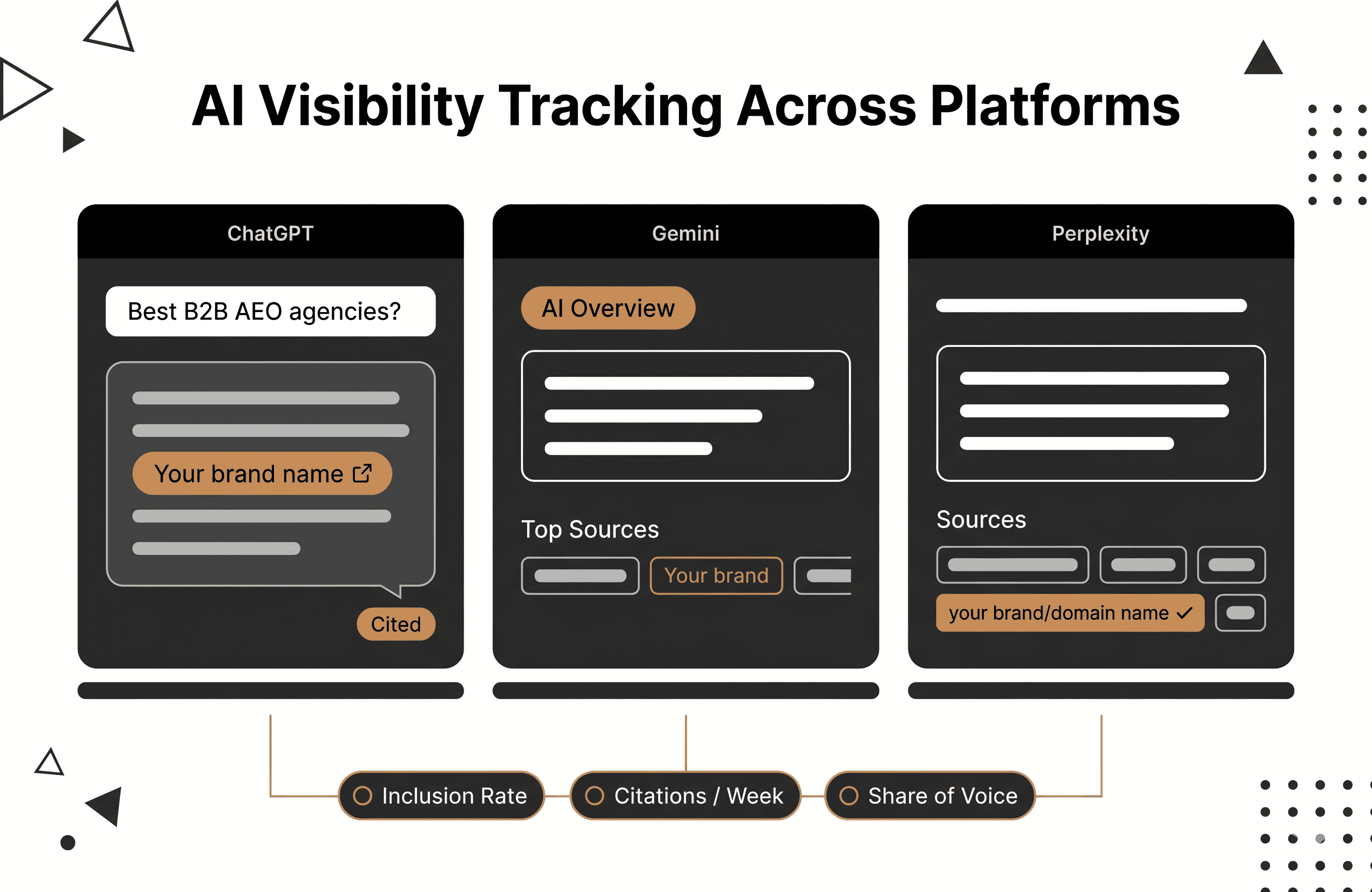
Not every AI recommendation includes a clickable link.
Sometimes an AI assistant simply mentions your brand as a trusted solution without linking to your website. While these unlinked mentions don't generate direct referral traffic, they still build awareness and influence purchasing decisions.
It's helpful to distinguish between the two:
- Linked citations direct users to your website and can drive measurable traffic.
- Unlinked mentions increase brand visibility without providing a clickable source.
Large language models don't rely solely on backlinks. They also learn authority from consistent brand mentions across trusted websites, industry publications, reviews, forums, and other reputable sources. The more often your brand appears in credible contexts, the more likely AI systems are to recognize it as an authoritative entity.
Grounding Queries
One of the most valuable AI metrics is understanding which questions AI models repeatedly rely on your content to answer. These are often called grounding queries.
Instead of focusing only on broad keywords, identify the specific questions where your content consistently appears as a trusted source.
For example, rather than tracking a broad keyword like:
- "Best CRM"
Measure whether your content is being used to answer more specific, high-intent queries such as:
- "Best CRM for SaaS startups"
- "CRM with WhatsApp integration"
- "CRM for small businesses with automation"
These targeted queries reveal where your topical authority is strongest and help you identify opportunities to expand your content strategy.
Share of AI Voice
SEO teams have long measured Share of Search to understand how visible their brand is compared to competitors.
AI search introduces a new benchmark: Share of AI Voice.
Instead of measuring search demand, Share of AI Voice measures how frequently your brand appears in AI-generated responses compared to competing brands.
For example, if someone asks ChatGPT or Perplexity for the best project management software, does your brand appear consistently alongside your competitors, or is it missing altogether?
Tracking Share of AI Voice gives you a clearer picture of your competitive visibility across AI search platforms and highlights where you need to strengthen your authority.
Commercial Intent Visibility
Not all AI visibility has the same business value.
Appearing in informational searches is useful, but visibility in commercial-intent queries is what drives revenue.
Prioritize measuring how often your brand appears for queries such as:
- Buying searches
- Product comparisons
- Pricing-related questions
- Alternative and competitor comparisons
For example, there's a significant difference between appearing for:
- "What is payroll?" (informational intent)
and
- "Best payroll software" (commercial intent)
The second query reaches users who are much closer to making a purchase.
By measuring visibility across high-intent commercial searches, you can better understand whether your AI search strategy is generating real business opportunities rather than just impressions.
Why Rankings Alone Can Be Misleading in AI Search?
For years, ranking #1 was the clearest indicator of SEO success. If you ranked higher than your competitors, you were more likely to earn clicks, traffic, and customers.
AI search doesn't follow that rule.
Ask the same question to ChatGPT today and tomorrow, or compare the responses across Google AI Overviews, Perplexity, Claude, and Bing Copilot, and you'll often see different answers, different sources, and different brand recommendations. Your content might be cited in one response, omitted in the next, and replaced by a competitor a few hours later.
This happens because AI systems generate stochastic outputs. In simple terms, they don't retrieve the exact same answer every time. Instead, they generate responses based on the prompt, available context, retrieved sources, and the model's underlying probability calculations. Even small changes can produce different citations and recommendations.
That's why brands should stop treating AI visibility as a fixed position and start measuring it over time. Instead of asking, "Do we rank for this query?", ask:
- How often does our brand appear for this query?
- Which AI platforms recommend us most consistently?
- Are we being cited for high-intent commercial searches?
- Is our AI visibility improving month over month?
In AI search, consistency matters more than a single appearance. The brands that are cited repeatedly across different platforms, prompts, and time periods are the ones building lasting authority.
A New Measurement Framework for AI Search
The biggest mistake brands make is replacing one vanity metric with another.
Instead of obsessing over rankings, AI citations, or referral traffic individually, build a measurement framework that follows the customer journey. Each metric should answer a different question: Are people seeing your brand? Are they visiting your website? Are they engaging with your content? And most importantly, are they converting?
A simple way to think about this is:
Visibility → Traffic → Engagement → Conversion
Let's break it down.
1.Visibility: Is Your Brand Showing Up?
Visibility is the first signal of success in AI search. Before users can click, convert, or buy, AI platforms need to recognize and recommend your content.
Track metrics such as:
- AI citations across Google AI Overviews, ChatGPT, and Perplexity
- Brand mentions, both linked and unlinked
- Visibility for high-value prompts
- Frequency of appearances across AI platforms
If your brand isn't showing up consistently, nothing else matters.
2. Traffic: Are AI Platforms Sending Visitors?
Visibility is valuable, but it should eventually translate into website visits.
Measure:
- AI referral traffic
- Which landing pages receive AI visitors
- Which commercial pages attract the most AI-driven sessions
- Traffic trends by AI platform
This helps you understand whether your AI visibility is generating qualified visitors rather than simply increasing mentions.
3. Authority: Is AI Choosing Your Brand Over Competitors?
Authority isn't just about backlinks anymore. It's about whether AI systems consistently trust your brand enough to recommend it.
Look at metrics like:
- Share of AI Voice
- Citation frequency compared to competitors
- Brand mentions across trusted publications and websites
- Coverage across commercial and informational queries
The more consistently your brand appears in AI-generated responses, the stronger your perceived authority becomes.
4. Engagement: Do AI Visitors Find Your Content Valuable?
Getting visitors is only half the battle. What they do after arriving matters just as much.
Monitor engagement signals such as:
- Time on page
- Scroll depth
- Pages per session
- User interactions with key content
Strong engagement indicates that your content delivers on the promise made by the AI recommendation.
5. Business Impact: Is AI Visibility Driving Revenue?
Ultimately, SEO exists to support business growth.
Track outcomes that directly impact your bottom line, including:
- Qualified leads
- Demo requests
- Purchases or subscriptions
- Revenue generated from AI-driven traffic
- Assisted conversions across the customer journey
These metrics connect AI visibility to real business results, making it easier to demonstrate ROI to stakeholders.
Tools That Help Measure AI Search Performance
You can't improve what you don't measure. As AI search evolves, marketers need tools that go beyond traditional SEO reporting to track AI visibility, citations, referral traffic, and brand presence across answer engines.
Here are some of the most useful tools for measuring AI search performance in 2026.
Semrush AI Toolkit
If you're looking for an all-in-one AI visibility platform, Semrush AI Toolkit is one of the strongest options available.
It helps you monitor how your brand appears across AI search platforms, track AI citations, measure share of AI visibility, and identify the prompts and topics where your competitors are outperforming you. It's particularly useful for understanding how AI search impacts your overall digital presence.
Google Analytics 4 (GA4)
Google Analytics 4 (GA4) remains essential because it shows what happens after users reach your website.
You can monitor AI referral traffic, identify which pages receive visitors from AI platforms, measure engagement metrics like time on page, and track conversions driven by AI-generated referrals. While GA4 doesn't measure AI visibility directly, it helps connect AI discovery to real business outcomes.
Google Search Console
Even in the age of AI search, Google Search Console continues to play a critical role.
It provides insights into your organic search performance, including impressions, clicks, indexing status, and technical health. While it doesn't currently report AI Overview visibility, it's still invaluable for understanding how your traditional SEO efforts support your broader AI search strategy.
Ahrefs
While Ahrefs wasn't built specifically for AI search, it remains one of the most valuable SEO tools available.
Use it to monitor backlinks, keyword rankings, organic traffic opportunities, and competitor strategies. Strong topical authority and a healthy backlink profile still influence how search engines and AI systems evaluate your content, making Ahrefs an important part of any modern measurement stack.
No single tool provides a complete picture of AI search performance. The most effective approach is to combine traditional SEO platforms like Google Search Console and Ahrefs with AI-focused tools such as Semrush. Together, they help you measure the entire journey from AI visibility and citations to referral traffic, engagement, and business results.
How Brands Can Adapt Their SEO Strategy for AI Search?
Chasing rankings alone isn't enough anymore. To succeed in AI search, brands need to focus on building authority, creating helpful content, and earning trust across the web.
Here's where to focus:
- Build topical authority by covering subjects in depth instead of targeting isolated keywords.
- Publish original research and first-party data that AI platforms are more likely to cite.
- Structure your content with clear headings, FAQs, and concise answers to make it easier for AI to understand.
- Optimize your entities so AI can confidently associate your brand with your areas of expertise.
- Create comparison pages and commercial landing pages that target high-intent buying queries.
- Invest in digital PR and brand mentions to strengthen your authority beyond backlinks.
Want to learn more? Check out our guides on AI Search Optimization, Answer Engine Optimization (AEO), Generative Engine Optimization (GEO), AI Visibility, and our Keyword Research Framework to build a strategy that performs across both search engines and AI platforms.
The Future of SEO Is Bigger Than Rankings
To understand your true performance in 2026, along with traditional metrics, you also need to measure AI visibility, citations, brand mentions, AI referral traffic, commercial query coverage, and conversions. Together, these metrics reveal not just whether your content ranks, but whether AI platforms trust and recommend your brand.
If you're still reporting rankings as your primary KPI, you're measuring yesterday's search.
At Sagashi Digital, we help brands build AI-ready measurement frameworks that track visibility across Google AI Overviews, ChatGPT, Perplexity, Claude, and other AI search platforms. Because in the future of search, success isn't just about where you rank - it's about where AI recommends you.
Commonly Asked Questions About Traditional SEO Metrics
Are keyword rankings still important in 2026?
Yes, but they shouldn't be your only KPI. Keyword rankings still help measure organic visibility, but they don't show whether AI platforms are citing or recommending your content. Pair rankings with AI visibility metrics for a more complete picture.
What is the most important SEO metric now?
There isn't a single metric that defines success anymore. The most effective approach is to track a combination of organic traffic, conversions, AI visibility, citations, brand mentions, and AI referral traffic to understand your overall search performance.
How do I measure AI traffic?
You can measure AI traffic by tracking referral sources in Google Analytics 4 (GA4), monitoring AI-driven visits to key landing pages, and using AI visibility tools like Semrush AI Toolkit to identify traffic from platforms such as ChatGPT and Perplexity.
Can Google Analytics track ChatGPT visitors?
Yes, GA4 can track visitors referred from ChatGPT and other AI platforms when referral data is available. However, it won't show how often your brand is mentioned or cited inside AI responses. For that, you'll need dedicated AI visibility tools.
What are AI citations?
AI citations are references to your content within AI-generated answers on platforms like Google AI Overviews, ChatGPT, and Perplexity. They help increase your brand's visibility and signal that AI systems consider your content a trustworthy source.
Frequently Asked Questions
Brands typically use AI visibility platforms like Semrush AI Toolkit, Profound, Peec AI, and Scrunch AI to monitor citations, brand mentions, Share of AI Voice, and prompt-level visibility across AI search platforms.
No. SEO rankings are still valuable, but they no longer tell the whole story. The best approach is to combine traditional SEO metrics with AI-specific metrics such as citations, AI referral traffic, brand mentions, and commercial query visibility to measure performance accurately in 2026.
Yes. A page may receive fewer clicks because users find answers directly in AI-generated responses, while still being frequently cited or recommended by AI platforms. That's why AI visibility and citations are becoming important performance metrics alongside organic traffic.
Focus on creating original, trustworthy, and well-structured content that answers user questions clearly. Strengthening topical authority, publishing first-party research, using clear headings and FAQs, and earning authoritative brand mentions can all improve your chances of being cited by AI.
Content that is well-structured, factually accurate, and demonstrates topical expertise performs best. Original research, in-depth guides, FAQs, comparison pages, and commercial landing pages are more likely to be cited and recommended by AI platforms.
Ready to Get Found by More Customers?
We help you generate qualified inbound leads through search - without paying for ads. Our content strategy is built to create a consistent pipeline, shorten sales cycles, and turn organic traffic into revenue.